
REVIEW · ROTTERDAM TOURS
Rotterdam: Architecture Highlights Tour including the Depot
Rotterdam rewards curious eyes. This private walking tour makes the city’s bold architecture easier to read, from the curved Depot to the clever housing above Markthal. I like the small private group, which lets you ask real questions, and I like the rooftop access, a rare chance to see the center from above. The main drawback is pace: 2.5 hours covers a lot of ground, so it may feel brisk if you prefer long stops.
The tour also gives architecture fans useful context, not just postcard views. Guides explain design choices, construction methods, and the city’s postwar urge to try something new. If Frank Schipper is leading your group, expect the warm, clear style that has made his tours especially popular. Do check the roof arrangement before booking, since weekday and weekend tours use different locations.
In This Review
- Key points at a glance
- Why Rotterdam needs an architecture tour
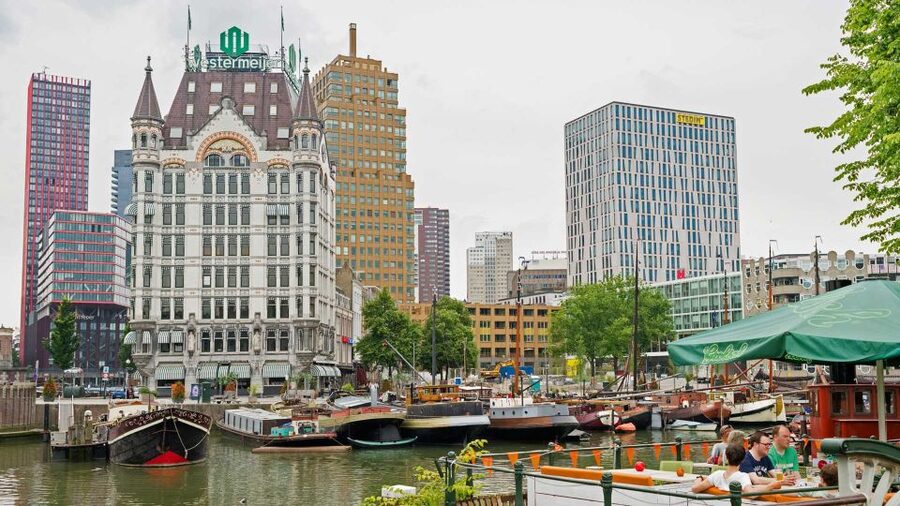
- Starting outside Het Witte Huis
- Markthal and the clever Cube Houses
- Grotekerkplein and the weekday rooftop
- Timmerhuis and Rotterdam’s mixed architectural past
- Postwar buildings around Schouwburgplein
- Calypso, Pauluskerk, and de Unie
- Museumpark and the final approach to Depot
- What the $494 group price really means
- Who will enjoy this walk most
- Should you book Rotterdam’s architecture tour?
- FAQ
- How long does the Rotterdam architecture tour last?
- How much does the private tour cost?
- Which languages are available?
- Where does the tour begin?
- Which rooftop will I visit?
- Is admission to the Cube Houses included?
Key points at a glance
- Depot Boijmans van Beuningen: Study the double-curved mirror facade and learn how aviation engineering helped operate its huge entrance doors.
- Two different rooftop experiences: Weekday tours include a terrace at Timmerhuis, while weekend tours visit the roof of Het Witte Huis.
- A compact lesson in Rotterdam architecture: See Markthal, Cube Houses, Central Station, Calypso, Sonneveld House, and much more in one route.
- Private value for groups: The $494 price covers up to six people, making the cost more reasonable when shared by a full group.
- Helpful extras: You receive three postcards by Rotterdam photographer Ossip van Duivenbode and a 50 percent discount on Cube Houses admission.
- Strong guide-led experience: Clear explanations of history, architects, engineering, and high-rise construction are central to the tour.
Why Rotterdam needs an architecture tour
Rotterdam is not a city you understand fully by wandering without a plan. Its buildings come from different eras and often seem to argue with one another. A prewar post office may sit near a glass tower, while a tilted cube house or a giant indoor market changes your idea of what a city block can be.
That contrast is the point. Much of Rotterdam was rebuilt after wartime destruction, and the city developed a strong appetite for modern design. This tour gives you a way to connect the dots. Instead of seeing strange shapes as isolated photo stops, you learn why Rotterdam keeps testing new ideas.
I especially like that the route includes both famous landmarks and less obvious urban projects. You see the buildings that fill guidebooks, but you also hear about office blocks, public squares, postwar monuments, and redevelopment schemes. That mix gives you a better sense of how the city works.
The private format matters here. A group of up to six can pause for questions without holding up a large crowd. Architecture can quickly become a lecture, but a good guide can make the subject practical by explaining how a building affects daily life, movement, housing, and public space.
More Rotterdam trips:
- Rotterdam: Harbor Sightseeing Cruise
★ 4.3 · 7,599 reviews - Rotterdam: 1-Hour Sightseeing Splash Tour
★ 4.5 · 3,299 reviews - Rotterdam: Rotterdam Zoo Blijdorp Entry Ticket
★ 4.6 · 2,754 reviews
Starting outside Het Witte Huis
The meeting point is outside the entrance of Het Witte Huis. This is a useful beginning because the building itself is part of Rotterdam’s architectural story. On weekend tours, you visit its roof, described as the oldest skyscraper in Europe, for a view across the central city.
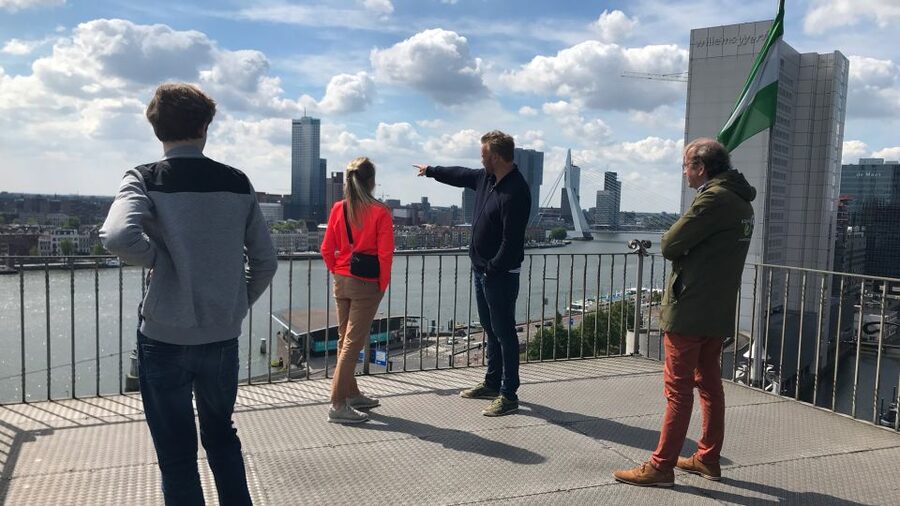
From above, you can take in Markthal, the Cube Houses, the Erasmus Bridge, the Willems Bridge, and De Rotterdam. This is the kind of view that helps you understand Rotterdam’s layout before you begin walking through it. Instead of looking at each building in isolation, you see how the skyline fits together.
The rooftop arrangement changes by day. Weekend tours use Het Witte Huis, while weekday tours include a rooftop terrace near Grotekerkplein at the Timmerhuis. That is an important planning detail. If the roof view is a major reason for booking, check the day of your tour and confirm which terrace you will visit.
The activity information describes the tour as wheelchair accessible, but it also says it is not suitable for people with mobility impairments. That is a meaningful inconsistency for anyone who needs step-free access or cannot manage a brisk urban walk. Contact the provider before booking and ask about the exact route, rooftop access, and walking demands.
Markthal and the clever Cube Houses
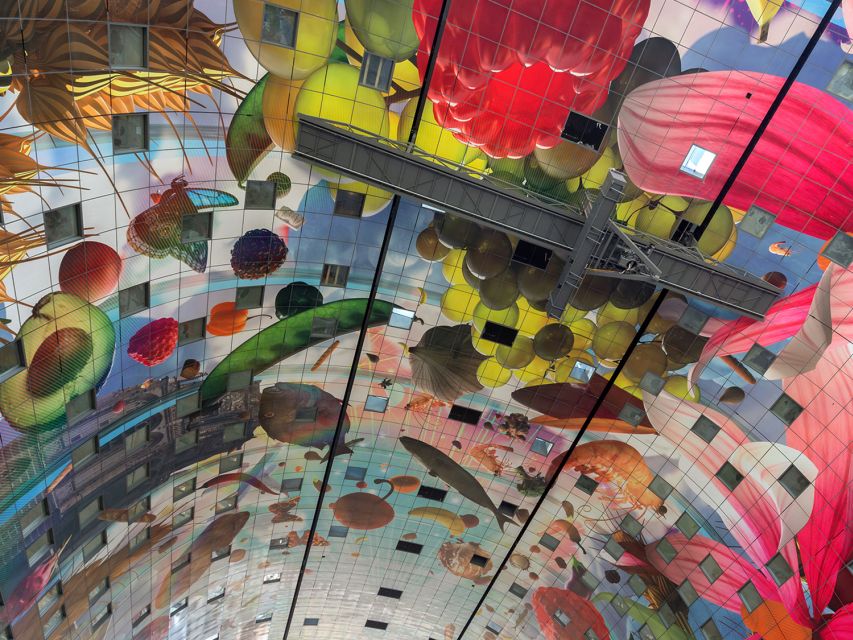
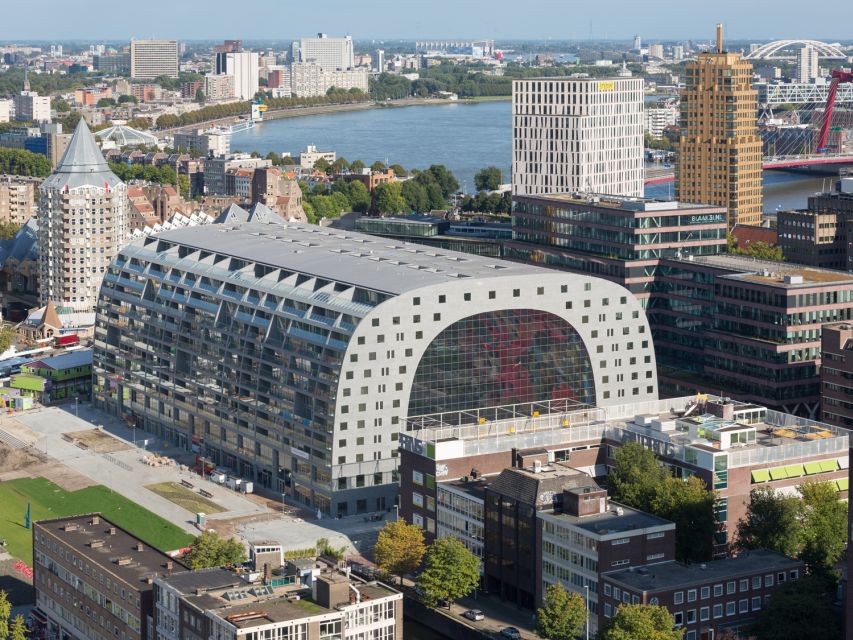
Markthal is one of Rotterdam’s clearest examples of architecture doing more than one job. It combines housing with a food market, placing apartments in a huge curved structure around an active public interior. You walk through the market rather than simply viewing it from outside.
I like this stop because the design concept is easy to grasp once you are inside. The building is not only a shell for shops. It puts homes, food, movement, and public activity in the same place. Your guide can help you see how the building changes the usual idea of a market hall.
Nearby, the Cube Houses add another twist to the city’s housing experiments. Their angled forms are playful, but they also raise practical questions about how people use ordinary rooms inside unusual shapes. The tour includes a 50 percent discount on Cube Houses admission, which gives you a good reason to extend your visit after the walking tour if the interiors interest you.
The discount is helpful, but it is not the same as admission being included. Budget for the ticket if you decide to go inside. The tour itself focuses on the outside and the wider architectural setting.
Grotekerkplein and the weekday rooftop
The route continues through Rotterdam’s newer city park around Grotekerkplein. The refurbished square includes a public stage for music and dance, giving the area more than a purely historical role.
On weekday tours, you visit a rooftop terrace near the square. The view includes the city center and Markthal, offering a different angle from Het Witte Huis. Since the terrace is normally closed to the public, this is one of the tour’s more unusual access points.
The rooftop is valuable less for the amount of time spent there than for what it reveals. From street level, the center can feel like a collection of separate buildings. From above, you can compare rooflines, see how blocks meet, and spot the tension between old streets and new construction.
Do not assume the weekday terrace and the weekend roof provide the same view. Both offer an elevated look at Rotterdam, but the specific setting differs. Pick your date with that distinction in mind.
A completely different kind of day out in Rotterdam:
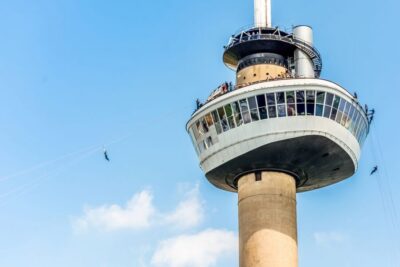
- Rotterdam: Euromast Lookout Tower Ticket
★ 4.4 · 2,549 reviews - Rotterdam: Pancake Cruise
★ 4.4 · 1,986 reviews - From Amsterdam: Rotterdam, Delft & The Hague Guided Day Tour
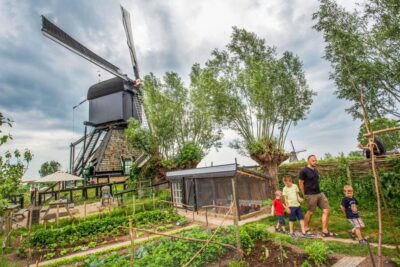
★ 4.2 · 1,765 reviews - Rotterdam: Kinderdijk UNESCO World Heritage Entry Ticket
★ 4.6 · 1,477 reviews
Timmerhuis and Rotterdam’s mixed architectural past
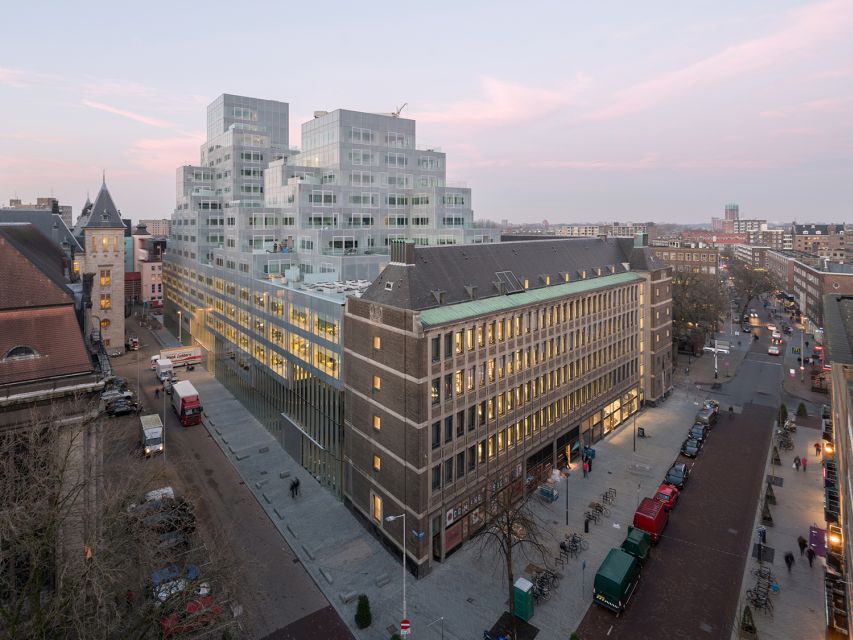
At the Timmerhuis, the guide explains a redevelopment project by Rotterdam-based firm OMA. The design joins a municipal office block from the 1950s with a pixel-like steel and glass structure.
This is a useful stop because it shows how Rotterdam handles older buildings. The city does not always clear away the past to make room for something new. Here, an existing office block was joined to a highly contemporary addition, creating a conversation between two periods.
The project also helps explain why an expert guide adds value. You can look at the glass and steel form on your own, but you may miss the decision to combine old and new. The guide gives you the design logic, rather than leaving you with a quick photograph and a vague impression.
You also pass Dudok’s Dudok, a building linked to architect Willem Marinus Dudok. The supplied route does not promise an interior visit here, so treat it as an exterior stop while walking between the larger landmarks.
Postwar buildings around Schouwburgplein
The middle section brings you past the post office and the de Bijenkorf warehouse, then toward Forum and Schouwburgplein. These stops broaden the tour beyond futuristic buildings.
Rotterdam’s architecture is not all mirrored curves and dramatic angles. Older commercial and civic buildings show how the center looked before later experiments arrived. The postwar monuments help you read the city as a series of rebuilding choices, not as one single modern design project.
At Kruiskadeplein, the route takes in Groothandelsgebouw, Central Station, and de Delftse Poort. Groothandelsgebouw is part of Rotterdam’s postwar identity, while Central Station shows the city’s newer transport architecture. De Delftse Poort adds another layer to the story.
Central Station deserves a careful look. It is both a transport hub and a major architectural statement, with a form designed to handle the movement of a modern city. The tour does not simply point out the facade. It places the station among nearby buildings, allowing you to compare different ideas about entrances, scale, and public space.
This portion may be the most demanding for anyone who wants to stop at every building. The route has many named sights, but 2.5 hours leaves limited time for long interior visits or extended photography.
Calypso, Pauluskerk, and de Unie
The next stretch includes Calypso, Pauluskerk, and de Unie. These buildings show the playful and sometimes challenging side of Rotterdam’s recent architecture.
Calypso is known for its strong visual form, while Pauluskerk carries a civic and social role in the city. De Unie adds another design reference to the route. Together, they remind you that architecture is not only about height or engineering. It can also express social purpose, color, movement, and a city’s willingness to take risks.
This is where the guide’s explanations can make a real difference. The strongest feedback about the experience praises detailed discussion of building history, architects, structure, and high-rise construction. One German-speaking participant described the tour as a fresh introduction to Rotterdam’s architectural history, especially useful for a group connected to an architecture office.
That detail tells you who will get the most from the tour. If you already follow architecture, you can ask technical questions about design and construction. If you are new to the subject, the guide should help you move beyond simply deciding which buildings look attractive.
Museumpark and the final approach to Depot
The route continues through Museumpark, where you see Sonneveld House and Het Nieuwe Instituut. These stops bring design, domestic architecture, and cultural institutions into the same part of the walk.
Sonneveld House offers a more intimate counterpoint to the city’s big public buildings. Het Nieuwe Instituut connects the area to architecture, design, and cultural study. You get a sense of Rotterdam at several scales, from a home to a major urban institution.
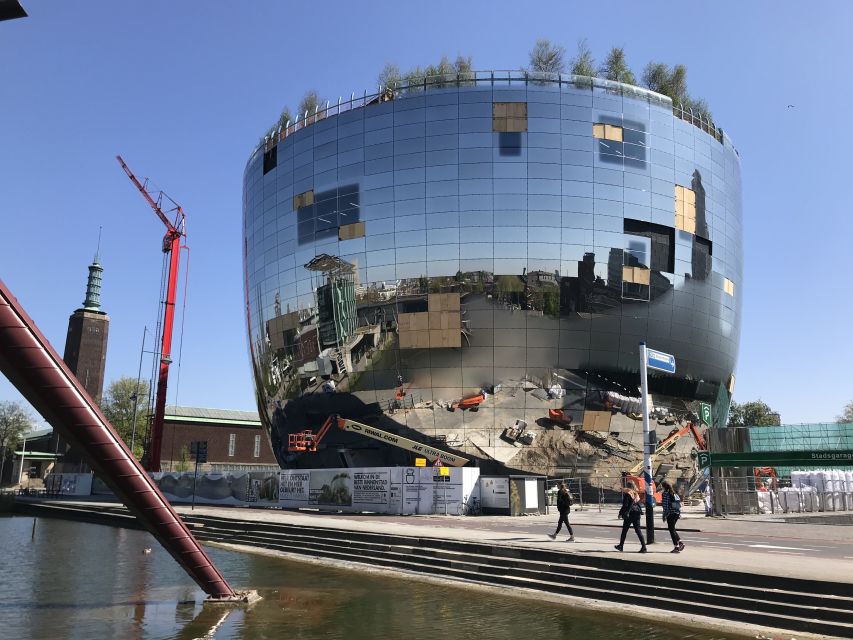
The final stop is Depot Boijmans van Beuningen, the tour’s architectural centerpiece. Its curved mirror facade is hard to miss, but the guide goes beyond the visual effect. You learn about the concept and construction of the reflecting panels that create the double-curved exterior.
The technical details are especially interesting. The enormous entrance doors required aviation engineering techniques to operate. That small fact turns the building from a shiny object into an engineering problem solved through unusual methods.
Depot is also the world’s first public art depot. The tour information centers on the exterior and its design, so do not assume this walking experience includes a full museum or depot visit. If you want to see the collection spaces inside, check separately for entry arrangements and available time.
I like ending here because the Depot gathers many of the tour’s themes in one place: public access, experimental form, technical skill, and Rotterdam’s taste for new ideas. After seeing older offices, warehouses, homes, markets, and stations, you arrive at a building that feels like a clear statement about the city’s future.
What the $494 group price really means
The listed price is $494 for a private group of up to six. With six people, that works out to about $82 per person. For two people, the effective cost is $247 each, so the value changes sharply with group size.
For a full group, the price can make sense if you care about architecture and want a private guide rather than a large public walk. You are paying for a focused route, rooftop access, a live guide, and the chance to ask questions throughout. The three postcards by Rotterdam architectural photographer Ossip van Duivenbode are a pleasant extra, though they should not determine your decision.
For a couple or solo visitor, the same price is harder to justify unless the private format matters greatly. A general city walk may cost less, but it is unlikely to cover this many buildings with the same architectural focus and special rooftop access.
The tour lasts 2.5 hours, which is long enough for a strong introduction but not enough for leisurely interiors at every stop. I would see it as a city orientation for architecture fans, not a full-day museum program.
The reserve-now, pay-later option and free cancellation up to 24 hours before the tour offer useful flexibility. Starting times depend on availability, so check the schedule before building the rest of your day around it.
Who will enjoy this walk most
I would choose this tour for a private group of friends, an architecture student group, a design professional, or a family with older children who enjoy unusual buildings. The private setting is also useful if your group wants explanations in Dutch, English, or German.
The tour received an overall rating of 4.6 from 17 reviews, with especially strong praise for the guides’ friendly manner and clear explanations. Frank Schipper is named in particularly warm feedback, with praise for his good humor, careful information, and ability to make Rotterdam’s building history approachable.
You should think twice if you dislike city walking, need frequent rest breaks, or want substantial time inside each building. The route is packed with sights, and the rooftop stops may involve access conditions that need checking in advance.
Pets are not allowed, except assistance dogs. The activity is described as wheelchair accessible but also not suitable for people with mobility impairments, so anyone with access concerns should get precise answers before paying.
Should you book Rotterdam’s architecture tour?
Book it if you want Rotterdam explained through its buildings rather than simply photographed. The combination of Markthal, Central Station, Timmerhuis, Museumpark, Depot, and a rooftop view gives you a broad look at the city in a short time.
I would especially recommend it for a full private group, since six people bring the cost down to about $82 each. Choose a weekend if the roof of Het Witte Huis appeals to you, or a weekday if you prefer the Timmerhuis terrace and Grotekerkplein setting.
Skip it if you want a slow food tour, a museum-heavy outing, or a simple highlights walk with little technical detail. This is a focused architecture lesson with a brisk route. For the right audience, it offers an unusually clear way to understand why Rotterdam looks the way it does.
FAQ
How long does the Rotterdam architecture tour last?
The tour lasts 2.5 hours.
How much does the private tour cost?
The price is $494 for a private group of up to six people.
Which languages are available?
The live guide can conduct the tour in Dutch, English, or German.
Where does the tour begin?
Meet your guide outside the entrance of Het Witte Huis.
Which rooftop will I visit?
Weekend tours visit the roof of Het Witte Huis. Weekday tours include a rooftop terrace near Grotekerkplein at the Timmerhuis.
Is admission to the Cube Houses included?
Admission is not listed as included, but the tour includes a 50 percent discount on the Cube Houses entrance ticket.
Just added around Rotterdam
- Private tour: Markthal, Cube houses and Rooftop Het Witte Huis★ 4.5 · 3 reviews
- Discover Rotterdam: Classic Highlights Bike Tour by a Local★ 5.0 · 3 reviews
- Private tour from Rotterdam to Windmills of Kinderdijk & Gouda Cheese Experience★ 5.0 · 3 reviews
- Discover Rotterdam’s most Photogenic Spots with a Local★ 5.0 · 3 reviews
- Private Transfer from Rotterdam Port to Amsterdam Airport (AMS)★ 5.0 · 3 reviews
- privatetour Delft, The Hague&Rotterdam Kinderdijk from Amsterdam★ 5.0 · 3 reviews
- Rotterdam: Capture the most Photogenic Spots with a Local★ 5.0 · 3 reviews
- Private Tour of Rotterdam and The Hague including Transfer★ 5.0 · 3 reviews
Rotterdam Tours, compared.



Kinderdijk UNESCO World Heritage Entry Ticket
Read our review →
Browse the lists this tour appears in