
REVIEW · ROTTERDAM TOURS
Rotterdam: Exclusive Rooftop Tour with 360˚ views
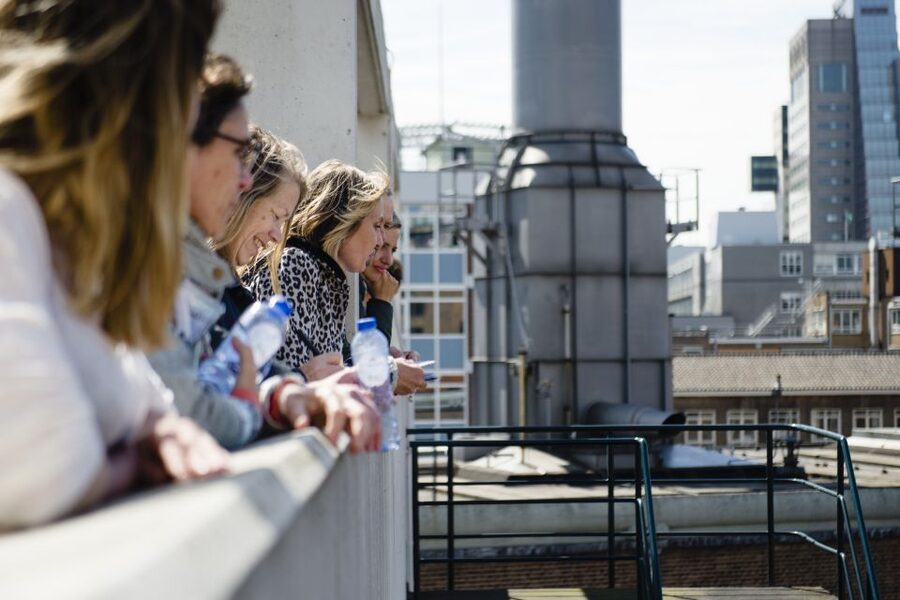
Rotterdam looks different from above. This 2.5-hour walking tour takes you onto four rooftops that are rarely open to the public, combining sweeping city views with a clear look at how Rotterdam uses its broad, flat roofs. I especially like the mix of big skyline viewpoints and the working DakAkker vegetable garden. I also like that the tour explains the city’s past, present, and plans for its rooftops rather than treating each stop as just a photo opportunity.
The main drawback is access. You’ll climb stairs on three rooftops, including the final steps even when an elevator is available, so this tour is not suitable for wheelchair users or people with mobility impairments. The tour also runs rain or shine, which makes comfortable shoes and a weather-ready jacket sensible choices.
In This Review
- Key points to know before booking
- Why Rotterdam’s rooftops matter
- Meeting your guide at Rotterdam Central Station
- DakAkker: a vegetable garden above the city
- The Coolsingel hotel rooftop and the value of multiple uses
- A central rooftop opposite Sint Laurenskerk
- The White House and views toward the Meuse
- How much walking and climbing is involved?
- Is the $40 price fair?
- Who will enjoy this rooftop tour most?
- Should you book Rotterdam’s rooftop tour?
- FAQ
- Where does the Rotterdam rooftop tour begin?
- How do I recognize the guide?
- How long does the tour last?
- Which languages are available?
- Are food and drinks included?
- Is the tour suitable for wheelchair users?
Key points to know before booking
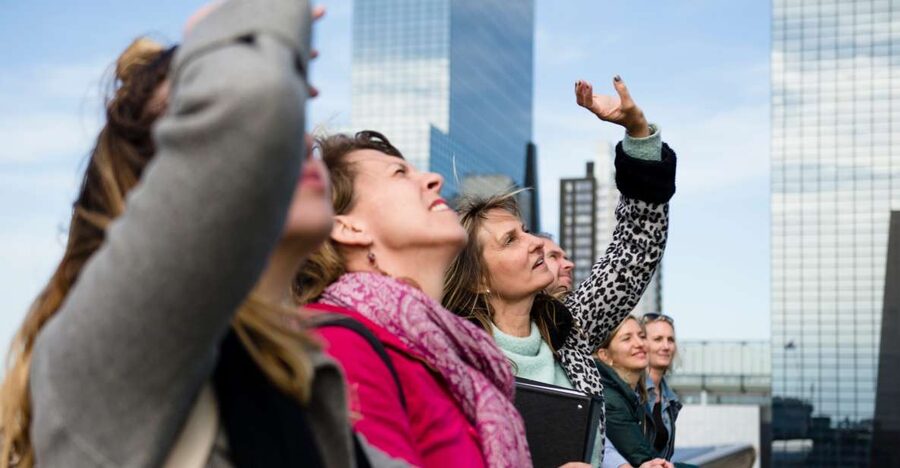
- Four normally restricted rooftops: See Rotterdam from the DakAkker, a hotel rooftop on Coolsingel, a central rooftop opposite Sint Laurenskerk, and the historic White House.
- A working organic garden: The DakAkker grows vegetables, fruit, and edible flowers for nearby restaurants.
- Strong city context: Your guide explains why Rotterdam has more than 18 million square meters of flat rooftops and how the city wants to use them.
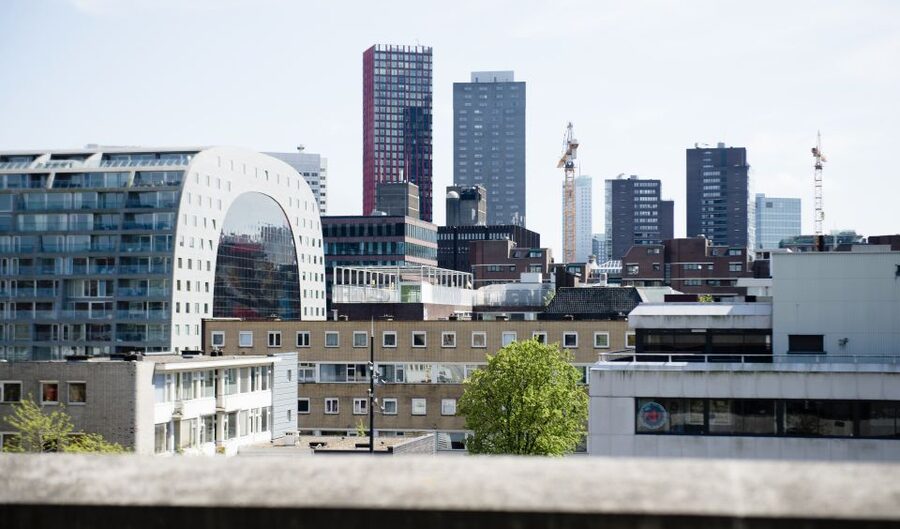
- The best skyline variety: Views include the Laurenskerk, Markthal, Cube Houses, Erasmus Bridge, Meuse River, and much of central Rotterdam.
- A walking tour as well as a rooftop tour: The route passes the Markthal, Cube Houses, and Old Harbor between viewpoints.
- English or Dutch guidance: The live guide meets you at Rotterdam Central Station, carrying a turquoise keycard and a folder marked rooftop tour.
Why Rotterdam’s rooftops matter
Rotterdam is famous for bold architecture at street level, but its rooftops tell another story. With more than 18 million square meters of flat roof space, the city has a huge amount of unused or underused ground above its streets.
That space can do more than hold air-conditioning units and gravel. Rooftops can grow food, collect rainwater, support plants, create gathering spots, and provide new views across a crowded city center. This tour makes that idea practical. You see working examples, then look across the city from them.
I like that the experience connects design with daily city problems. Rainwater management, food production, green space, and limited land are not abstract topics here. You can see how a roof might help with each one.
The tour also gives you a useful orientation to Rotterdam. From above, the city’s modern towers, older buildings, churches, bridges, and riverfront fit together more clearly. You get the broad picture first, then walk through some of the most recognizable central districts.
More Rotterdam trips:
- Rotterdam: Harbor Sightseeing Cruise
★ 4.3 · 7,599 reviews - Rotterdam: 1-Hour Sightseeing Splash Tour
★ 4.5 · 3,299 reviews - Rotterdam: Rotterdam Zoo Blijdorp Entry Ticket
★ 4.6 · 2,754 reviews
Meeting your guide at Rotterdam Central Station
Your guide waits 10 minutes before departure in front of the Rotterdam Tourist Information shop in the central hall of Rotterdam Central Station. Look for the turquoise keycard and the folder marked rooftop tour. That detail matters in a busy station, where finding a guide without a clear marker could take time.
The opening introduction lasts about 10 minutes. It sets up the main question of the tour: why does Rotterdam have so much flat rooftop space, and what can the city do with it?
Starting at Central Station is convenient if you arrive by train or are staying elsewhere in the city. It also gives the tour a natural beginning. You start in one of Rotterdam’s major modern transport spaces, then move into the historic and commercial center on foot.
The group walks to the first rooftop after this introduction. The exact starting time changes by date, so check availability before planning other activities around it. At 2.5 hours, the tour takes a meaningful part of your day, but it is still short enough to fit alongside other central Rotterdam sights.
DakAkker: a vegetable garden above the city
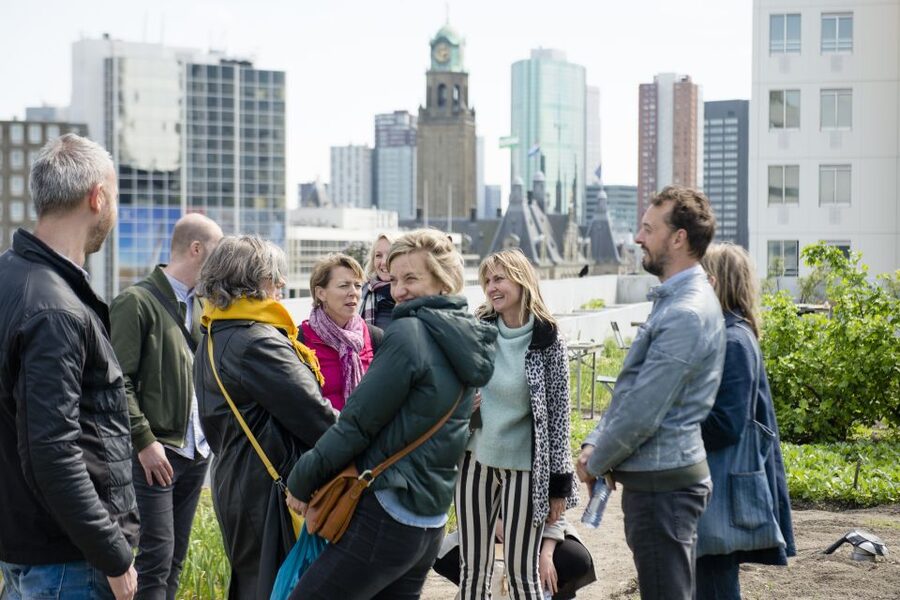
The first rooftop is DakAkker, one of the tour’s most distinctive stops. It became Europe’s first organic agricultural rooftop in 2011 and is maintained by a rooftop farmer with help from volunteers.
Here, vegetables, fruits, and edible flowers grow above the city. The produce is sold to surrounding restaurants, giving the garden a direct connection with Rotterdam’s food scene. This is not simply a roof decorated with pots. It is a working garden with a useful purpose.
You may also see the café-restaurant connected with the rooftop. The roof includes a rainwater buffer, another example of how one rooftop can take on more than one job. It can grow food, help manage rain, and provide a place for people to eat.
This stop adds substance to the tour. The skyline views are the obvious attraction, but DakAkker shows why rooftop development matters. A green roof can offer food production and water storage in a city where ground-level space is limited.
The garden is also a good reminder to bring practical footwear. You will be walking between several rooftops and climbing steps. Comfortable shoes are more useful here than anything designed mainly for photographs.
The Coolsingel hotel rooftop and the value of multiple uses
The second rooftop sits on a hotel along Coolsingel. From here, you get a broad view over Coolsingel and the eastern side of Rotterdam’s city center.
This stop shifts the focus from agriculture to urban planning. Your guide explains the role of multifunctional rooftops and what Rotterdam is doing to encourage more roof projects. The phrase matters because the best rooftop spaces solve more than one problem at a time.
A roof might support plants while slowing rainwater runoff. It might offer a place for people while adding insulation to a building. It might produce food, create habitat, or provide a useful viewpoint. The tour helps you see these possibilities as part of a wider city plan.
The Coolsingel view is also valuable because it shows the city from a different angle than the riverfront viewpoints later in the route. You look across the center rather than simply down toward the Maas. That variety keeps the tour from feeling like four versions of the same photo stop.
The hotel setting may feel less atmospheric than the garden or the White House, but its importance is practical. It shows that rooftop use is not limited to a special cultural building. Ordinary commercial buildings can also contribute to Rotterdam’s plans for greener, more useful roofs.
A completely different kind of day out in Rotterdam:
- Rotterdam: Euromast Lookout Tower Ticket
★ 4.4 · 2,549 reviews - Rotterdam: Pancake Cruise
★ 4.4 · 1,986 reviews - From Amsterdam: Rotterdam, Delft & The Hague Guided Day Tour
★ 4.2 · 1,765 reviews - Rotterdam: Kinderdijk UNESCO World Heritage Entry Ticket
★ 4.6 · 1,477 reviews
A central rooftop opposite Sint Laurenskerk
The third rooftop sits in the middle of the city center, opposite Sint Laurenskerk, Rotterdam’s well-known Laurenskerk. This is the place for a classic 360-degree view.
From the top, you can see the Laurenskerk, the Markthal, the Cube Houses, and the wider Rotterdam skyline. The position gives you a helpful contrast between the city’s surviving older architecture and its modern, sharply designed buildings.
The Laurenskerk is especially important in understanding Rotterdam. It is one of the clearest reminders that the city is not only a collection of postwar towers and experimental buildings. From this rooftop, the church becomes part of a larger composition that includes the angular Markthal and the unusual Cube Houses.
This is likely one of the most satisfying stops for photography, though you should give yourself time to look in every direction rather than aiming only at the most famous buildings. A 360-degree view rewards a slow turn. The tour’s subject also becomes easier to grasp here because you can see how much roof space is packed into the center.
After this rooftop, the guide takes you past the Markthal, Cube Houses, and Old Harbor. That walk is an important part of the experience. You are not being moved from roof to roof by vehicle. You pass through central Rotterdam and see how the buildings look from street level before climbing again.
The White House and views toward the Meuse
The final rooftop is at the White House, once considered the first skyscraper in Europe. It provides a different kind of view from the central rooftop.
From the top, you can look toward the Meuse River, Erasmus Bridge, Cube Houses, and the city beyond. The river gives the view more space, while the bridge provides an instantly recognizable Rotterdam landmark. Looking down toward the Cube Houses from above also reveals their unusual shape in a way that is hard to appreciate from the pavement.
The White House adds historical weight to the final stop. Rotterdam’s skyline is often associated with new towers and recent architectural experiments, but this building represents an earlier stage in the city’s modern identity.
Ending with the river and bridge gives the route a strong visual finish. You have already seen a garden, a commercial rooftop, and a central church district. The White House brings those subjects together with a broad view toward the water.
The supplied meeting information is not fully consistent: one part says the activity ends back at the meeting point, while the practical notes say the starting point differs from the ending point and the route description finishes at the White House. I would confirm the exact end location when booking, especially if you have a train reservation or a timed attraction afterward.
How much walking and climbing is involved?
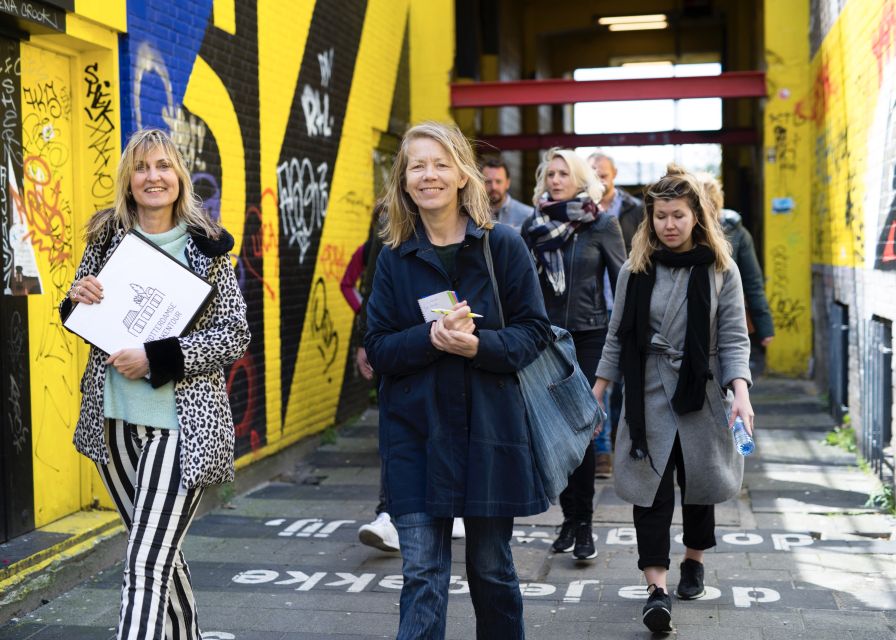
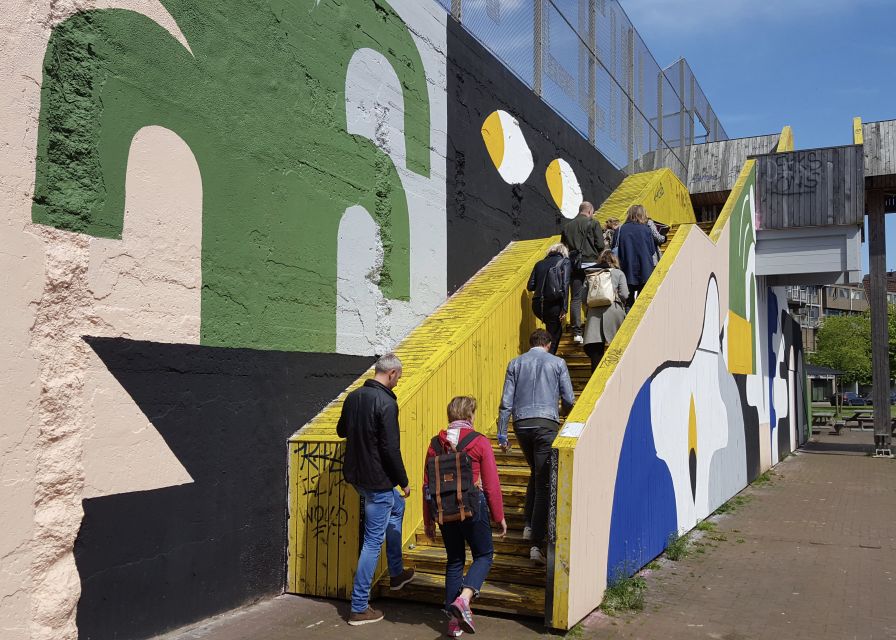
This is a walking tour with repeated rooftop access, not a lift-based sightseeing outing. You will climb stairs to reach three of the rooftops. Elevators are available at some locations, but you still need to climb the final steps.
That makes the tour unsuitable for wheelchair users and people with mobility impairments. Even if you usually manage city walking well, think about how repeated stairs, roof access, and possible wet weather might affect you.
The tour takes place rain or shine. Rotterdam weather can change quickly, so I would bring a light waterproof layer and wear shoes with a secure sole. An umbrella may be awkward on stairs and exposed rooftops, so a rain jacket is the more practical choice.
The route does not include food or drinks. The DakAkker has a café-restaurant, but you should not assume that a meal or refreshment is included in the tour price. Eat beforehand or plan a stop afterward.
Is the $40 price fair?
At $40 per person, this is not the cheapest way to see Rotterdam from above. You are paying for more than a public viewpoint, though. The price includes access to four exclusive rooftops and a live guide in Dutch or English.
That access is the key value. Several of these roofs are rarely available to the public, and the tour links them into one route. If you tried to find four comparable viewpoints independently, you might not be able to enter them at all.
I also think the interpretation improves the value. Without a guide, you could identify the Markthal, Erasmus Bridge, and Cube Houses, but you would miss the reasons DakAkker matters and the city’s plans for multifunctional rooftops.
The tour is a good buy for visitors interested in architecture, urban planning, sustainability, photography, or city design. It is less compelling if you only want a quick skyline photo and do not care about the rooftop projects themselves.
Food and drinks are not included, and hotel pickup is not provided. Those exclusions are reasonable for a central walking tour, but remember to budget for your own refreshments and make your way to Central Station.
Who will enjoy this rooftop tour most?
I would recommend it to anyone who wants a fresh view of Rotterdam beyond the usual street route. It suits architecture fans, photographers, city planners, and curious visitors who like understanding how a place works.
It is also a smart choice early in a Rotterdam visit because the rooftops help you get your bearings. After seeing the Markthal, Old Harbor, river, church, bridge, and Cube Houses from above, walking through the city becomes easier.
Families with older children may enjoy the variety, especially the garden and unusual buildings. The tour is less suitable for very young children who struggle with a 2.5-hour walk or repeated stairs.
You should skip it if rooftop access makes you uncomfortable, if bad weather would spoil your day, or if mobility limitations make the stair sections difficult. The tour is not designed as an accessible alternative with every rooftop reachable by elevator.
The experience has a 4.8 rating from 34 ratings, which fits its strongest qualities: unusual access, clear city views, and a route that combines sightseeing with useful local context. The guide is central to the experience, since the meaning of each roof matters as much as the view.
Should you book Rotterdam’s rooftop tour?
Book it if you want more than a standard city walk. The four viewpoints are different enough to keep the route interesting, and DakAkker gives the tour a practical purpose beyond collecting skyline photos.
I would especially choose this tour on a first visit, or on a day when you want to understand Rotterdam’s architecture and future plans. The $40 price is fair for the restricted access and live explanation, provided you are comfortable with stairs and uncertain weather.
Before booking, check the start time, prepare for rain, wear comfortable shoes, and confirm the exact ending point. If those details suit you, this is one of Rotterdam’s more useful and unusual ways to see the city.
FAQ
Where does the Rotterdam rooftop tour begin?
The guide meets you 10 minutes before departure in front of the Rotterdam Tourist Information shop in the central hall of Rotterdam Central Station.
How do I recognize the guide?
Look for a guide carrying a turquoise keycard and a folder marked rooftop tour.
How long does the tour last?
The tour lasts 2.5 hours. Starting times vary, so check availability for your chosen date.
Which languages are available?
The live tour guide provides the experience in Dutch or English.
Are food and drinks included?
No. Food and drinks are not included in the tour price.
Is the tour suitable for wheelchair users?
No. The tour is not suitable for wheelchair users or people with mobility impairments. You will climb steps to three rooftops, and even rooftops with elevators require climbing the final steps.
Just added around Rotterdam
- Rotterdam: Summer Cocktail Cruise★ 4.7 · 18 reviews
- Skip the Line: SS Rotterdam Steam Ship Entrance Ticket★ 4.5 · 18 reviews
- Rotterdam: Beer Brewery Noordt Tastings with Optional Tour★ 4.9 · 18 reviews
- Guided 3-Hour Food Tasting Experience in Rotterdam★ 5.0 · 19 reviews
- Private Day Trip from Amsterdam to Rotterdam and the Hague★ 5.0 · 19 reviews
- Rotterdam Must Do Tour: Highlights, History, WW2 and Architecture★ 5.0 · 20 reviews
- Private Day Tour: Rotterdam and The Hague. English or Spanish★ 4.5 · 20 reviews
- Private Day Tour to Keukenhof Gardens – from Amsterdam/Rotterdam★ 5.0 · 20 reviews
Rotterdam Tours, compared.


Kinderdijk UNESCO World Heritage Entry Ticket
Read our review →
Browse the lists this tour appears in