
REVIEW · ROTTERDAM TOURS
Rotterdam Must Do Tour: Highlights, History, WW2 and Architecture
Rotterdam tells its story in concrete and steel. This two-hour walking tour is a useful introduction to a city rebuilt after wartime destruction, with a local guide leading you from Rotterdam Centraal to the Cube Houses, Markthal, Old Harbour, and other key sights. It combines architecture and WWII history in a compact route, which makes it a smart first look at Rotterdam.
I like the route’s variety. You move from grand postwar buildings and shopping streets to a wooden pedestrian bridge, a surviving medieval church, and some of the city’s most playful modern architecture. I also like the small-group limit of 15 people, since a guide can usually answer questions without turning the walk into a moving lecture hall.
The main drawback is the short running time. Ten stops in about two hours means some places receive only a quick explanation, and one account describes moving at a fast pace after a delayed ship arrival. The quality also depends on your guide. Several guides, including Susan, Edwin, Michel, John, Ed, and Stephan, received warm praise, while one experience felt too light on detail.
In This Review
- Six things to know before you book
- Starting at Rotterdam Centraal
- Groot Handelsgebouw and the first postwar lesson
- West-Kruiskade and Lijnbaan
- Crossing the 390-meter Luchtsingel
- The Nieuwe Delftse Poort and a lost city gate
- Sint-Laurenskerk, Rotterdam’s medieval survivor
- Markthal and the city’s most colorful interior
- Oude Haven and the Cube Houses
- What the guides add to the walk
- Is $29.41 good value for two hours?
- Who should book this Rotterdam walk?
- Final verdict: book it for the city story
- FAQ
- How long does the Rotterdam Must Do Tour last?
- Where does the tour begin?
- Where does the tour end?
- Is the tour offered in English?
- What is included in the price?
- How large is the tour group?
Six things to know before you book
- The route begins at Rotterdam Centraal: Meet at Stationsplein 10, where the guide starts with the station’s striking architecture and an introduction to the city.
- WWII and rebuilding are central themes: The tour explains how Rotterdam’s old shopping district was destroyed and how the city took shape again after the bombing.
- You see both old and new Rotterdam: The medieval Sint-Laurenskerk is paired with the futuristic Markthal and Cube Houses.
- The Markthal is a highlight, not a meal stop: Entry is free, but food and drinks are not included.
- The group is capped at 15 people: That is small enough for conversation and questions, at least when the tour fills normally.
- Allow for a brisk walk: The route covers many sights, and this is an overview rather than a slow architectural study.
Starting at Rotterdam Centraal
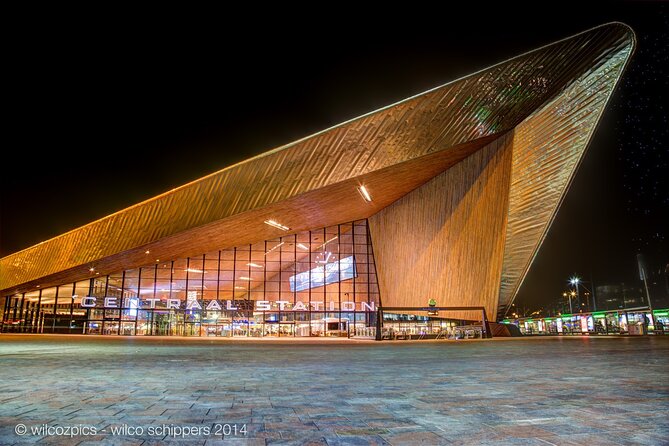
The tour begins outside Rotterdam Centraal at Stationsplein 10. This is a practical meeting place, especially if you arrive by train or connect to the city through public transportation.
Your guide introduces the architecture of the station before setting off. That opening matters because Rotterdam is not a city where history sits only in old stone buildings. Its identity is tied to rebuilding, bold design, transport, and the working port.
The station also gives you an immediate sense of the city’s modern character. You are not simply walking toward a collection of old monuments. You are beginning in a major piece of contemporary Rotterdam and then tracing how the city changes from district to district.
Different start times are available, which helps if you are fitting the walk around a train, a day in port, or another city visit. Still, arrive with enough time to find the exact meeting point. One participant had a delayed ship arrival and needed special help arranging a late connection with the guide. That was handled well, but it is better not to rely on last-minute rescue.
More historical tours:
- Rotterdam: Kinderdijk UNESCO World Heritage Entry Ticket
★ 4.6 · 1,477 reviews - Rotterdam: Harbor Cruise on a Historic Ship
★ 4.2 · 812 reviews - MUST DO: Rotterdam highlights & history with a local guide
★ 4.5 · 57 reviews
Groot Handelsgebouw and the first postwar lesson
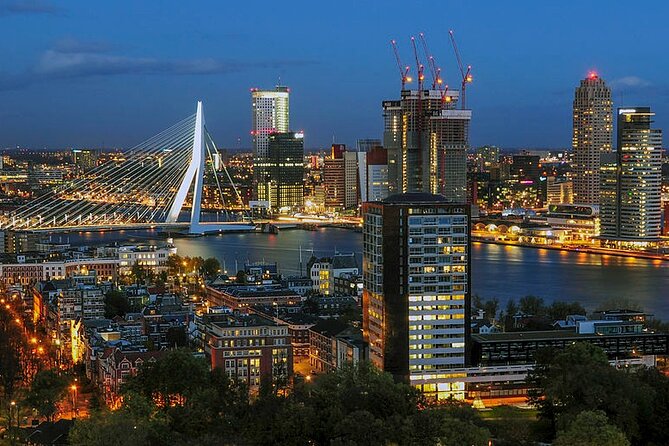
The Groot Handelsgebouw was completed in 1953 and was among the first major buildings erected after the bombing of Rotterdam in WWII. It gives the guide a natural place to explain the scale of the city’s loss and the speed of its rebuilding.
This is one of the strongest parts of the route for anyone who wants context rather than just photographs. The building is not presented as an isolated sight. It helps explain why Rotterdam feels so different from many Dutch cities, where historic centers often dominate the view.
You may spend only about ten minutes here, so listen for the wider point. Rotterdam’s modern appearance was not created by accident or by a single architect. It grew from a difficult decision: rebuild a damaged center in a new form rather than reproduce the old one exactly.
West-Kruiskade and Lijnbaan
The walk continues through the Kruiskade and West-Kruiskade shopping streets. These streets show the city in everyday use, with shops and central-city movement replacing the formal feel of a monument district.
Next comes Lijnbaan, Rotterdam’s main pedestrian shopping street. It opened in 1953 as part of the new shopping district, after the former shopping area was destroyed during the bombing.
Lijnbaan is important because it represents a new kind of city planning for the postwar period. It was designed around pedestrians and a modern retail center, not simply as a repaired version of the past. Your guide can connect this practical urban design to the larger story of Rotterdam’s recovery.
The tradeoff is that shopping streets may not hold your attention as long as the Markthal or Cube Houses. If you want only postcard sights, this section may feel ordinary. If you want to understand how the rebuilt city works, it earns its place.
Crossing the 390-meter Luchtsingel
The Luchtsingel is a 390-meter wooden pedestrian bridge linking Rotterdam North with the center. Its practical purpose is easy to understand, but its larger story is just as interesting: it helped reconnect an area that had suffered from vacancy and neglect.
This is a good example of Rotterdam’s habit of using design to change how people move through the city. The bridge is useful, visible, and a little unexpected. It also gives the walk a break from conventional streets and large commercial buildings.
Because the tour is only two hours, expect a short stop rather than a long examination of the bridge. You will have time to see how it fits into the city, but not necessarily to explore the surrounding district at leisure. I would make a note of the area if you want to return later on your own.
More Rotterdam trips:
- Rotterdam: Harbor Sightseeing Cruise
★ 4.3 · 7,599 reviews - Rotterdam: 1-Hour Sightseeing Splash Tour
★ 4.5 · 3,299 reviews - Rotterdam: Rotterdam Zoo Blijdorp Entry Ticket
★ 4.6 · 2,754 reviews - Rotterdam: Euromast Lookout Tower Ticket
★ 4.4 · 2,549 reviews
The Nieuwe Delftse Poort and a lost city gate
The original Delftsche Poort was a city gate, with the last version built in 1764. About fifty years later, a steel reconstruction designed by artist Cor Kraat was placed close to the original site on the Pompenburg.
This stop offers a compact lesson in how Rotterdam treats its past. The city has lost much of its older center, but that does not mean history has vanished. Parts of it survive in reconstructions, street plans, churches, fragments, and stories tied to the places where older structures once stood.
The stop is brief, around ten minutes, so the guide’s explanation is especially useful. Without context, the gate can seem like an unusual modern sculpture. With context, it becomes a reminder of the city that existed before the wartime destruction and the rebuilding that followed.
Sint-Laurenskerk, Rotterdam’s medieval survivor
The Grote of Sint-Laurenskerk is the only remaining part of Rotterdam’s medieval city. It is a Protestant church, and you can also enter it free of charge.
This may be the most important historical contrast on the walk. Around you, Rotterdam is known for experimental buildings and postwar planning. Inside or beside the church, you encounter the physical remnant of the older city.
The tour allows roughly ten minutes here. That is enough to see the church and understand why it matters, but you should not expect a full church visit during the group walk. If the interior is open when you pass, the free entry gives you a good reason to return after the tour for a slower look.
For me, this stop keeps the architecture theme from becoming a parade of new buildings. Rotterdam’s story is not only about looking forward. It is also about what survived.
Markthal and the city’s most colorful interior
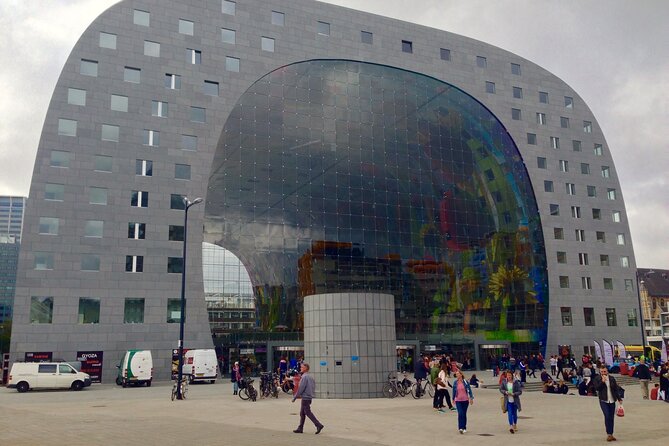
The Markthal is one of the tour’s major stops, with about 30 minutes allocated to the building and its surroundings. Designed by MVRDV, it has a gray natural-stone exterior and a large arch shaped somewhat like a horseshoe.
Inside, the dramatic artwork is the main event. Enlarged fruits, vegetables, seeds, fish, flowers, and insects cover the interior arch, creating a huge, colorful ceiling over restaurants and food stalls.
The free admission is useful because you can enter without paying an additional attraction fee. Food and drinks are not included, so treat this as a chance to look around, snack, or plan a separate meal rather than as part of the tour price.
This is also a place where the guide can add real value. The building is easy to photograph, but its form, scale, artwork, and role in the rebuilt center make more sense with explanation. One less positive experience here came from feeling that the guide did not fully explain the artistic buildings around the Markthal. That is a fair warning: if your guide moves quickly, take time to look up and around rather than focusing only on the food stalls.
Oude Haven and the Cube Houses
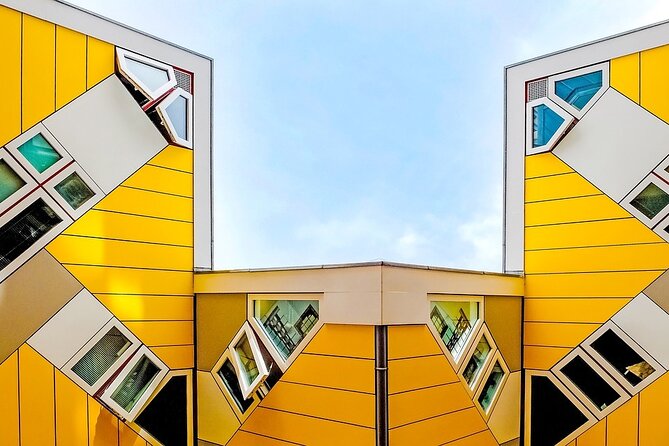
The Oude Haven, or Old Harbour, is the historic center’s waterfront area north of the Maas. It has developed into a lively part of central Rotterdam and is home to the famous Cube Houses.
This is the tour’s natural finale. The route has moved through wartime destruction, postwar commerce, pedestrian planning, public art, and surviving medieval architecture. At the Old Harbour, Rotterdam’s modern identity becomes especially clear.
The Cube Houses are hard to miss. Their tilted forms show the city’s willingness to test unusual ideas in ordinary residential buildings. You get the best value here if you listen to how the guide explains the relationship between design and daily life, rather than treating the houses as a quick photo stop.
The tour ends back at the meeting point, so you may want to note the Old Harbour and Markthal for a later return. Since the walk covers them at the end of a compact route, you may prefer to explore these areas independently afterward.
What the guides add to the walk
The strongest feedback centers on the guides’ enthusiasm and storytelling. Ed was praised for sharing lesser-known facts, while John was described as clearly proud of Rotterdam. Susan received especially warm praise for making the city feel personal, explaining buildings clearly, and even suggesting places to find gifts.
Edwin’s strength was explaining Rotterdam’s reconstruction after WWII along with the city’s sculpture and architecture. Michel was praised for clear information and an easy manner. Stephan led a small, flexible group and was described as doing an excellent job.
That range tells you something important. This is a locally guided walk, not an audio tour with a fixed script. You may get a history-heavy explanation, an architecture-focused walk, or a more conversational introduction to daily life in the city.
The downside is the same feature that makes the tour appealing. Because the experience depends on the person leading it, the depth can vary. If you want detailed architectural analysis at every building, a specialist architecture tour may suit you better. If you want a friendly orientation with history, WWII, and major sights, this format is a good match.
Is $29.41 good value for two hours?
At $29.41 per person, the tour is priced as an affordable introduction rather than a full-day experience. You are paying for a local guide, a planned route, and the chance to connect Rotterdam’s sights into one clear story. There are no extra admission charges for the listed stops, and the Sint-Laurenskerk can also be entered free of charge.
The value is strongest if this is your first time in Rotterdam or if you have only a few hours. In that case, the tour can help you decide where to spend more time later.
Food and drinks are not included, but that is reasonable for a walking tour that passes through the Markthal. You can choose your own snack or meal there instead of being tied to a set arrangement.
A group discount is available, and the maximum group size is 15. The smaller limit is a useful feature at this price, especially if you want to ask questions. The tour is also offered in English and includes a mobile ticket.
Who should book this Rotterdam walk?
I would recommend it to first-time visitors who want a clear introduction to Rotterdam’s buildings, history, and city center. It also suits anyone arriving by train, since the meeting point is at Rotterdam Centraal.
The tour works well for people interested in:
- Postwar rebuilding and WWII history
- Modern architecture and urban design
- The Cube Houses and Markthal
- A guided overview before exploring alone
- A small group rather than a large coach tour
It may be less suitable if you walk slowly, want long visits inside each sight, or prefer a single subject explored in great depth. The pace can be brisk, and several stops last only about ten minutes.
Most people can take part, and service animals are allowed. The tour runs near public transportation, but the information provided does not specify the exact walking distance, route surface, or pace beyond the two-hour format. If mobility is a concern, contact the provider before booking.
Final verdict: book it for the city story
Book this tour if you want Rotterdam to make sense quickly. The best feature is not any single building. It is the link between the 1940 bombing, the 1950s rebuilding, bold modern architecture, and the city’s surviving medieval church.
The $29.41 price is fair for a two-hour guided overview, especially with a group cap of 15 and free access to the listed sights. Go in expecting a brisk orientation, not a slow study of every building. If you get a guide with the warmth and clarity shown by Susan, Edwin, Michel, John, Ed, or Stephan, the walk can give you a strong start to a day in Rotterdam.
You can cancel for a full refund up to 24 hours before the local start time. The experience requires a minimum number of participants, and if that is not met, you are offered another date or experience, or a full refund.
FAQ
How long does the Rotterdam Must Do Tour last?
The tour lasts approximately two hours.
Where does the tour begin?
It begins at Stationsplein 10, 3013 AJ Rotterdam, Netherlands, at Rotterdam Centraal Station.
Where does the tour end?
The activity ends back at the meeting point.
Is the tour offered in English?
Yes. The tour is offered in English.
What is included in the price?
A local guide is included. Food and drinks are not included.
How large is the tour group?
The maximum group size is 15 people. Group discounts are also available.
Just added around Rotterdam
- Rotterdam: Summer Cocktail Cruise★ 4.7 · 18 reviews
- Skip the Line: SS Rotterdam Steam Ship Entrance Ticket★ 4.5 · 18 reviews
- Rotterdam: Beer Brewery Noordt Tastings with Optional Tour★ 4.9 · 18 reviews
- Guided 3-Hour Food Tasting Experience in Rotterdam★ 5.0 · 19 reviews
- Private Day Trip from Amsterdam to Rotterdam and the Hague★ 5.0 · 19 reviews
- Private Day Tour: Rotterdam and The Hague. English or Spanish★ 4.5 · 20 reviews
- Private Day Tour to Keukenhof Gardens – from Amsterdam/Rotterdam★ 5.0 · 20 reviews
- Private Day Tour: Rotterdam, Delft & The Hague From Amsterdam★ 5.0 · 22 reviews
Rotterdam Tours, compared.



Kinderdijk UNESCO World Heritage Entry Ticket
Read our review →
Browse the lists this tour appears in