
REVIEW · HISTORICAL TOURS
Amsterdam: Private Pedicab Historical Sightseeing Tour
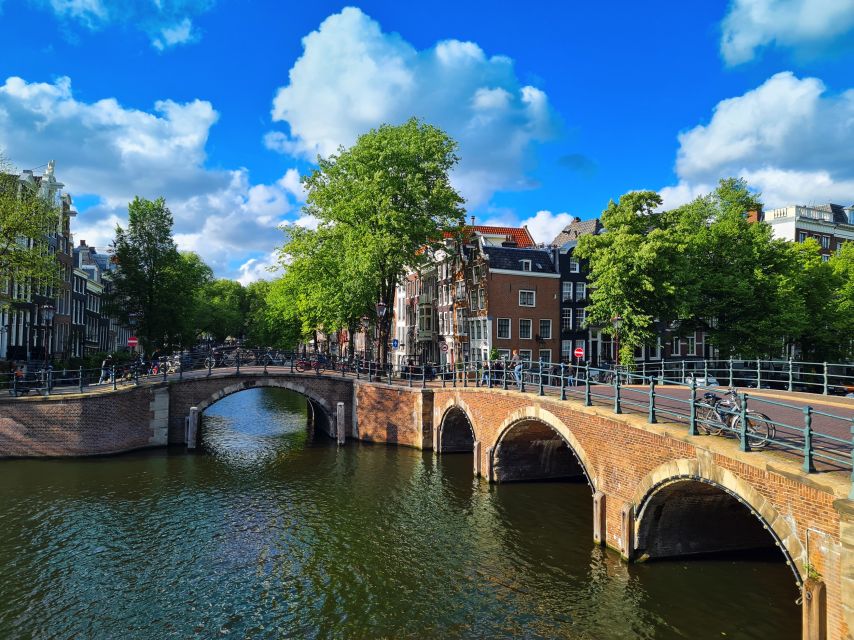
Amsterdam is best seen at street level. This private two-hour pedicab tour links the old centre, canal ring, Jewish Quarter, Chinatown, Amstel River, and Museumplein without asking you to march between them. I like the small private format and the way local guide Bram de Haan uses maps, photographs, and personal insight to explain how the city grew. I also like the hotel pickup and drop-off, which make this a smart first outing after arrival.
The main caution is size. The pedicab allows a combined passenger weight of 200 kilograms, and the activity is not suitable for anyone over 100 kilograms. At $230 per group of up to two, this is not a budget sightseeing ride, but it can offer good value if you want personal guiding, less walking, and a broad first look at Amsterdam.
In This Review
- Key points at a glance
- Why a pedicab works well in central Amsterdam
- Dam Square explains where Amsterdam began
- Zeedijk, the old dike, and a glimpse of Chinatown
- New Market and the Montelbaanstoren
- Amsterdam’s Jewish Quarter and places of remembrance
- The Hermitage and Amsterdam’s waterborne identity
- The 17th-century canal ring, read from a pedicab
- Rijksmuseum, Van Gogh Museum, and Museumplein
- What the guiding is really like
- Comfort, weather, and mobility
- Price, group size, and who gets the best value
- Should you book the Amsterdam pedicab tour?
- FAQ
- How long does the Amsterdam private pedicab tour last?
- How many people can join the private pedicab tour?
- Where does the tour begin and end?
- Which languages does the guide speak?
- Is the tour suitable for someone with limited walking ability?
- What should I bring for the ride?
Key points at a glance

- A private route through five different sides of Amsterdam: You move from Dam Square and medieval city defenses to the canal ring, Jewish Quarter, Chinatown, and Museumplein.
- Bram de Haan brings visual aids: Maps and photographs help explain how Amsterdam changed from its earliest days through the Second World War.
- A useful choice for limited mobility: You stay seated for most of the ride, with hotel pickup and drop-off included.
- The Skinny Bridge and Amstel River provide the best photo pause: The view combines water, bridges, old houses, and one of the city’s most recognizable crossings.
- The pedicab reaches streets cars cannot: That gives you a closer look at central Amsterdam than a standard car tour.
- Plan for cool weather: Warm clothing matters, though a blanket is provided when conditions are cold.
Why a pedicab works well in central Amsterdam
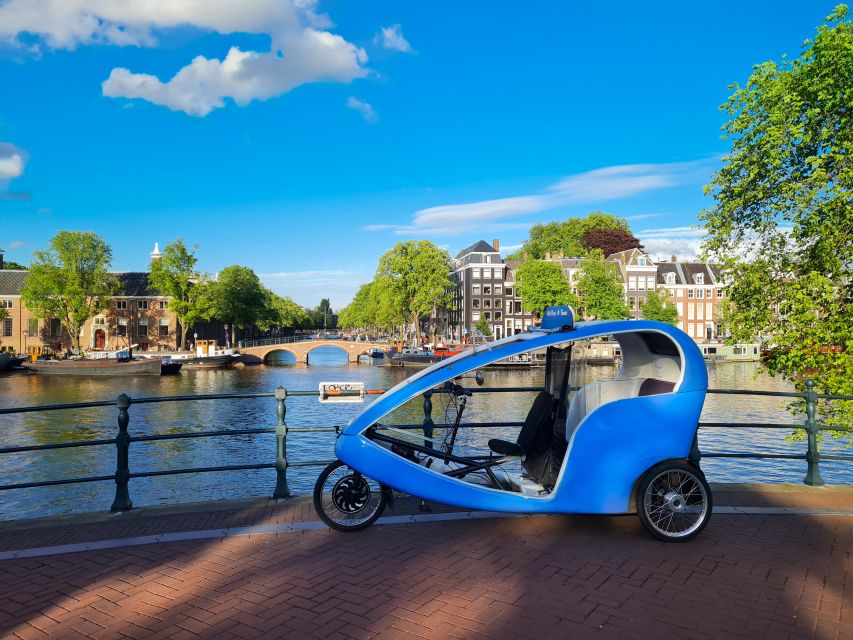
Amsterdam’s centre is compact, but it is not always easy to cover. Canals, narrow streets, bikes, pedestrians, and water crossings can turn a short walk into a tiring zigzag. A pedicab gives you a moving seat while still keeping you close to the buildings and street life.
That middle ground is the appeal. You are not sealed inside a bus, and you are not trying to keep pace with a walking guide. You can look up at canal houses, pause for photographs, and hear commentary while moving between districts.
The private format matters. The price is $230 for up to two people, not per passenger. For a couple, that works out to $115 each. It remains a fairly expensive two-hour activity, but the cost buys a dedicated guide, hotel transportation, and a route shaped around your interests. One pair extended the ride to three hours, so asking about extra time may be possible, though the standard experience lasts two hours.
This is especially useful at the start of a visit. You get a sense of Amsterdam’s layout before returning to places such as the Rijksmuseum, Van Gogh Museum, or Jewish Cultural Quarter on your own.
More Historical Tours in Amsterdam
- Amsterdam Food and Cultural Tour with Tastings
★ 5.0 · 2,442 reviews - Amsterdam: Haunted History and Ghost Walking Tour
★ 4.5 · 488 reviews - Amsterdam High-End Dutch Food & History Tour – Up to 8 guests
★ 5.0 · 482 reviews
Dam Square explains where Amsterdam began
The tour begins at Dam Square, the central landmark of the old city. It is introduced as the birthplace of Amsterdam, and the stop gives you the basic political and civic frame for what follows.
The Royal Palace, the New Church, and the National Monument surround the square. These buildings and monuments represent different chapters of the city, from royal power to religious life and modern remembrance.
Dam Square can be crowded and visually busy, so a guide helps you know what deserves attention. Rather than treating it as a quick photo stop, Bram explains how the square became the heart of the city. That context makes the later canals and neighborhoods easier to understand.
The practical benefit is simple: you begin in a place you can easily find again. If you are staying in the centre, the tour may also pick you up at your hotel and return you there, with the option to finish at another agreed location.
Zeedijk, the old dike, and a glimpse of Chinatown
Next comes Zeedijk, a street whose name recalls its original purpose as a dike protecting the old settlement. Amsterdam’s street names often preserve clues about the city’s physical past, and this is a good early example.
You will see the oldest cafe still standing with its original interior. The ride also brings you close to Chinatown, giving you a quick look at a part of central Amsterdam that is easy to miss if you stick only to the grand canals.
This section is valuable because it shows how the city has changed without losing every trace of its earlier shape. The area is not presented as a separate food tour, and food and drinks are not included, so think of Chinatown as a neighborhood introduction rather than a tasting stop.
New Market and the Montelbaanstoren
New Market Square adds another layer to the old centre. Its key building is a 15th-century city gate positioned in the middle of the square. You get time to hear why the structure mattered and how the square fits into Amsterdam’s early development.
A few minutes later, the pedicab reaches the Montelbaanstoren. This old watch and defense tower formed part of Amsterdam’s expanded defenses in the early 16th century. It is a strong reminder that Amsterdam was once a fortified town, not simply a picturesque collection of canals.
The view from here looks toward the Oude Waal, where houseboats sit against a backdrop of 17th-century canal houses. This is one of the more revealing stops on the route because it brings together old defenses, residential waterways, and modern life on the canals.
If you like photographs, have your camera ready before reaching the stop. The pedicab makes it easy to see the view, but the tour is still moving through a working city, not a staged attraction.
More Private Tours in Amsterdam
- Rijksmuseum Amsterdam Small-Group Tour with Private Upgrade
★ 4.5 · 1,547 reviews - Van Gogh Museum Tour Reserved Entry Semi Private
★ 5.0 · 1,437 reviews - Private Amsterdam Red Light District and Coffee Shop Tour
★ 5.0 · 763 reviews - Anne Frank and Jewish Quarter Amsterdam Private Walking Tour
★ 5.0 · 684 reviews
Amsterdam’s Jewish Quarter and places of remembrance
The Jewish Quarter is the most serious part of the route. You will see the Big Synagogue, described as the first synagogue Jewish people were allowed to build in Western Europe more than 350 years ago. Across the street is the Portuguese Synagogue.
Nearby, the Holocaust Names Monument contains 102,000 bricks bearing the names of Dutch Jewish victims of the Second World War. That number gives the memorial a scale that is difficult to grasp from statistics alone. The stop deserves attention and quiet, and your guide’s historical explanation helps place it in Amsterdam’s wider story.
Across from the monument is a row of 17th-century canal houses once inhabited by successful Sephardic Jewish immigrants involved in the diamond trade. This detail adds social and economic context. You are not just looking at attractive facades. You are seeing homes linked to a community, its work, and its place in the city.
Bram’s use of maps and photographs is especially helpful here. The past is not always obvious from the street, and visual material can show how neighborhoods and boundaries changed over time. The tour also connects Amsterdam’s earlier history with the occupation by Hitler’s army, giving you a fuller account than a quick monument visit usually provides.
The Hermitage and Amsterdam’s waterborne identity
The route continues to the Hermitage, housed in a large 17th-century widowhouse. This is a useful stop even if you do not plan to enter a museum during the tour. The building itself tells you something about the wealth, charity, and social structures of historic Amsterdam.
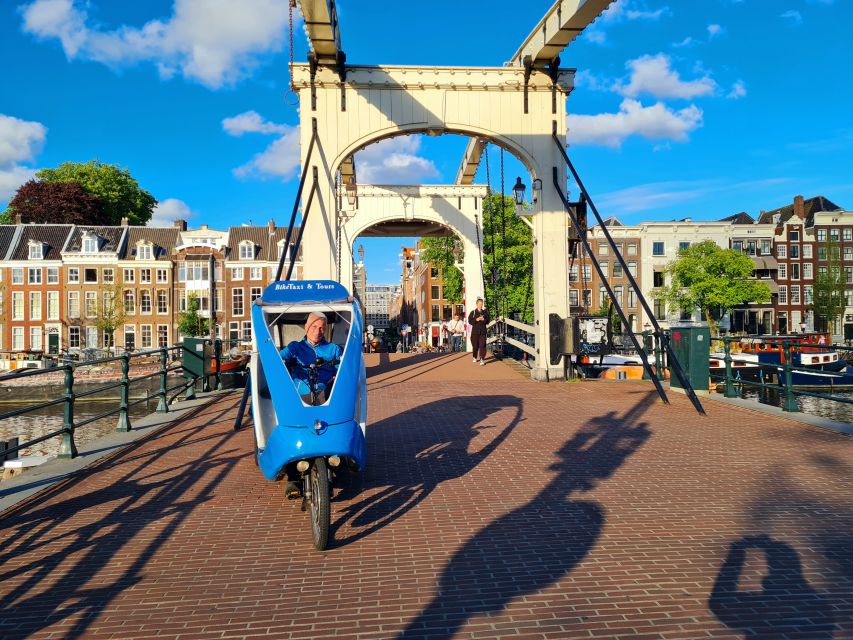
The pedicab then reaches the Amstel River and the Skinny Bridge. The bridge is one of Amsterdam’s best-known views, especially after dark when hundreds of light bulbs outline its narrow design. During the daytime tour, the main attraction is the broad panorama over the canalized Amstel.
The Amstel is the city’s main and widest canal, and this is one of the clearest places to understand its scale. The water, bridge, and surrounding buildings create a fine picture stop. Ask to pause for photographs if you want more than a passing view. The route includes stops, but you should speak up if you want to get out briefly for a picture.
The 17th-century canal ring, read from a pedicab
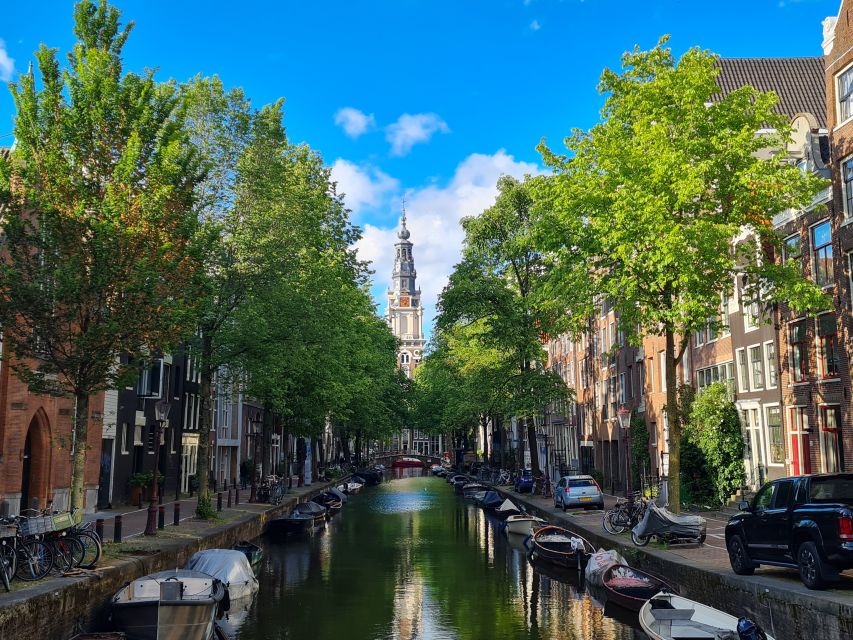
The canal district is the visual centerpiece. On a map, its canals form broad half circles around the old centre. In person, the pattern becomes easier to grasp from a pedicab because you move through several sections rather than seeing only one postcard view.
Many of the canal houses were once homes of successful merchants. Their narrow fronts, tall windows, and varied details reflect the city’s commercial past. No two houses are exactly alike, yet repeated features reveal when and why they were built.
A guide can point out those similarities while you are still looking at them. That is more useful than receiving a list of dates after the ride. You begin to notice how the houses relate to the canals, why their fronts differ, and how a district built centuries ago remains part of daily city life.
The pedicab also has a practical edge here. Some central streets are inaccessible to cars, while a pedicab can take you closer to the canal houses. You still share the roads with bikes and other traffic, so this is not a silent or private ride through empty lanes. It is a close-up view of Amsterdam as it functions today.
Rijksmuseum, Van Gogh Museum, and Museumplein
The last major stop is Museumplein, a large 19th-century green square surrounded by the country’s major museums. The Rijksmuseum and Van Gogh Museum are the big names, and the square gives you a useful orientation before you visit either one.
The route passes through the Rijksmuseum tunnel and stops in the middle of Museumplein. That passage is a distinctive part of the experience. You get both a landmark view of the museum and a sense of how the square connects the central districts with the museum area.
This stop is particularly useful if you are deciding how to organize the rest of your stay. You can identify the museums, understand their position, and return later with a clearer plan. The tour does not include museum admission, and two hours is not enough to visit the collections, so treat Museumplein as an orientation and photo stop.
Afterward, you can return to your hotel or choose a different finishing point in advance. That flexibility can save time if you want to continue directly to lunch, a museum visit, or another part of the city.
What the guiding is really like
The strongest part of this experience is the interpretation. Bram de Haan is described as a local native who guides in English, Dutch, or German. His approach combines city history with maps, old photographs, and personal observations.
That mix matters because Amsterdam’s past is layered. A watchtower can sit beside houseboats, a synagogue can face a modern street, and a merchant’s canal house can still serve as a working building. Names and dates alone do not explain those contrasts.
The guiding also appears well suited to first-time visitors. You can ask questions, request photo pauses, and focus more time on neighborhoods that interest you. One useful detail from the feedback is that Bram accommodated an extended three-hour tour, though you should confirm availability and any added cost before relying on that option.
The tone is personal rather than purely scripted. That makes the ride feel more like an introduction from someone who cares about Amsterdam than a fast checklist of sights.
Comfort, weather, and mobility
The pedicab is a good option for people who cannot manage a long walking tour. Several recent bookings came from seniors or people with limited walking ability, and the seated format allowed them to see the centre without covering every street on foot.
Still, do not treat it as a fully accessible vehicle without checking your needs. The stated limit is 200 kilograms combined, and anyone over 100 kilograms is not suitable for the activity. The information provided does not specify wheelchair storage, step-free boarding, or transfer assistance.
Amsterdam weather can change quickly, so bring warm clothing. A blanket is available in cold weather, and it helped keep riders comfortable during a cool, rainy outing. The pedicab is open to the air, so a jacket remains a better plan than relying only on the blanket.
Because the tour lasts two hours, it gives you a broad view without becoming an all-day commitment. You will sit for much of it, but you may want to get out at selected stops. Tell the guide clearly when you want a closer look or a photograph.
Price, group size, and who gets the best value
At $230 for up to two people, this is best judged as a private guide service with transport, not as a simple ride. The cost includes hotel pickup, hotel drop-off, the pedicab, a live guide, historical explanations, and a blanket in cold weather. Food and drinks are not included.
I see the best value for couples who want a relaxed introduction, older visitors, and anyone who prefers not to navigate the centre alone. It can also work well for a short Amsterdam stay, when two hours of focused sightseeing may be more useful than spending half a day finding your way between districts.
The value is weaker if you enjoy long walks, already know Amsterdam well, or mainly want entry to museums. You will not tour the inside of the Royal Palace, synagogues, Hermitage, Rijksmuseum, or Van Gogh Museum during this ride. You are paying for access, orientation, and explanation.
The booking terms add useful flexibility. You can reserve and pay later, and cancellation is free up to 24 hours before the tour for a full refund. Check the available start times when booking, since the standard duration is two hours.
Should you book the Amsterdam pedicab tour?
Book this tour if you want to cover many central districts with little walking, value a private guide, and enjoy history explained through stories, maps, and photographs. It is also a strong choice for a first day in Amsterdam, when you want to get your bearings before choosing which museums and neighborhoods deserve more time.
Think twice if you are above the stated weight limit, want a fully indoor activity, or prefer to spend your sightseeing budget on museum admission. For everyone else, the pedicab offers a comfortable and personal way to connect Amsterdam’s major sights, from Dam Square to Museumplein, with the Amstel and canal ring tying it all together.
FAQ
How long does the Amsterdam private pedicab tour last?
The standard tour lasts two hours. A longer three-hour version has been arranged before, but you should confirm availability and pricing in advance.
How many people can join the private pedicab tour?
The price covers a private group of up to two people. The combined passenger weight must not exceed 200 kilograms.
Where does the tour begin and end?
Hotel pickup and drop-off are included. You should wait outside in front of your hotel, and you can arrange a different finishing location beforehand.
Which languages does the guide speak?
The live guide is available in English, Dutch, and German.
Is the tour suitable for someone with limited walking ability?
The seated pedicab and hotel transportation can make it suitable for people with limited walking ability. However, the experience is not suitable for anyone over 100 kilograms, and the provided information does not specify wheelchair boarding or storage.
What should I bring for the ride?
Bring warm clothing. The pedicab is open to the weather, and a blanket is provided when conditions are cold. Food and drinks are not included.
More Historical Tours
- Amsterdam: Historic City Sightseeing Canal Cruise
★ 4.5 · 444 reviews - Amsterdam: Historical Highlights Walking Tour with Tasting
★ 4.6 · 381 reviews - Anne Frank and the Jewish History of Amsterdam Private Tour
★ 5.0 · 307 reviews - Amsterdam: 3-Course Meal in Historic 1st Class Waiting Rooms
★ 4.5 · 292 reviews
Just added around Amsterdam
- Amsterdam 1-Hour Rickshaw Tour★ 4.9 · 17 reviews
- Amsterdam: Canal Cruise and Jewish Cultural Quarter Tickets★ 4.2 · 17 reviews
- Keukenhof Gardens and Tulip Experience Tour from Amsterdam★ 4.8 · 17 reviews
- Marken, Volendam and Edam: Private Full-Day Tour★ 4.6 · 18 reviews
- Discover Amsterdam’s city center in this Outside Escape game tour★ 4.5 · 18 reviews
- Amsterdam: Personal Travel & Vacation Photographer★ 4.8 · 18 reviews
- Amsterdam: Luxury Saloon Boat Cruise with 3-Course Dinner★ 3.9 · 18 reviews
- Rijksmuseum & Amsterdam City Center Semi-Private Tour 12ppl Max★ 5.0 · 18 reviews
Historical Tours, compared.

Amsterdam Food and Cultural Tour with Tastings
Read our review →
Kinderdijk UNESCO World Heritage Entry Ticket
Read our review →
Hop-on Hop-off Old-Fashioned Heritage Tram Tour
Read our review →

Amsterdam High-End Dutch Food & History Tour – Up to 8 guests
Read our review →
Cruise through the Historic City Center with Guide
Read our review →
Browse the lists this tour appears in