
REVIEW · EINDHOVEN TOURS
Eindhoven: journey to the future
Eindhoven turns industry into imagination. This private walking tour makes the city’s transformation its main subject, linking Philips inventions, modern architecture, design education, and human-centered city planning in about three hours. I like the clear focus on technology and design, and I like that the tour moves beyond postcard sights into the ideas shaping daily life in Eindhoven. The main drawback is the price: at $285.94 per person, it is a serious splurge for a three-hour walk, especially since food, coffee, and museum admission are not included.
You start at Monkey Coffee outside Eindhoven Central Station and finish at the same meeting point. The pace is calm, according to the comments about guide Anna, and the tour is private for your group alone. That makes it a good choice if you want time for questions, though the experience may feel expensive for solo visitors or couples.
In This Review
- Key points before you book
- Starting at Eindhoven Central Station
- Lichttoren and the city’s many meanings of light
- De Blob, modern design, and tomorrow’s technology
- Philips inventions, Einstein, and affordable museum culture
- Hotel Mariënhage and a thirteenth-century foundation
- Design Academy Eindhoven and ideas that challenge convention
- From industrial city to creative center
- The guide makes the difference
- Is $285.94 per person a fair price?
- Timing, meeting point, and practical details
- Who should book Eindhoven: Journey to the Future?
- FAQ
- How long does the Eindhoven future-focused tour last?
- Where does the tour begin?
- Where does the tour end?
- Is the tour private?
- What language is the tour offered in?
- Are food and drinks included?
Key points before you book
- Philips gives Eindhoven its central story: You will connect the city’s old light-bulb industry with its modern technology scene.
- The route mixes old and new: A former abbey, industrial buildings, glass towers, a shopping center, and a design school all appear in the same walk.
- The tour is private and English-speaking: Only your group participates, which allows for a quieter pace and more direct conversation.
- Design is treated as a practical subject: You will hear about public space, sustainability, well-being, solar energy cars, 3D printing, and human-centered planning.
- Anna receives especially warm praise: Her calm manner, broad knowledge, personal stories, and clear explanations are major strengths of the experience.
- The cost needs careful thought: Group discounts may help, but you should compare the fee with the value of personalized guiding rather than expecting a standard city walk.
Starting at Eindhoven Central Station
The tour begins at the square in front of Eindhoven Central Train Station, at Monkey Coffee, Stationsplein 22-13. This is a sensible meeting point because it is easy to reach by train and public transportation, and it puts you immediately in the middle of the city’s modern face.
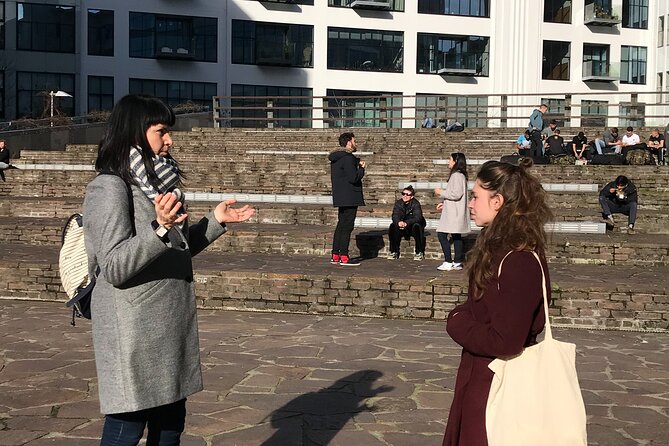
The opening question is not simply what can you see in Eindhoven. It is why people find the city attractive as a place to live. Your guide introduces the idea of human-centered urban planning, asking how streets, buildings, transport, and public spaces can serve people instead of forcing people to adapt to them.
That theme gives the walk more purpose than a basic list of landmarks. I appreciate tours that explain how a city functions, and this one seems designed to make you look at ordinary spaces with fresh eyes. You may spend less time on famous monuments and more time considering how Eindhoven has been planned and reshaped.
The start is also a useful orientation. You get a sense of the city center, its connection to rail travel, and the modern character that will continue through the rest of the walk.
More Eindhoven trips:
- Eindhoven: Motion Experience Light Art Playground Ticket
★ 4.0 · 168 reviews - Eindhoven: PSV Stadium Museum Entry Ticket
★ 4.1 · 101 reviews - Eindhoven: Philips Museum Entry Ticket
★ 4.3 · 95 reviews
Lichttoren and the city’s many meanings of light
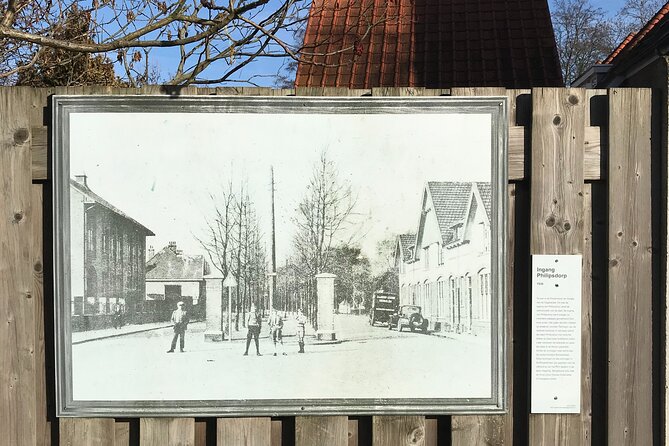
The next stop is Lichttoren, or Light Tower, with about 15 minutes set aside for the visit and discussion. This is where Eindhoven’s connection with Philips comes into sharper focus.
The guide explores why the city is called the city of light. The answer may relate to Philips and bulb production, the Light Tower itself, or the glow visible from space. That playful question reflects the tone of the tour: factual, but not dry.
Lichttoren is important because it represents the industrial force that helped shape Eindhoven. The city’s identity did not come from centuries of royal monuments or grand canals. Its modern growth is closely linked to manufacturing, invention, and the Philips company.
I would pay close attention here if you are interested in how a company can shape an entire city. You will hear about Philips inventions and the people connected with the company, including why Einstein visited Eindhoven. These details help turn industrial buildings into places with a human story.
The stop itself is brief, so do not expect a long architectural study of every building. Its value comes from the explanation that ties the site to the city’s wider development.
De Blob, modern design, and tomorrow’s technology
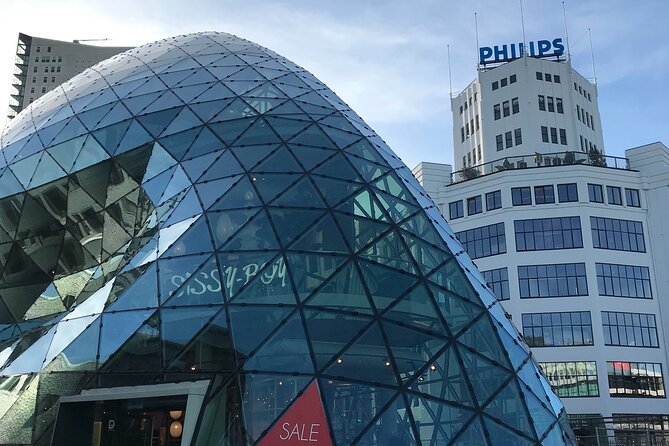
At De Blob, the tour shifts from industrial history to future-facing design. The building is a striking structure of solid and transparent materials, designed by architect Massimiliano Fuksas. It now functions as a shopping center, but its unusual shape gives it a role in Eindhoven’s visual identity.
You will discuss 3D printing, solar energy cars, and the ways technology might affect human life. These subjects could easily become vague or overly futuristic, but the tour’s broader design focus gives them a practical frame. The point is not simply to admire a strange building. It is to ask what kind of city new technology might create.
A previous visitor described the nearby Philips area through its glass and steel towers, including the Admirant, the Lichttoren, and the Witte Dame. That description is useful because it shows how much has changed around the former industrial center. Conference spaces, exhibitions, shopping, and cafés now occupy places once tied to manufacturing.
I like this part because it lets you compare old and new Eindhoven within a short walk. You can see how industrial buildings have gained new uses instead of disappearing entirely. Still, you should know that the discussion may appeal more to people who enjoy architecture, design, and ideas than to anyone seeking traditional sightseeing.
Philips inventions, Einstein, and affordable museum culture
One section of the walk brings together several subjects that help explain Eindhoven’s wider cultural life. You will hear why Einstein visited the city and learn about major Philips inventions.
The tour also explains how people living in the Netherlands can visit museums across the country without spending heavily each time. This includes famous institutions in Amsterdam as well as small local heritage museums. The subject is practical and useful because it shows how culture can be made accessible beyond one famous city.
This part may be especially helpful if you are planning a longer stay in the Netherlands. Eindhoven is well connected by train, and one of the comments about the city points out how easy it can be to use Eindhoven as a base for reaching other Dutch destinations.
I would not expect a detailed museum pass briefing with every current rule, since the available information gives only the general idea. Instead, think of this as context about Dutch access to museums and the country’s cultural habits.
A completely different kind of day out in Eindhoven:
- Eindhoven: Next Nature Museum Entry Ticket
★ 3.9 · 83 reviews - Eindhoven: Bottle Distillery Tour and Tasting Experience
★ 4.9 · 74 reviews - Eindhoven: City Center Walking Tour
★ 4.7 · 43 reviews - Discover the best spots in Eindhoven with Outside Escape
★ 4.5 · 40 reviews
Hotel Mariënhage and a thirteenth-century foundation
Hotel Mariënhage provides one of the route’s strongest changes of mood. The site began as an abbey with origins in the 13th century and has since been adapted into a modern hotel with fine dining.
This is a good example of Eindhoven’s ability to reuse old structures. The tour does not treat the past and the future as enemies. An old religious site can now support hospitality, dining, and contemporary city life while retaining its earlier identity.
The stop is listed at about 15 minutes. That is enough for an introduction and a look at the setting, but not enough for a full architectural tour of the former abbey. If you are fascinated by religious buildings, you may wish you had more time to examine the details.
For me, the appeal lies in the contrast. After hearing about light towers and solar cars, you encounter a place whose origins reach back many centuries. It gives the walk a needed pause and keeps Eindhoven from appearing like a city built only in the last few decades.
Design Academy Eindhoven and ideas that challenge convention
The Design Academy Eindhoven is the longest listed stop, with about 30 minutes devoted to it. The school is famous for encouraging students to work outside traditional frameworks, especially in areas connected with sustainability, well-being, quality of life, public spaces, and environmentally friendly living.
You may hear about graduation projects involving bags made from cow stomachs or the use of plants to create human-compatible organs. These examples are unusual, but they show how design education here can move into biology, materials, health, and ethics.
I consider this one of the tour’s most distinctive stops. Many city walks mention design as a slogan. This visit gives you a sense of what design can mean when it asks difficult questions about waste, health, public life, and the materials people use.
The school’s work may not always be easy to understand at first. That is part of the point. You are not being shown a collection of pretty objects. You are being introduced to proposals that test your assumptions about what a product, building, or public space should do.
Because the tour lasts only about three hours, access inside the academy or to exhibitions is not specified. You should think of this as an exterior stop and guided discussion unless your provider confirms otherwise. The value comes from the explanation, not a guaranteed school tour.
From industrial city to creative center
The final section turns back to Eindhoven’s industrial foundation. You will hear about one of the Netherlands’ influential modern art and design museums and how its creation grew from the passion of a local captain of industry and rivalry with others.
The exact museum is not named in the available details, so I would not book this expecting a museum admission or a scheduled gallery visit. Instead, the guide uses the subject to explain how private ambition, collecting, industry, and competition helped shape Eindhoven’s cultural institutions.
The route then gives proper attention to industrial heritage. If you are willing to walk farther, you can see buildings that have become city icons and consider how former factories and company sites were transformed into places for shopping, design, exhibitions, offices, and public life.
This is where the tour’s central idea comes together. Eindhoven is presented as a city that moved from industrial production toward creative work and design. The change is not shown as a clean break. Old structures remain part of the new city, often with very different uses.
That approach is more interesting than simply calling Eindhoven modern. You see the tension between preserving what made the city and making room for what comes next.
The guide makes the difference
The strongest praise is directed at Anna, whose name also appears as Anya in one comment. She is described as calm, professional, pleasant to talk with, and able to explain both the past and present of Eindhoven in an accessible way.
One particularly positive account describes the walk as intense in content but enjoyable in conversation. Another highlights the calm pace and meaningful explanations. Those details matter because a tour built around design and technology can become dense if the guide rushes from one concept to another.
The guide is also praised for sharing personal stories. That can make an industrial subject feel less like a lecture and more like a conversation while walking through the city.
I would choose this experience if you value discussion and questions. It seems less suited to someone who wants a fast procession of famous sights with only a sentence or two at each stop. The private format should make it easier to adjust the conversation to your interests, though the exact amount of flexibility is not specified.
Is $285.94 per person a fair price?
At $285.94 per person, the tour is expensive for three hours. The price includes a guide, but not snacks, coffee, tea, or stated admission tickets. The listed stops themselves are free to enter, so the main thing you are paying for is private guiding and interpretation.
That can be worthwhile for a small group that wants a tailored introduction to Eindhoven. If several people share the booking and a group discount applies, the cost may become easier to justify. You are paying for a focused conversation about Philips, design, architecture, urban planning, and industrial reuse rather than for entry to attractions.
For one person or a couple, I would think carefully. Eindhoven has many sights you can see on your own, and the walk does not include a meal or museum ticket. The price makes sense only if the guide’s insight and the private format are central to what you want.
A calm pace, fluent English, and the chance to ask questions can matter a great deal in a city whose story is not immediately obvious. If you prefer independent wandering, the price is harder to defend.
Timing, meeting point, and practical details
The experience lasts approximately three hours and is offered in English. You meet at Monkey Coffee, Stationsplein 22-13, 5611 AC Eindhoven, in the square outside the central train station. The walk returns to that same meeting point.
The route includes several 15-minute stops, a 30-minute visit around Design Academy Eindhoven, and a further 30-minute look at industrial heritage. The description also includes additional discussion between stops, so allow the full three hours rather than planning a tight connection immediately afterward.
Wear comfortable shoes. The experience is a city walk, and the final section may include extra walking if you choose to see more industrial buildings. Coffee and snacks are not included, so eat beforehand or plan to buy something separately.
Most people can participate, and the tour is near public transportation. Confirmation arrives when you book. Free cancellation is available if you cancel at least 24 hours before the local start time. Changes or cancellations made later are not accepted for a refund.
Who should book Eindhoven: Journey to the Future?
I would recommend this tour to you if you enjoy architecture, design, technology, urban planning, or industrial transformation. It is also a strong pick if you have already seen the standard Dutch canal cities and want a different side of the Netherlands.
Families with older children, design students, business visitors, and curious first-time visitors may find the subjects especially engaging. The private setup is useful for groups that want to ask questions or keep a relaxed pace.
I would hesitate if you want a museum-heavy experience, a food tour, or a low-cost introduction to Eindhoven. There is no included meal, coffee, or confirmed museum entry, and the price is high for a short walk.
Book it if Anna’s guiding style and the city’s future-focused identity appeal to you. Skip it if you mainly need a quick orientation. For the right audience, this tour explains why Eindhoven feels different from many Dutch cities: its past is industrial, but its questions are aimed at tomorrow.
FAQ
How long does the Eindhoven future-focused tour last?
The tour lasts approximately three hours.
Where does the tour begin?
It begins at Monkey Coffee, Stationsplein 22-13, 5611 AC Eindhoven, Netherlands, in the square outside Eindhoven Central Train Station.
Where does the tour end?
The activity ends back at the meeting point near Eindhoven Central Train Station.
Is the tour private?
Yes. Only your group participates in this private tour or activity.
What language is the tour offered in?
The tour is offered in English.
Are food and drinks included?
No. Snacks, coffee, and tea are not included.
Just added around Eindhoven
- Roermond Self Guided Sherlock Holmes Murder Mystery Game★ 4.5 · 3 reviews
- Eindhoven: Private Guide for a Bike Tour★ 5.0 · 4 reviews
- Comedy Walks© Eindhoven (the comedy walking tour)★ 3.5 · 10 reviews
- Eindhoven: E-Fatbike Tour In The Footsteps of Vincent van Gogh★ 4.0 · 11 reviews
- e-Scavenger hunt Roermond: Explore the city at your own pace★ 4.5 · 16 reviews
- Eindhoven: Wings of Liberation, The WWII Airborne experience★ 4.7 · 20 reviews
- Eindhoven: Strijp-S Industrial Park Guided Walking Tour★ 4.3 · 21 reviews
- Eindhoven: Guided bicycle tour of the Highlights of Eindhoven★ 5.0 · 27 reviews
Eindhoven Tours, compared.
Discover the best spots in Eindhoven with Outside Escape
Read our review →
e-Scavenger hunt Den Bosch: Explore the city at your own pace
Read our review →Browse the lists this tour appears in