
REVIEW · RED LIGHT DISTRICT TOURS
Exclusive small-group Amsterdam Red Light District tour
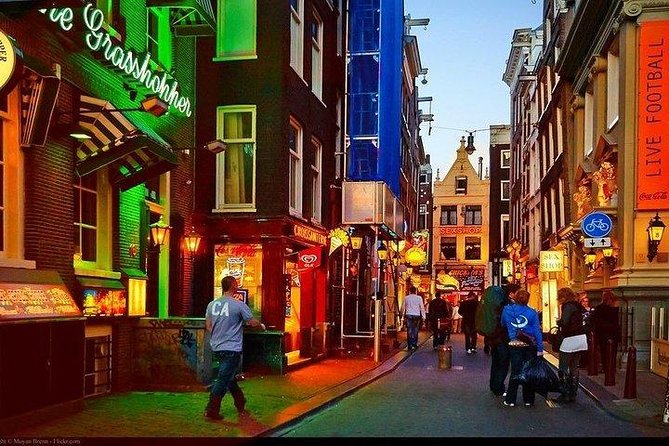
Amsterdam gets more complicated after dark. This two-hour walking tour links De Wallen’s sex work and coffeeshop culture with older sights such as the Waag and Dam Square. I like the local angle, and I like that the route uses small details, including wooden buildings, a tiny former storage house, and a specialist condom shop, rather than treating the district as a sideshow. The main drawback is the group limit of 32, which feels less intimate than the phrase small group suggests.
I also like the practical format: several start times, a central meeting point at Geldersekade 2HS, and a short route that fits neatly into a busy Amsterdam visit. Guides Adam and Aarre have earned especially strong praise for clear explanations, humor, patience with questions, and adapting the walk to a group’s needs. Keep in mind that this is an outdoor walking tour, not a visit inside the windows or a private discussion with sex workers.
In This Review
- Key points at a glance
- What this Amsterdam walk is really about
- Meeting at Geldersekade and entering the Old Town
- Dam Square and the city built on wooden poles
- Int Aepjen, one of Amsterdam’s last wooden buildings
- The Waag and Amsterdam’s old defenses
- The Smallest House and the scale of Amsterdam living
- The condom shop that reflects Amsterdam’s practical side
- How much value do you get for $63.67?
- Who will get the most from this experience?
- Should you book the Amsterdam Red Light District walk?
- FAQ
- How long does the Amsterdam Red Light District tour last?
- Where does the tour start and finish?
- What will I see on the tour?
- Does the tour discuss coffeeshop culture and sex work?
- How many people can join the tour?
- Can I cancel for a full refund?
Key points at a glance
- Two hours through De Wallen and Old Town: A compact way to understand Amsterdam’s best-known district without giving up half a day.
- Local perspective on sex work and coffeeshops: The guide explains how these industries fit into Amsterdam’s past and present.
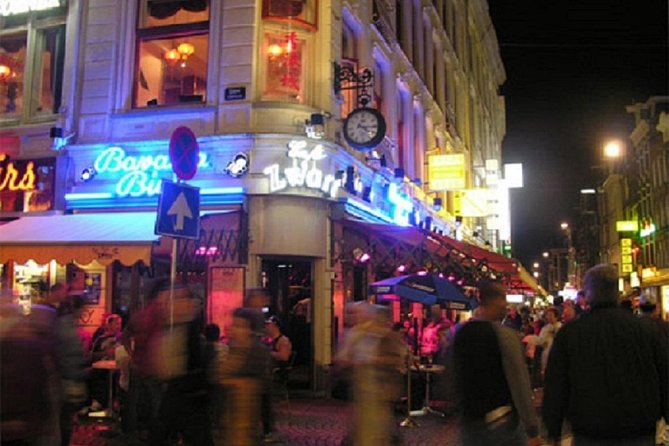
- More than red-lit windows: The walk includes the Waag, Int Aepjen, Dam Square, the Smallest House, and a historic condom shop.
- Strong guide feedback: Adam is praised for humor and clear facts, while Aarre is praised for being accommodating and tailoring the route.
- Maximum group of 32: The size is capped, but I would not expect the quiet, personal feel of a six-person walk.
- $63.67 per person: A fair price if you value context and questions, but less attractive if you only want a quick look around.
What this Amsterdam walk is really about
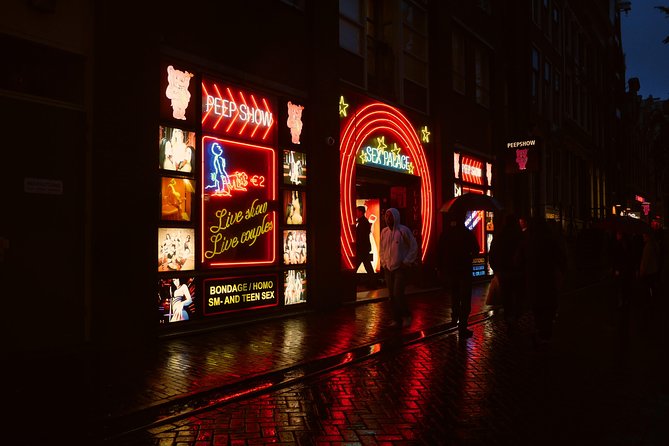
De Wallen is easy to misunderstand. A quick pass through its narrow lanes can leave you with little more than bright window lights, crowds, and a few half-remembered myths. This tour gives you a guide to explain how the Red Light District developed within Amsterdam’s oldest quarter.
That setting matters. The area is part of the Old Town, not a separate attraction built only for modern nightlife. Its streets grew alongside the city’s trade, waterways, churches, defensive works, homes, taverns, and commercial life. The result is a neighborhood where centuries-old buildings sit close to businesses that draw international attention today.
I like that the experience connects the famous subject with ordinary city details. You hear about sex work and coffeeshop culture, but you also hear why buildings needed wooden foundation piles and why one old pub is unusually important. That mix gives you a better sense of Amsterdam as a working city rather than a collection of postcard scenes.
The tone will depend partly on your guide. Adam is singled out for being entertaining as well as informed, and Aarre is praised for answering questions and adjusting the tour to meet the group’s needs. Those comments point to the most important feature here: the quality of the explanation. The streets are free to enter on your own. You are paying for someone to make sense of them.
More Red Light District walks:
- Amsterdam: Red Light Secrets Museum Entry Ticket
★ 4.2 · 5,722 reviews - Amsterdam: Red Light District Tour in German/English/Italian
★ 4.9 · 5,623 reviews - Amsterdam Red Light District & Coffee Shop Tour
★ 4.6 · 4,134 reviews
Meeting at Geldersekade and entering the Old Town
The walk begins at Geldersekade 2HS, 1012 BH Amsterdam, and ends back at the same meeting point. That simple out-and-back arrangement makes the tour easy to fit before dinner, after a museum visit, or between other plans.
You should arrive ready to walk through narrow streets and busy public areas. The experience is not recommended for people with limited mobility, so consider the physical demands before booking. Service animals are allowed, and the meeting point is near public transportation.
The first major subject is the Red Light District itself. Your guide introduces the narrow lanes and explains the local context of coffeeshops and sex work. The point is not simply to identify what you are seeing, but to separate Amsterdam’s actual policies and traditions from the exaggerated stories often attached to the neighborhood.
That distinction is useful. A guide can explain the area without turning it into a morality play or a cheap joke. The best part of this format is the chance to ask questions. One strong comment about the tour specifically praises the number of opportunities to ask questions, which is exactly what you want in a subject full of confusion.
You should also bring a respectful attitude. De Wallen is a real neighborhood and a workplace for people, not just a backdrop for photographs. The tour information does not promise access to workers or private spaces, so expect public streets, exterior views, and explanation from the guide.
Dam Square and the city built on wooden poles
The route includes the Dam, one of Amsterdam’s central public spaces, and uses it to explain a basic fact about the city: much of Amsterdam is built on difficult ground.
The soil contains thick layers of fen and clay. To support buildings, builders drove wooden poles through the soft ground until they reached a firmer sandy layer about 11 meters below. This is not a minor engineering footnote. It helps explain why Amsterdam’s buildings look the way they do and why foundation work has always mattered so much here.
I appreciate this stop because it changes how you look at the city. Instead of seeing leaning facades and narrow houses as purely charming, you begin to notice the practical problem beneath them. Amsterdam’s appearance is tied to water, soft soil, trade, and clever construction.
The Dam also helps place De Wallen within the larger Old Town. You are not just being taken from one nightlife point to another. The guide uses central Amsterdam to show how the district grew as part of the city’s oldest core.
The supplied details do not promise a long stop at every location, so you should expect a moving walking tour rather than a series of extended visits. If you want museum-style depth at each building, this will feel brisk. If you want useful context in a short amount of time, the pace should work well.
Int Aepjen, one of Amsterdam’s last wooden buildings
Pub The Ape, known in Dutch as Int Aepjen, is one of the more memorable stops. The building dates to around 1540 and is one of only two remaining wooden buildings in Amsterdam.
That survival is especially striking because a major fire in 1452 led the government to require brick facades after the disaster. Int Aepjen therefore offers a quick lesson in building rules, fire, and preservation. You are looking at an old pub, but the story is really about how Amsterdam changed its building practices.
This is the kind of stop I value on a walking tour. It takes only a few minutes to point out, yet it gives you a reason to pay attention to a building you might otherwise pass. The connection between a tavern, a city fire, and new construction rules is more memorable than a list of dates.
The name and history also add a bit of character to the route. De Wallen can seem visually repetitive if you only focus on the red-lit windows. A surviving wooden pub gives the walk another layer, showing that the neighborhood contains old commercial buildings as well as modern adult businesses.
You should not assume the tour includes a drink or an interior visit. The information provided identifies Int Aepjen as a stop, but it does not promise admission, food, or time inside. Treat it as an exterior landmark and a story point unless your guide says otherwise.
A few more trips of this kind worth comparing:
- Amsterdam: Van Gogh Museum Ticket
★ 4.7 · 52,054 reviews - Amsterdam Classic Saloon Boat Cruise with Drinks and Cheese
★ 5.0 · 31,825 reviews - Amsterdam Luxury Canal Cruise + Unlimited Drinks & Bites option
★ 5.0 · 30,518 reviews - Amsterdam: Heineken Experience Ticket
★ 4.6 · 30,055 reviews
The Waag and Amsterdam’s old defenses
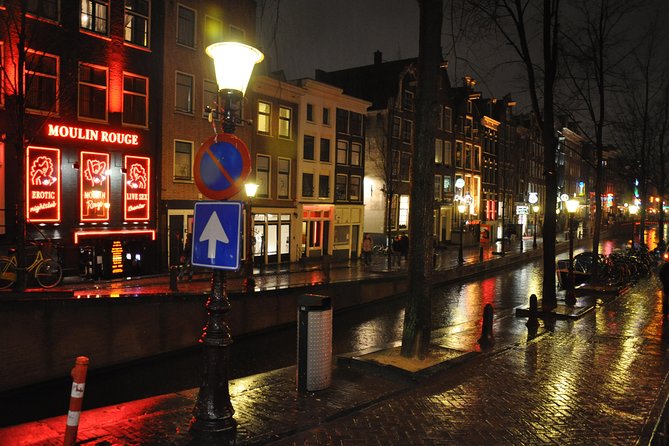
The Waag is another important change of pace. Built around the 1400s, it originally served as one of Amsterdam’s city gates and formed part of the defensive wall. It is also described as the second-oldest building in Amsterdam.
Later, the building housed guilds, the organizations that represented craftspeople and trades. Its position near the square made it part of the city’s public and working life, not merely a monument left behind after the city grew.
For you, the value of this stop is scale. The Red Light District can seem like a self-contained zone, but the Waag shows that it grew inside a fortified medieval city. The same streets that now draw people for nightlife once supported defense, trade, and regulated crafts.
This is also where the tour’s broader approach pays off. You get a clearer picture of why the Old Town has so many layers packed together. The route treats De Wallen as an urban district with a long life, not a theme park devoted to one subject.
Again, the tour is short. The guide will likely explain the building from the street rather than provide an extended architectural lecture. If you enjoy short, well-chosen stories, that is a strength. If your main interest is detailed medieval architecture, you may want a separate Old Town walk.
The Smallest House and the scale of Amsterdam living
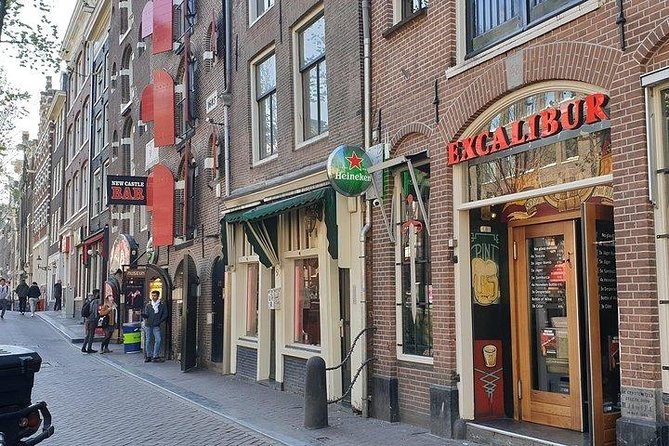
The Smallest House dates to around the 1700s and was first used as a storage place for the Dutch East India Company, often called the VOC. Later, people lived there for a long time.
Its appeal is immediate. In a city known for narrow canal houses and limited space, a tiny building makes the pressures of urban life visible. The stop also ties the neighborhood to Amsterdam’s trading past without requiring a long museum visit.
I like the way this detail gives the tour a human scale. You move from city defenses and construction methods to a building that raises a simple question: how did people actually use such a small space? The answer, even in brief form, helps you understand how valuable urban land was.
The available information does not give the house’s exact dimensions or promise entry. You should expect to see the building and hear its story, not tour a furnished interior. That is fine for a two-hour route, but it is worth knowing if you are hoping for a full house visit.
The condom shop that reflects Amsterdam’s practical side
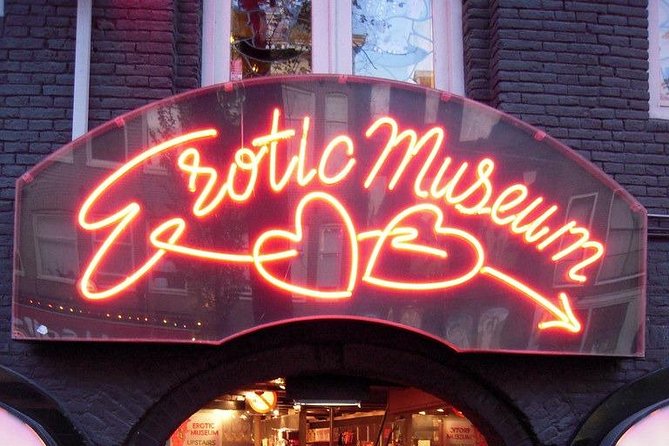
The route also passes what is described as the world’s first shop devoted specifically to condoms. It has been in place since 1987 and offers custom-sized condoms along with novelty options.
This stop fits the subject of the district, but it also shows Amsterdam’s practical, matter-of-fact approach to sexual health and adult commerce. The shop is not presented simply as a joke. Its place on the route helps explain how the city’s public attitude toward sex has been expressed through ordinary retail.
The stop may be one of the tour’s lighter moments, especially for groups comfortable with adult humor. At the same time, the tone will not suit every family or every visitor. This is clearly not a general sightseeing walk for young children, and you should be comfortable discussing sex work, condoms, and coffeeshops in an open public setting.
The information does not state that the tour includes shopping or a purchase. Consider it a landmark and discussion point. If you are looking for practical sexual health services, this experience does not promise that kind of consultation.
How much value do you get for $63.67?
At $63.67 per person, this is not a bargain basement stroll. The value depends on what you want from the Red Light District.
If you only plan to walk through De Wallen, look at the architecture, and take in the atmosphere, you can do that without paying for a guide. In that case, the price may feel high for two hours.
I see better value if you want interpretation. The fee pays for a local guide, a structured route, the background behind several easy-to-miss buildings, and time for questions. Adam’s humor and facts, along with Aarre’s willingness to adapt the tour, are exactly the qualities that can make a paid walk worthwhile.
The tour is also useful if you have limited time. Two hours is long enough to add context but short enough to fit into a packed Amsterdam schedule. Multiple start times make planning easier, although the exact options are not specified here.
The group limit is 32 people. That is a firm cap, but I would be careful about expecting a truly intimate small-group experience. In a narrow district, a group of that size can affect how easily you hear the guide and how personal the conversation feels. The strongest praise centers on questions and customization, so ask about that when you meet your guide, but do not assume a private tour.
Group discounts are available, which may improve the price for people booking together. Free cancellation is allowed up to 24 hours before the start time. Changes or cancellations inside that window are not accepted for a refund.
Who will get the most from this experience?
I would choose this walk if you want a frank introduction to De Wallen without spending a full day on the subject. It suits first-time visitors who want the basic story, couples and friends who are comfortable with adult topics, and anyone who prefers local explanation to wandering without context.
It is also a good fit for people who enjoy small architectural details. Int Aepjen, the Waag, the Smallest House, and the foundation-pole story give the tour more range than a simple nightlife circuit.
I would hesitate if you dislike crowded walking groups, need a highly accessible route, or want private, in-depth discussion. The maximum of 32 people and the mobility warning are important. I would also skip it if you want to enter the windows, meet sex workers, or receive access to places not open to the public. Nothing in the experience promises those things.
Should you book the Amsterdam Red Light District walk?
Book it if you want context, local stories, and a compact route through Amsterdam’s oldest quarter. The strongest reason to go is not the novelty of seeing De Wallen. It is the chance to understand how sex work and coffeeshops sit beside medieval defenses, old pubs, tiny houses, and modern commerce.
The $63.67 price is reasonable when the guide is engaging and open to questions, qualities associated with Adam and Aarre. It is less compelling for independent walkers who are happy to see the district on their own.
My practical advice is simple: reserve ahead, since this experience is commonly booked about 37 days in advance, and leave enough time to find Geldersekade 2HS. Choose it for explanation rather than spectacle, arrive ready to walk, and keep your expectations realistic about group size. For a short, frank introduction to De Wallen, it earns a place in an Amsterdam plan.
FAQ
How long does the Amsterdam Red Light District tour last?
The walking tour lasts approximately two hours.
Where does the tour start and finish?
It starts at Geldersekade 2HS, 1012 BH Amsterdam, Netherlands, and ends back at the same meeting point.
What will I see on the tour?
The route covers Amsterdam’s Red Light District and Old Town, with stops or discussion involving the Dam, Int Aepjen pub, the Waag, the Smallest House, and a condom shop established in 1987.
Does the tour discuss coffeeshop culture and sex work?
Yes. The guide explains Amsterdam’s coffeeshop culture and sex work industry from a local perspective.
How many people can join the tour?
The activity has a maximum of 32 participants. Group discounts are available.
Can I cancel for a full refund?
Yes. You can cancel at least 24 hours before the local start time for a full refund. Cancellations or changes made less than 24 hours before the start time are not refunded or accepted.
Just added around Amsterdam
- Amsterdam City Center Guided Walking Tour – 12 guests 2,5h★ 5.0 · 3 reviews
- Amsterdam Light Festival Boat Cruise★ 5.0 · 3 reviews
- Daytrip Tour from Amsterdam to Zaanse Schans and Giethoorn★ 5.0 · 3 reviews
- Amsterdam: Roller Dreams & Amsterdam Nightlife Experience★ 3.7 · 3 reviews
- Amsterdam: Van Gogh Museum Entrance and Guided Tour★ 3.5 · 3 reviews
- Amsterdam: Red light tour in German/English for groups of 4 people or more★ 5.0 · 3 reviews
- 2 Hour Making Rembrandt’s Traditional Oil Paints in Amsterdam★ 5.0 · 3 reviews
- Amsterdam Red Light District and Old Town Walking Tour★ 5.0 · 3 reviews
Red Light District Tours, compared.

Red Light District Tour in German/English/Italian
Read our review →
Amsterdam Red Light District & Coffee Shop Tour
Read our review →
Red Light District Pub Crawl with Unlimited Shots
Read our review →
Private Amsterdam Red Light District and Coffee Shop Tour
Read our review →Browse the lists this tour appears in