
REVIEW · HISTORICAL TOURS
History & culture tour in Amsterdam with a local
Amsterdam’s past is hiding in plain sight. This two-hour walking tour connects the city’s main historical clues, from a fishing village at Beursplein to the canals, courtyards, guild halls, and streets around Centraal Station. I like the clear focus on Amsterdam’s origins and culture, and I like that the walk includes a classic Dutch stroopwafel. The small group, limited to 15 people, also gives the outing a more personal feel than a large city tour.
I especially like this as a first-day activity because it gives you a working map of central Amsterdam while explaining how the city developed. Guide Manouk has been praised for friendly, thoughtful tours that can be adjusted to suit the group. The main consideration is pace: you walk between seven stops for two to two and a half hours, so this is not the best choice if you want long visits inside buildings or a slow, seated experience.
In This Review
- Key points to know before you book
- Why this walk works well on your first day
- Beursplein: from fishing village to world economy
- Dam Square: power, memory, and the Royal Palace
- Begijnhof: a quiet courtyard with a complicated past
- The house on three canals and the bicycle bridge
- Nieuwmarkt: the Waag, guilds, and leaning houses
- Zeedijk: Amsterdam Chinatown and a changing street
- Centraal Station: a grand finish with a wider view
- What the $30.07 price really buys you
- Pace, group size, and practical comfort
- Who will get the most from this Amsterdam walk
- Should you book this history and culture tour?
- FAQ
- How long does the tour last?
- Where does the tour start?
- Where does the activity end?
- Is the tour offered in English?
- How many people can join the tour?
- What is the price per person?
- Can I cancel for a full refund?
Key points to know before you book
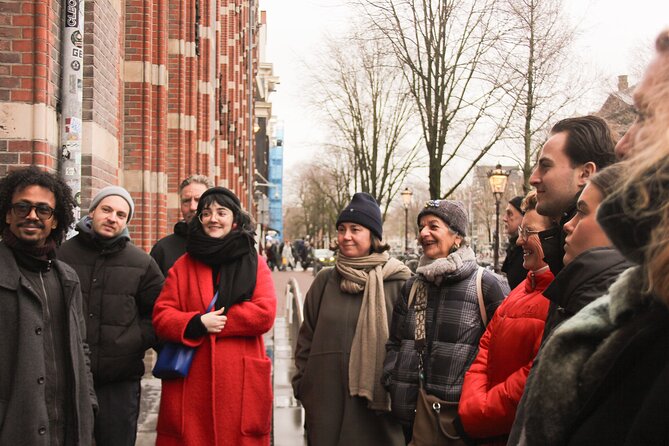
- Amsterdam’s story unfolds across seven central stops, including Beursplein, Dam Square, Begijnhof, Nieuwmarkt, Zeedijk, and Centraal Station.
- A stroopwafel adds a small Dutch treat to a tour built mainly around stories, streets, and public spaces.
- The group is capped at 15 people, a useful limit for hearing the guide and asking questions.
- The walk suits history lovers and first-day visitors, especially if you want context before exploring on your own.
- The price is $30.07 per person, reasonable for a two-hour English-language walking tour with a local guide.
- Free cancellation is available up to 24 hours ahead, giving you some flexibility when planning your Amsterdam days.
Why this walk works well on your first day
I see the main value here in the connections. Amsterdam can look like a pretty collection of canals and narrow houses, but the city makes more sense once you understand how water, trade, religion, transport, and civic power shaped it. This tour links those subjects in a compact route.
You are not simply ticking off monuments. At Beursplein, you hear how a fishing settlement grew into a center of global commerce during the 17th century. At Begijnhof, the focus shifts to religious life and Amsterdam’s tradition of tolerance. Later, at Nieuwmarkt and Zeedijk, the guide brings in guilds, immigration, crime, and urban change.
The tour is offered in English, and the small group size should help if you want to ask about something you notice along the way. A maximum of 15 people is not the same as a private tour, but it is far more manageable than a large crowd gathered around a guide in a busy square.
Manouk receives especially warm praise for making tours informative while still personal. One description highlights her ability to tailor the outing, explain both Amsterdam’s past and present, and finish with a thoughtful treat. Another calls her friendly and able to adjust the tour to suit the group. That flexibility matters if you have a particular interest in architecture, wartime history, religious life, or daily Amsterdam culture.
More Historical Tours in Amsterdam
- Amsterdam Food and Cultural Tour with Tastings
★ 5.0 · 2,442 reviews - Amsterdam: Haunted History and Ghost Walking Tour
★ 4.5 · 488 reviews - Amsterdam High-End Dutch Food & History Tour – Up to 8 guests
★ 5.0 · 482 reviews
Beursplein: from fishing village to world economy
The tour begins at Beursplein, a central square near the old commercial heart of Amsterdam. This is where the guide introduces the basic question behind the whole city: how did a small settlement become an international economic power?
You learn about the origins of Amsterdam and how the city got its name. The story then moves toward the 17th century, when Amsterdam became a major center of global trade and finance. I like starting here because it gives the rest of the walk a useful frame. The grand buildings and busy streets around the center are easier to understand when you know that commerce helped drive the city’s growth.
The stop lasts about 10 minutes and has no admission charge. It is an outdoor introduction, not a museum visit, so the value comes from the guide’s explanation and the setting around you. If you enjoy economic history, city planning, or the way trade shapes urban life, pay close attention at this first stop.
Dam Square: power, memory, and the Royal Palace
From Beursplein, the tour continues to Dam Square, one of Amsterdam’s most recognizable public spaces. The guide explains the square’s role in the formation of the city and points out the Royal Palace on the Dam.
This stop also brings in the Second World War. That gives the square a more serious layer than its present-day crowds and street activity suggest. Amsterdam’s central spaces have not only been used for ceremonies and royal display, but also shaped by national memory and wartime experience.
You spend about 10 minutes here, again without entering a paid attraction. That is worth noting if you are hoping to tour the Royal Palace itself. The walk offers context from outside, but it does not include an interior visit or admission ticket.
Begijnhof: a quiet courtyard with a complicated past
Begijnhof is likely to feel like the sharpest change of mood during the walk. After the open public spaces, you enter a serene courtyard associated with religious history. The guide explains who lived here and what the site reveals about Amsterdam’s approach to religious difference.
The courtyard also contains one of Amsterdam’s oldest houses, one of two surviving wooden cottages. That detail gives the stop a strong visual anchor. You are not just hearing about old Amsterdam in the abstract. You are looking at a surviving piece of the city’s domestic past.
The stop lasts about 15 minutes, making it the longest scheduled pause. I consider that useful because Begijnhof needs a little time. Its quiet character can be lost if you only rush through for a photograph. At the same time, remember that this is a shared courtyard, so respectful behavior and a calm voice are appropriate.
For me, the strongest idea here is tolerance. Amsterdam’s reputation for openness did not appear from nowhere, and Begijnhof gives the guide a place to explain how religion and civic life interacted over time. The story is more useful than simply calling the courtyard pretty.
More historical tours:
- Amsterdam: Historic City Sightseeing Canal Cruise
★ 4.5 · 444 reviews - Amsterdam: Historical Highlights Walking Tour with Tasting
★ 4.6 · 381 reviews - Anne Frank and the Jewish History of Amsterdam Private Tour
★ 5.0 · 307 reviews - Amsterdam: 3-Course Meal in Historic 1st Class Waiting Rooms
★ 4.5 · 292 reviews
The house on three canals and the bicycle bridge
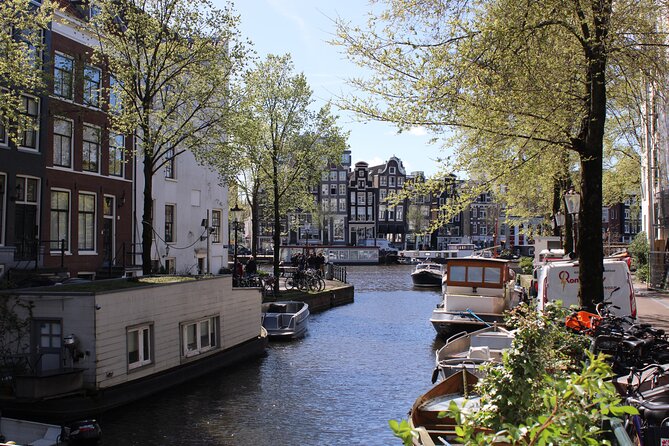
The next stop focuses on a house positioned on three canals and a feature known as the bicycle bridge. It lasts about 10 minutes and offers a close look at the practical oddities that make Amsterdam’s central streets so memorable.
This is the kind of short stop that works best when you let the guide point out details you might otherwise walk past. Canal houses can appear similar at first glance, but their location, shape, and relationship to the water reveal how tightly the city was built around canals and narrow plots.
The bicycle bridge adds a distinctly modern Amsterdam note to the historical route. The tour does not treat the city as a museum frozen in the past. Instead, it links older buildings with the ways residents move through the city today.
Because the stop is brief, you should not expect a long architectural lecture or an extended photo break. Think of it as a visual example that supports the larger story about canals, buildings, and everyday urban life.
Nieuwmarkt: the Waag, guilds, and leaning houses
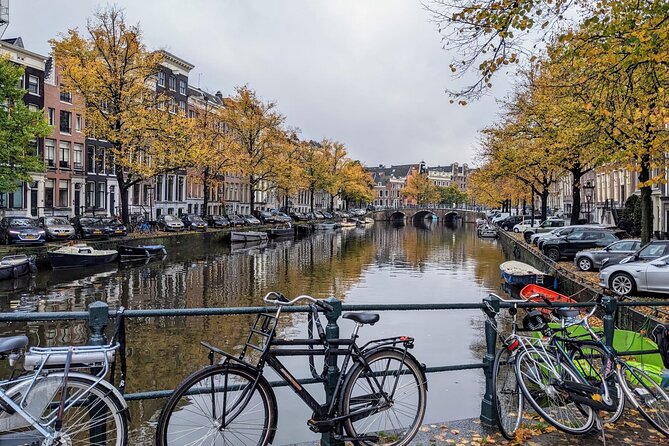
At Nieuwmarkt, the guide turns to the Waag, one of Amsterdam’s old city gates. The building later became a guild hall, so this stop opens a window onto the organized trades that helped run the city.
Guilds may sound like a dry subject, but they explain a lot about working life, business rules, and social power in historic Amsterdam. The Waag gives the discussion a physical focus, while the surrounding square helps you picture how commerce and civic control operated in earlier centuries.
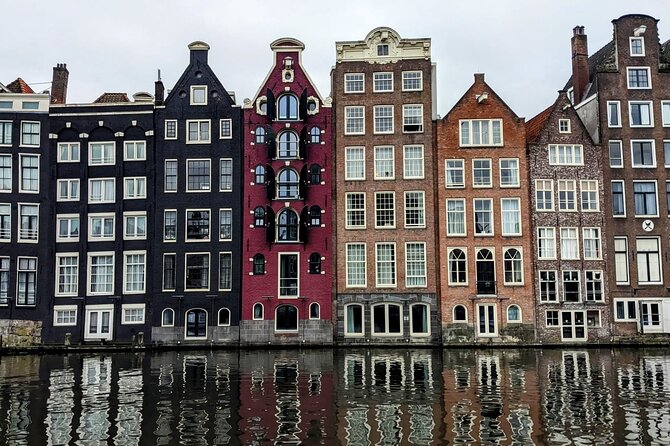
You also see Amsterdam’s famous dancing houses. Their tilted façades are one of the city’s familiar sights, but the tour gives them a place within the wider story of Amsterdam’s narrow buildings and shifting ground. This is a good moment to look up rather than only at street level.
Nieuwmarkt is another 10-minute stop. It gives you a compact mix of architecture, business history, and urban character. If you are taking photographs, this part of the route should provide several useful details, but the guide’s explanation is what turns a collection of old buildings into a coherent story.
Zeedijk: Amsterdam Chinatown and a changing street
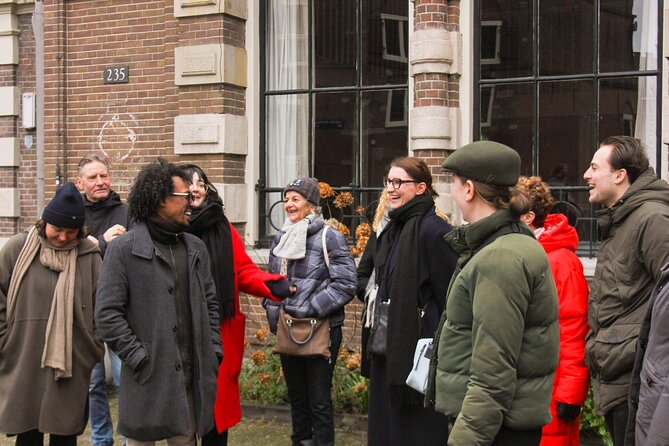
Zeedijk brings the tour into a different part of Amsterdam’s social history. Here, you explore Chinatown and learn how the street changed from one of the city’s most dangerous places during the 1970s into a favorite spot for many people who live in Amsterdam.
That change is important. It shows that city history is not only about royal buildings, famous dates, or the 17th century. Neighborhoods shift as populations, businesses, public safety, and local habits change. Zeedijk lets the guide discuss decline and renewal in a direct, street-level way.
I like this stop because it keeps the tour from becoming too polished. Amsterdam has attractive canals and grand civic spaces, but its identity also comes from ordinary streets that have gone through hard periods and adapted.
The scheduled visit lasts about 10 minutes. You will not get a full study of Amsterdam’s Chinatown in that time, but you will receive a useful introduction to the area and its changing role in city life.
Centraal Station: a grand finish with a wider view
The final named stop is Centraal Station, one of Amsterdam’s most striking buildings. The guide explains its architecture and why this location has served as a transportation center for centuries.
The station is more than a place where trains arrive and leave. Its position connects Amsterdam with other places and reflects the city’s long relationship with trade, movement, and prosperity. Ending near such an important transport hub brings the earlier stories together: fishing, commerce, canals, guilds, migration, and modern connection.
The stop lasts about 10 minutes. The activity is listed as ending back at the meeting point, while Centraal Station is the final named sight on the route, so you should confirm the exact end position and walking direction when you meet the guide. The central location is useful for continuing your day, but the stated meeting point is Beursplein.
What the $30.07 price really buys you
At $30.07 per person, this is not the cheapest way to wander Amsterdam, since the stops themselves have no admission charge. You are paying for the guide’s organization, local explanation, route planning, and ability to connect details that would otherwise pass unnoticed.
I think the price is fair if you want a strong introduction rather than a list of landmarks. A two-hour guided walk can save you from spending your first day looking at buildings without knowing why they matter. It also gives you a base for later exploring on your own.
The value depends on how you like to sightsee. If you prefer museums, long interior visits, or independent wandering with an audio guide, you may find the outdoor format limited. If you want human explanation, a manageable group, and a focused history lesson while walking through the city, the cost is easier to justify.
The included stroopwafel is a pleasant extra, but it should not be the reason you book. The real product is the conversation and the route.
Pace, group size, and practical comfort
The experience is described as lasting roughly two to two and a half hours. You spend part of that time at the seven named stops and the rest walking between them while the guide discusses related subjects.
Wear shoes you can walk in comfortably. The tour is near public transportation, begins at Beursplein, and includes several busy central areas. Most people can take part, and service animals are allowed.
The group maximum is 15 people. That is small enough for a guide to keep the group together and respond to questions, while still giving you the social feel of a shared activity. Private tours are also possible based on the experience described by one participant, and Manouk has been praised for shaping the walk around individual interests.
Confirmation arrives at booking, and free cancellation is available if you cancel at least 24 hours before the start time. Changes or cancellations inside that 24-hour window are not accepted for a refund. The cut-off follows Amsterdam local time, so keep that in mind if you are arranging the tour from another time zone.
Who will get the most from this Amsterdam walk
I would choose this tour for a first visit, especially if you want to understand the city before filling your days with museums and canal trips. It is also a good match for anyone who enjoys history but prefers seeing it in streets and buildings rather than reading every detail in a gallery.
You will probably appreciate it most if you enjoy:
- City origins and urban development
- Religious and social history
- Architecture viewed from the street
- Small-group guiding
- A mix of famous sights and less obvious stories
- A gentle introduction to Amsterdam’s neighborhoods
Families and mixed-age groups may also find the variety helpful, though the two-hour walk still requires steady movement. People with limited mobility should consider the walking distance and ask about the route before booking, since the activity is primarily on foot.
Should you book this history and culture tour?
Book it if you want a friendly, English-language introduction to central Amsterdam, with real attention to how the city grew and changed. The strongest reasons are the focused route, the 15-person limit, the range of subjects, and Manouk’s ability to make the experience personal.
Skip it if you mainly want entry to major attractions, long stops at each monument, or a purely architectural tour. You will spend much of the time walking and listening outdoors.
For most first-day visitors, I think the $30.07 price is sensible. You get a compact city orientation, useful historical context, a stroopwafel, and a guide who can help turn Amsterdam’s famous sights into a connected story.
FAQ
How long does the tour last?
The walking tour takes about two to two and a half hours.
Where does the tour start?
It starts at Beursplein, 1012 JW Amsterdam, Netherlands.
Where does the activity end?
The activity ends back at the meeting point.
Is the tour offered in English?
Yes. The tour is offered in English.
How many people can join the tour?
The tour has a maximum group size of 15 people.
What is the price per person?
The price is $30.07 per person.
Can I cancel for a full refund?
Yes. You can cancel at least 24 hours before the start time for a full refund. Cancellations or changes made less than 24 hours before the experience are not accepted for a refund.
Just added around Amsterdam
- Amsterdam City Center Guided Walking Tour – 12 guests 2,5h★ 5.0 · 3 reviews
- Amsterdam Light Festival Boat Cruise★ 5.0 · 3 reviews
- Daytrip Tour from Amsterdam to Zaanse Schans and Giethoorn★ 5.0 · 3 reviews
- Amsterdam: Roller Dreams & Amsterdam Nightlife Experience★ 3.7 · 3 reviews
- Amsterdam: Van Gogh Museum Entrance and Guided Tour★ 3.5 · 3 reviews
- Amsterdam: Red light tour in German/English for groups of 4 people or more★ 5.0 · 3 reviews
- Amsterdam Red Light District and Old Town Walking Tour★ 5.0 · 3 reviews
- 2 Hour Making Rembrandt’s Traditional Oil Paints in Amsterdam★ 5.0 · 3 reviews
Historical Tours, compared.

Amsterdam Food and Cultural Tour with Tastings
Read our review →
Kinderdijk UNESCO World Heritage Entry Ticket
Read our review →
Hop-on Hop-off Old-Fashioned Heritage Tram Tour
Read our review →

Amsterdam High-End Dutch Food & History Tour – Up to 8 guests
Read our review →
Cruise through the Historic City Center with Guide
Read our review →
Browse the lists this tour appears in