
REVIEW · RED LIGHT DISTRICT TOURS
Red Light District Tour – It’s History & It’s Future
Amsterdam after dark tells a different story. This two-hour walk connects the Red Light District with old churches, Chinatown, canals, and the city’s trading past. I like the small group of up to 10 people, which should make it easier to hear the guide and ask questions. I also like the clear focus on respect for sex workers, an essential lesson in this busy part of town.
The 8 p.m. start gives you the district at its most atmospheric, but it also means crowds and distractions can build as the night goes on. The opening history talk may feel a little long before the walking begins, and admission to some sights is not included. Still, the route covers a lot of ground for $60.15, especially if you want context rather than a quick neon-lit stroll.
In This Review
- Key points to know before you go
- Why this Red Light District tour offers more than neon
- Starting at the Weeping Tower at 8 p.m.
- St. Nicholas Basilica and Amsterdam’s seafaring past
- Zeedijk: from troubled street to lively neighborhood
- A quiet pause at He Hua Temple
- Nieuwmarkt and the city’s changing character
- Entering the Red Light District with the right attitude
- The Oude Kerk, an 800-year-old landmark
- The Condomerie and a lighter final stretch
- Finishing at Beurs van Berlage
- Is $60.15 a fair price?
- Who should book this evening walk?
- FAQ
- Where does the tour start?
- What time does the tour begin?
- How long does the tour last?
- Where does the tour end?
- How large is the group?
- What languages are available?
- Are admission tickets included?
- Can I cancel for a full refund?
- Should you book this Red Light District tour?
Key points to know before you go
- A 8 p.m. start reveals the district at night: You see the Red Light District during its active evening hours, not as a quiet daytime street.
- Sander brings the past into focus: His tours are praised for clear storytelling, humor, and a strong grasp of Amsterdam’s development.
- The route goes beyond the windows: You also visit Zeedijk, Nieuwmarkt, Chinatown, the Old Church, and major landmarks near Damrak.
- Respect is part of the lesson: You receive direct guidance about appropriate behavior around sex workers.
- The group is capped at 10: That is a useful size for a crowded central Amsterdam walk.
- The tour finishes near Dam Square: The endpoint at Beurs van Berlage is only about a 10-minute walk from the starting point.
Why this Red Light District tour offers more than neon
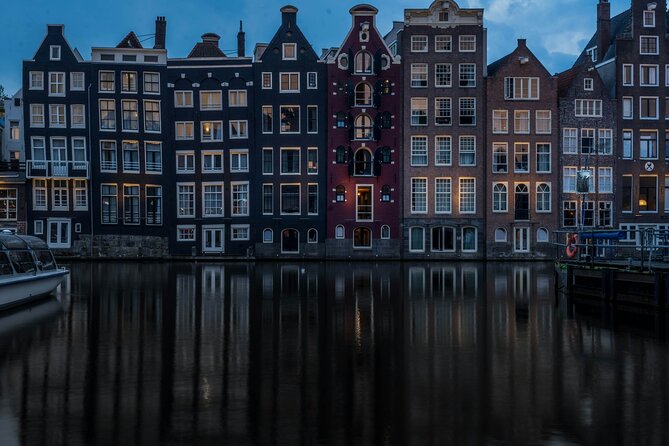
Amsterdam’s Red Light District is easy to misunderstand. A quick walk can leave you with a few photographs, a handful of jokes, and little sense of how the area came to be. This tour takes a broader view, connecting the district with the city’s maritime, religious, commercial, and immigrant past.
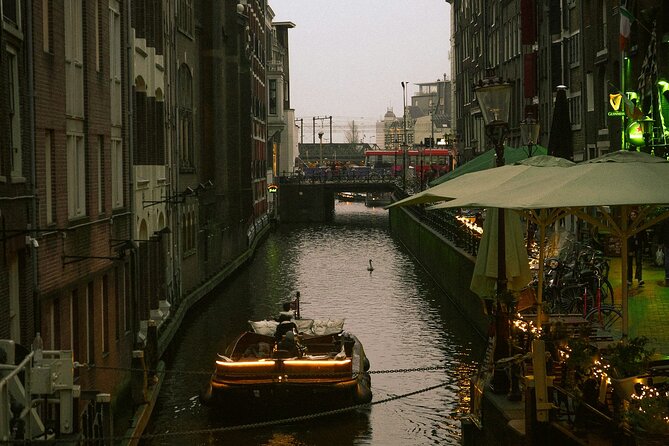
That wider route is the main reason I find the experience useful. You do not simply arrive at the famous windows and hear a string of sensational facts. You begin near the old city edge, pass through Zeedijk and Nieuwmarkt, see a Buddhist temple and Chinatown, then spend focused time in the district itself.
The tone matters here. The best part of a Red Light District walk is not shock value. It is learning how to move through a working neighborhood without treating people or businesses as a spectacle. The guide makes that point clearly, and the advice about respecting sex workers is one of the strongest features of the experience.
The tour is offered in English, with English, Spanish, Italian, and Dutch guide options listed as included. The booking information also identifies English as the offered language, so you should confirm your preferred language when reserving.
More Historical Tours in Amsterdam
- Amsterdam Food and Cultural Tour with Tastings
★ 5.0 · 2,442 reviews - Amsterdam: Haunted History and Ghost Walking Tour
★ 4.5 · 488 reviews - Amsterdam High-End Dutch Food & History Tour – Up to 8 guests
★ 5.0 · 482 reviews
Starting at the Weeping Tower at 8 p.m.
Meet at Café the Schreiertower, at Prins Hendrikkade 95. The location puts you close to Amsterdam Centraal and the old waterfront, though the tour itself does not include a transfer. You should arrive ready to walk and dressed for an evening outdoors.
The first stop is the Weeping Tower, where you spend about 10 minutes. Its name and stories provide a fitting opening for a tour about Amsterdam’s sailors, departures, trade, and uncertain lives. Admission is not included, so the stop is primarily for exterior history and explanation rather than an interior visit.
This is also where the guide sets the tone. Sander, the guide most often singled out in the feedback, is praised for making the background easy to follow and for sharing his enthusiasm without burying you in dates. One practical note: the introduction can take a little time before the group gets moving. If you prefer instant sightseeing, the start may feel slow. If you want the district to make sense, the context pays off later.
St. Nicholas Basilica and Amsterdam’s seafaring past
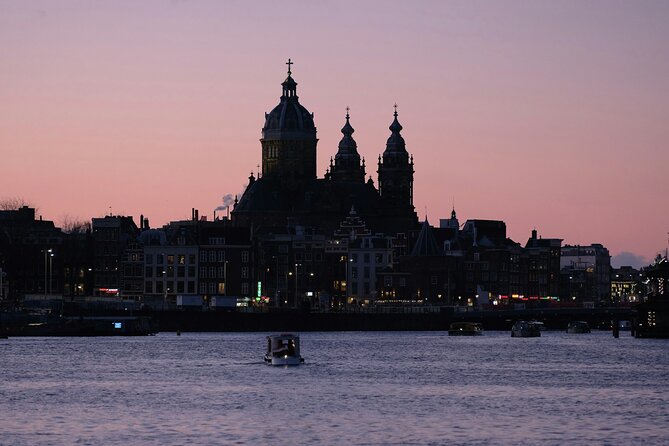
From the tower, the walk continues to St. Nicholas Basilica, a major Catholic church dedicated to the patron saint of seafarers. You spend about 15 minutes here, with free admission listed for the stop.
The basilica helps explain an Amsterdam shaped by water and international trade. Its architecture also gives the tour a useful change of mood before the evening streets become more crowded. You get a moment to look up, take in the building, and consider the religious side of a city often reduced to nightlife and liberal social policy.
The stop is not presented as a long church visit, so do not expect a full guided tour of every chapel or artwork. Think of it as a carefully chosen landmark that anchors the story of the old port.
Zeedijk: from troubled street to lively neighborhood
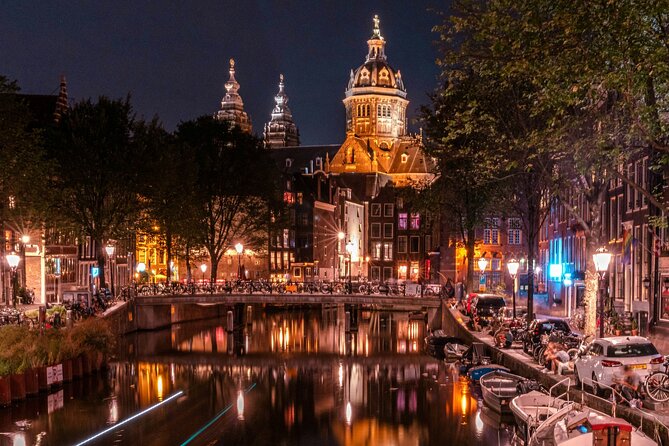
Zeedijk receives about 15 minutes. This historic street has gone through a difficult period, including serious problems during the 1970s, and its later renewal shows how parts of central Amsterdam can change over time.
Today, the street brings together shops, cafés, food, and a mix of cultures. The guide uses Zeedijk to show that the Red Light District does not exist in isolation. Its surrounding streets have their own communities, businesses, and memories.
I like this section because it adds social history to the tour. You are not just collecting landmarks. You are seeing how reputation, neglect, and renewal shape a neighborhood. The drawback is that 15 minutes is enough for an introduction, not a full exploration. If Zeedijk interests you, note the street and return in daylight when you have more time.
More Red Light District walks:
- Amsterdam: Red Light Secrets Museum Entry Ticket
★ 4.2 · 5,722 reviews - Amsterdam: Red Light District Tour in German/English/Italian
★ 4.9 · 5,623 reviews - Amsterdam Red Light District & Coffee Shop Tour
★ 4.6 · 4,134 reviews - Amsterdam: Red Light District Pub Crawl with Unlimited Shots
★ 4.1 · 2,130 reviews
A quiet pause at He Hua Temple
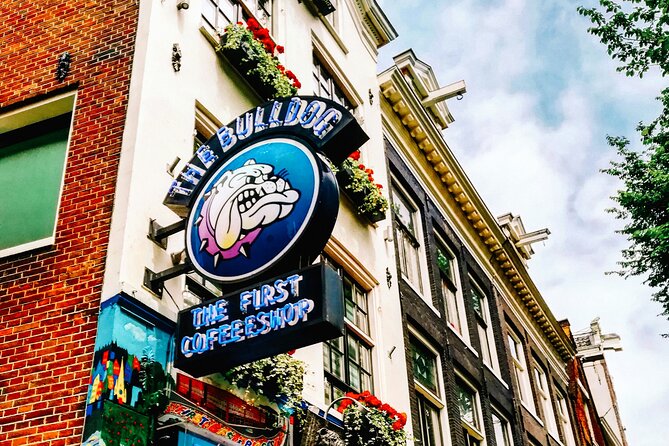
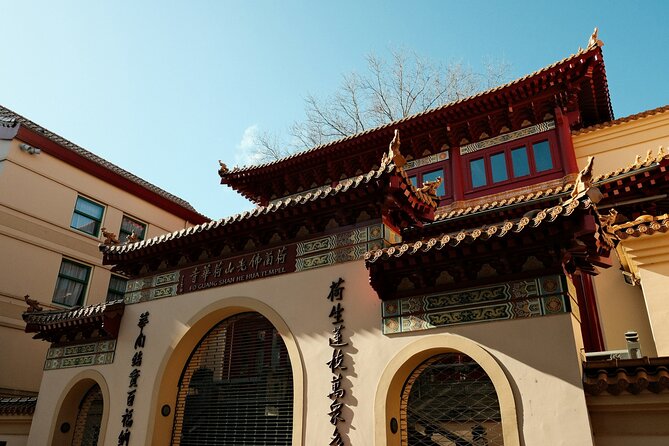
The five-minute stop at Fo Guang Shan He Hua Temple is brief but distinctive. This Buddhist temple offers ornate architecture and a calm setting close to the city center. Admission is not included.
The short visit works as a visual pause in the route. After the maritime stories and the busy streets, the temple introduces another part of Amsterdam’s cultural mix. You may only have time for a quick look and a few comments from the guide, so do not plan on a long religious or architectural visit.
Still, this is exactly the kind of detail that improves the route. Many people come to this part of Amsterdam expecting only bars, windows, and crowds. A temple stop reminds you that the neighborhood contains more than its famous nightlife.
Nieuwmarkt and the city’s changing character
Nieuwmarkt gets about 15 minutes. The square brings together markets, cafés, old buildings, and daily city life. It is another useful bridge between Amsterdam’s past and present.
The tour uses the square to explain how the center has developed beyond its old commercial role. You get a sense of the area’s social rhythm before entering the Red Light District proper. This makes the main section feel less like an isolated attraction and more like one part of a larger central neighborhood.
There is no admission charge for the stop. Because the route is outdoors, the experience depends on the evening atmosphere and the group’s pace. On a busy night, you may hear plenty of street noise, so stay close to the guide, especially in narrow passages and crowded areas.
Entering the Red Light District with the right attitude
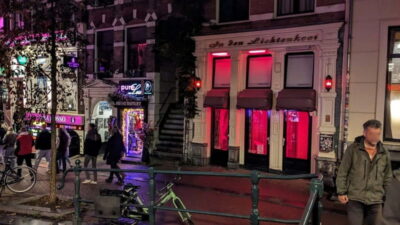
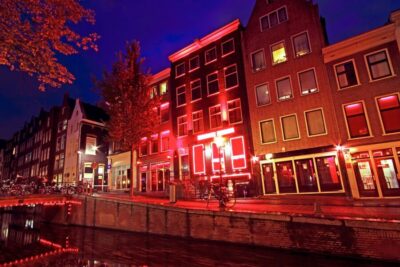
The main Red Light District section lasts about 30 minutes. That is the longest single stop, and rightly so. The guide introduces the area’s streets, neon windows, bars, and unusual attractions while explaining how the district has changed over time.
The most valuable part is the practical guidance. You are reminded to show respect to the people who work there. That means treating the area as a real workplace and neighborhood, not as a stage built for tourists. The advice also helps you avoid behavior that can cause offense or create problems.
The evening timing is a real advantage. At 8 p.m., you see the district in operation, with its lights and nightlife atmosphere. You also need to accept that it can be crowded and visually intense. The experience is not designed to sanitize the area, nor is it meant to turn it into a joke.
Sander’s approach receives especially strong praise. His strength appears to be balance: he gives enough background to explain the district, keeps the group interested, and makes the subject approachable without losing respect. He also connects the district to Amsterdam as a whole, which keeps the tour from becoming a collection of crude anecdotes.
Photography deserves care. The supplied information does not state a formal photography policy, so follow the guide’s instructions and be respectful around workers and windows. This is one place where good manners matter more than getting a souvenir photograph.
The Oude Kerk, an 800-year-old landmark
The Oude Kerk, or Old Church, receives about 10 minutes. This 800-year-old building sits at the heart of the Red Light District, creating one of Amsterdam’s most striking contrasts: sacred architecture beside one of the city’s most famous nightlife zones.
Admission is not included. The stop may involve an exterior explanation rather than a full interior visit, so check your expectations before booking. If you want to explore the church properly, you should set aside separate time and budget.
Even from the outside, the location is important. The church helps show that the district is not a modern entertainment quarter placed far from the old city. The religious and commercial parts of Amsterdam grew up side by side. That tension is one reason the area is historically interesting.
The Condomerie and a lighter final stretch
The Condomerie takes about five minutes. It is described as the world’s first specialty condom shop, with playful and educational displays focused on sexual health and safe sex. Admission is free.
This stop gives the tour a touch of humor after more serious discussion. It also reflects Amsterdam’s practical approach to adult subjects. The shop is not just a novelty. Its educational purpose fits the tour’s broader message that the Red Light District should be understood responsibly, not treated as a sideshow.
Five minutes is enough for an introduction, but not much more. If the shop catches your interest, you may want to return independently. The tour keeps moving, and the Condomerie is one small part of a route packed with landmarks.
Finishing at Beurs van Berlage
The last stop is Beurs van Berlage, a former stock exchange and now a venue for events, exhibitions, and concerts. You spend around 15 minutes here, with free admission listed.
The building brings the story back to commerce. After hearing about sailors, churches, street life, nightlife, and sexual health, you finish with a landmark tied to Amsterdam’s trading identity. It is a fitting endpoint for a tour that treats the Red Light District as part of the city’s economic and social history.
The tour ends at Damrak 243, near Dam Square. The endpoint is only about a 10-minute walk from the starting point, so you remain in a convenient central area after the tour. You can continue exploring, find food, or make your way back toward the station without arranging transport.
Is $60.15 a fair price?
At $60.15 per person, this is not the cheapest way to see the Red Light District. You can walk through the area yourself for free. The price makes more sense if you want a guide, a planned route, historical background, and a small group rather than a self-guided wander.
The route covers roughly two hours and includes nine stops or points of interest. Several are free, while entry to the Weeping Tower, He Hua Temple, and Oude Kerk is not included. You should treat the cost as payment for interpretation and organization, not as an admission bundle.
I see the value in three areas:
- Context: You learn how the district relates to Amsterdam’s port, faith, trade, immigration, and urban change.
- Efficiency: The route links several central sights in one evening, reducing the need to plan your own path.
- Guidance: You receive direct advice about respectful conduct in a sensitive working neighborhood.
You will get less value if you already know Amsterdam’s history or mainly want unstructured time for food and nightlife. The opening talk may feel too long for someone eager to reach the windows, and the two-hour route leaves limited time at individual stops.
Food and drinks are not included. The supplied cost ranges place coffee or tea at 5 to 10 euros, alcohol at 5 to 10 euros for adults aged 18 and over, and meals at roughly 20 to 50 euros. Those are optional expenses, but they matter when you plan your evening budget.
Who should book this evening walk?
I would recommend it to a first-time Amsterdam visitor who wants a more thoughtful introduction to the Red Light District. It also suits anyone interested in urban history, changing neighborhoods, architecture, or the way Amsterdam handles adult entertainment in a public setting.
The small group is helpful for solo visitors and couples who want to ask questions. A maximum of 10 people is much more manageable than a large crowd in narrow central streets.
This tour may be less suitable if you dislike nighttime crowds, want extensive interior visits, or prefer to explore at your own pace. The itinerary is fixed, and several stops last only five to 15 minutes. You should also be comfortable discussing sex work and sexual health in a public group setting.
Most people can participate, and service animals are allowed. The route is near public transportation, but the supplied details do not specify the exact walking distance or accessibility of every street and entrance. If mobility is a concern, ask before booking.
Free cancellation is available if you cancel at least 24 hours before the local start time. Changes or cancellations inside that window are not accepted for a refund.
FAQ
Where does the tour start?
It starts at Café the Schreiertower, Prins Hendrikkade 95, 1012 AE Amsterdam, Netherlands.
What time does the tour begin?
The tour starts at 8:00 p.m.
How long does the tour last?
The experience lasts approximately two hours.
Where does the tour end?
It ends at Beurs van Berlage, Damrak 243, 1012 ZJ Amsterdam, Netherlands.
How large is the group?
The tour has a maximum of 10 participants.
What languages are available?
The experience is offered in English, and English, Spanish, Italian, and Dutch guide options are listed as included. The booking information identifies English as the offered language, so confirm your preferred option when reserving.
Are admission tickets included?
Admission is free at St. Nicholas Basilica, Zeedijk, Nieuwmarkt, the Red Light District, the Condomerie, and Beurs van Berlage. Admission is not included at the Weeping Tower, He Hua Temple, or Oude Kerk.
Can I cancel for a full refund?
Yes. You can cancel at least 24 hours before the experience’s start time for a full refund. Cancellations or changes made less than 24 hours before the start are not accepted for a refund.
Should you book this Red Light District tour?
Book it if you want the Red Light District explained, not merely displayed. The combination of Sander’s engaging history, respectful guidance, nighttime timing, and stops through Zeedijk, Nieuwmarkt, Chinatown, the Oude Kerk, and Beurs van Berlage gives you a fuller picture of central Amsterdam.
Skip it if you only want a quick independent walk or if $60.15 feels high for an outdoor experience with several short stops. For everyone else, the route offers a useful balance of history, local context, and evening atmosphere. Arrive ready to walk, keep an open mind, and treat the neighborhood as a real place where people live and work.
More Historical Tours
- Amsterdam: Historic City Sightseeing Canal Cruise
★ 4.5 · 444 reviews - Amsterdam: Historical Highlights Walking Tour with Tasting
★ 4.6 · 381 reviews - Anne Frank and the Jewish History of Amsterdam Private Tour
★ 5.0 · 307 reviews - Amsterdam: 3-Course Meal in Historic 1st Class Waiting Rooms
★ 4.5 · 292 reviews
Just added around Amsterdam
- Amsterdam City Center Guided Walking Tour – 12 guests 2,5h★ 5.0 · 3 reviews
- Amsterdam Light Festival Boat Cruise★ 5.0 · 3 reviews
- Daytrip Tour from Amsterdam to Zaanse Schans and Giethoorn★ 5.0 · 3 reviews
- Amsterdam: Van Gogh Museum Entrance and Guided Tour★ 3.5 · 3 reviews
- Amsterdam: Red light tour in German/English for groups of 4 people or more★ 5.0 · 3 reviews
- Amsterdam: Roller Dreams & Amsterdam Nightlife Experience★ 3.7 · 3 reviews
- 2 Hour Making Rembrandt’s Traditional Oil Paints in Amsterdam★ 5.0 · 3 reviews
- Amsterdam Red Light District and Old Town Walking Tour★ 5.0 · 3 reviews
Red Light District Tours, compared.
Red Light District Tour in German/English/Italian
Read our review →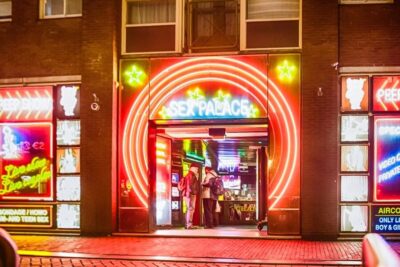
Amsterdam Red Light District & Coffee Shop Tour
Read our review →
Red Light District Pub Crawl with Unlimited Shots
Read our review →
Private Amsterdam Red Light District and Coffee Shop Tour
Read our review →Browse the lists this tour appears in