
REVIEW · VAN GOGH MUSEUM TICKETS
Van Gogh Museum Amsterdam Small Group Guided Tour
Art can feel easier when someone gives you the key. This two-hour Van Gogh Museum tour follows Vincent’s artistic growth from early peasant studies to the final works of his life, with museum admission and a live English-speaking guide included. I like the small group limit of 14, and I like the wireless headphones, which help you hear without crowding around the guide. The main drawback is that adults only may join, and one weak guide can make the $77.43 price feel high.
I also like the choice of morning or afternoon departures. Guides such as Martina, Claire, Kawika, Marlene, Roland, and Holly have been praised for tying Van Gogh’s personal struggles to changes in his technique. Still, the route gives a fair amount of time to the self-portraits, so you may prefer exploring independently if you already know the collection well.
In This Review
- Key points to know before you book
- Starting at Museumplein with a small group
- First stop: Van Gogh’s self-portraits
- The Dutch years: Millet, Breton, and The Potato Eaters
- Paris from 1886 to 1888: color begins to open up
- Arles and the South of France: the famous pictures arrive
- Saint-Rémy: Almond Blossoms, Irises, and a changed voice
- Auvers and the final room
- How much the $77.43 price buys you
- Who will get the most from this tour?
- Should you book the Van Gogh Museum guided tour?
- FAQ
- How long does the Van Gogh Museum tour last?
- What language is the tour offered in?
- Is museum admission included?
- Where does the tour start?
- Where does the tour finish?
- Are special exhibitions included?
- How many people can join the group?
- Can children join the tour?
Key points to know before you book
- You follow Van Gogh’s career in order: The route moves from his Dutch period through Paris, Arles, Saint-Rémy, and Auvers.
- The group is capped at 14 people: That is small enough for questions and easier conversation than a large museum party.
- Wireless headphones are included: You can hear the guide even when the museum is crowded.
- The famous works are part of the route: Expect Sunflowers, The Bedroom, Almond Blossoms, Irises, The Potato Eaters, and Tree Roots.
- You stay inside after the tour: The tour ends at the museum, and you may continue looking around until closing time.
- The tour is for adults aged 18 and older: It is offered in English, with morning and afternoon options.
Starting at Museumplein with a small group
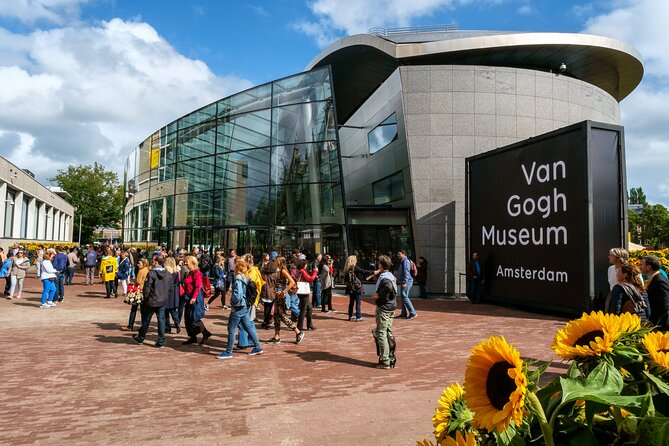
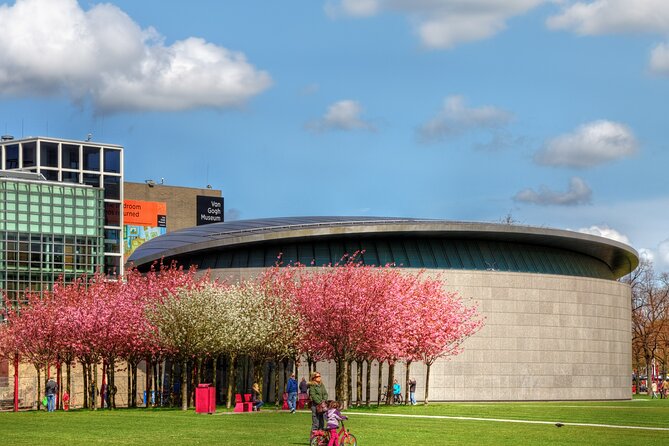
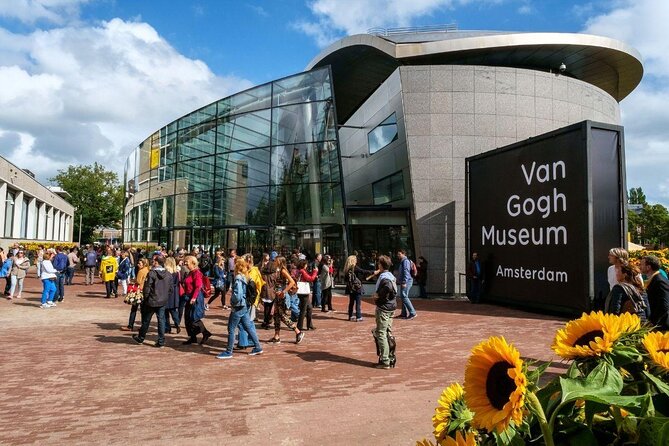
You meet at Cobra Café on Hobbemastraat, close to Amsterdam’s Museumplein and the Van Gogh Museum. The tour ends inside the museum at Museumplein 6, so you do not need to walk back to the starting point after the guided portion.
That end point is one of the tour’s practical strengths. Your two hours with the guide are only the beginning. Once the group portion finishes, you can stay in the museum and revisit paintings, spend time in rooms the guide skipped, or see a special exhibition at your own pace. Special exhibitions are not part of the guided tour, so check your plans if that is your main reason for visiting.
The museum is near public transportation, and most adults can take part. The provider limits the group to 14 people, though the exact number on your date can be smaller. I would arrive early enough to locate Cobra Café without rushing. Museumplein can feel confusing when you are watching the clock, especially if you are already carrying a full day of sightseeing.
The wireless headphone system matters more than it may sound. Museum rooms can be full, and a guide speaking softly at the front of a group is easy to lose. With the headset, you can stand close to the paintings while still following the explanation. One visitor specifically found the system useful while wearing hearing aids.
More Museums in Amsterdam
- Amsterdam: Van Gogh Museum Ticket
★ 4.7 · 52,054 reviews - Moco Museum Amsterdam Entrance Tickets with Banksy & More
★ 4.4 · 10,088 reviews - Amsterdam: The Upside Down Museum Entrance Ticket
★ 4.4 · 9,506 reviews
First stop: Van Gogh’s self-portraits
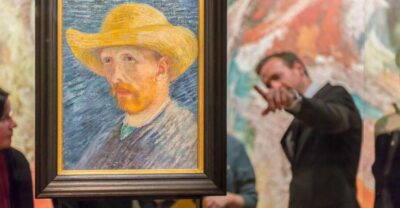
The tour begins with Van Gogh’s self-portraits, allowing you to see his face change across different periods of his life. The paintings are not simply a collection of similar faces. They show shifts in color, brushwork, confidence, and mood.
This is a useful opening because it gives you a visual guide for the rest of the museum. You begin noticing how Van Gogh handled paint, rather than seeing each picture as an isolated famous object. The guide can point out the difference between the earlier, darker work and the later, more forceful style.
The planned time is about 20 minutes. That is enough for a clear introduction, but it can feel long if your main goal is Sunflowers or The Bedroom. One less enthusiastic assessment of the tour specifically wished for less time with the self-portraits. If you already know Van Gogh’s face well, you may find this portion slower than the later rooms.
Still, I think the opening earns its place. The paintings establish the artist as both subject and observer. You are not just looking at what Van Gogh painted. You are watching him test how paint could describe himself.
The Dutch years: Millet, Breton, and The Potato Eaters
The next section moves to the first floor foyer and Van Gogh’s early interest in rural life. You see works connected to Jean-François Millet and Jules Breton, along with Woman Lifting Potatoes and the wall of portraits titled Head of a Peasant Woman.
This section makes The Potato Eaters more meaningful. Without the earlier studies, it is easy to see the painting only as a dark, serious family scene. The guide can show you how Van Gogh practiced drawing working people, rough hands, tired faces, and the physical weight of farm labor before creating his best-known early painting.
The Potato Eaters is not a bright crowd-pleaser. Its colors are subdued, and its figures sit under heavy shadow. That is exactly why the context helps. You see Van Gogh trying to make a painting that felt honest to the lives he wanted to portray, even before his later use of bright yellow and swirling color.
The planned stop lasts about 20 minutes. This is a good place to ask about influences, training, and the difference between copying an admired artist and finding your own voice. The route is strongest when the guide links one painting to the next, showing development rather than offering separate facts.
Paris from 1886 to 1888: color begins to open up
The Paris section marks a clear change. Van Gogh moved there between 1886 and 1888, and the works on this stop show him responding to new artistic ideas and a brighter urban setting.
You see Self-Portrait with Felt Hat, Still Life with Absinthe, In the Café: Agostina Segatori in Le Tambourin, and Garden with Courting Couples. The subjects vary, but the important point is the change in surface and color. Van Gogh was no longer working only with the heavy tones associated with his early Dutch paintings.
I find this section especially helpful for understanding that Van Gogh did not suddenly become the artist of Sunflowers. His style changed through experiments. The guide may point to brush direction, paint color, and the way he built energy into ordinary scenes.
The café painting also gives you a glimpse of the social world around him. The garden scene feels lighter, while the still life lets you focus on how he arranged objects and applied paint. Looking at these works together makes the Paris years feel like a working laboratory.
Again, the planned time is about 20 minutes. A good guide will keep the pace moving while giving you enough time to look closely. Guides praised on this tour, including Martina, Claire, and Kawika, were especially appreciated for explaining how Van Gogh’s life and artistic changes fit together.
More Van Gogh Museum tickets and tours:
- Amsterdam: Van Gogh Museum Ticket and City Canal Cruise
★ 4.6 · 3,899 reviews - Amsterdam: Van Gogh Museum Ticket & Canal Cruise
★ 4.5 · 3,304 reviews - Van Gogh Museum Amsterdam Exclusive Tour w/ Reserved Entry
★ 5.0 · 1,760 reviews - Van Gogh Museum Tour Reserved Entry Semi Private
★ 5.0 · 1,437 reviews
Arles and the South of France: the famous pictures arrive
The Arles section contains the works many people have come to Amsterdam hoping to see. Van Gogh moved to Arles in 1888, and the route includes Sunflowers, Almond Blossoms, The Bedroom, Japanese paintings copied from prints, and The Yellow House.
Here, the tour reaches its most familiar material, but familiarity does not make these paintings ordinary. Seeing the brushstrokes close up can change your impression of reproductions and postcards. One guide was praised for helping people notice Van Gogh’s technique at close range, which is one of the strongest reasons to choose a guided visit.
Sunflowers often looks simple from a distance. In person, the surface and paint handling give it much more force. The guide can help you notice how the flowers differ from one another and how the background, vase, and petals work together.
The Bedroom offers another useful lesson. You can look at its unusual perspective and strong outlines as choices, not mistakes to be corrected. The guide may also connect the painting to Van Gogh’s desire for a place of his own in Arles.
The Japanese prints are an important part of this stop. They show that Van Gogh was not working in isolation. He studied Japanese art and made copies from prints, using those examples to think about outline, flat areas of color, and composition.
The Yellow House adds another layer. You see how place, friendship, and artistic ambition entered his work. If you want a simple explanation of why the Arles paintings look so different from The Potato Eaters, this is where the tour earns much of its cost.
The stop lasts about 20 minutes. It may feel short beside such famous works, but remember that you can return to the museum’s rooms later on your own.
Saint-Rémy: Almond Blossoms, Irises, and a changed voice
On level three, the tour turns to Saint-Rémy-de-Provence. The route includes Almond Blossoms, Wheatfield with a Reaper, Irises, and Pieta after Delacroix.
This part asks you to look beyond the popular image of Van Gogh as a painter of sunlit fields. The works show a range of subjects and sources. Pieta after Delacroix, for example, links Van Gogh to another artist and makes clear that his work included deliberate responses to paintings he admired.
Irises is a good place to study how Van Gogh used repeated forms. The flowers can seem decorative at first, but the brushwork gives them movement and structure. Almond Blossoms offers a different mood, with branches set against a clear background and a design that can feel almost graphic.
Wheatfield with a Reaper brings you back to the countryside, but it does not simply repeat the Dutch period. By this stage, color and motion have become major tools. The guide’s job here is to help you see how the same broad subject, rural work and nature, could look entirely different at different points in Van Gogh’s career.
Several guides have been praised for explaining paint types, methods, and the way Van Gogh built feeling through technique. That practical detail is valuable. Instead of hearing only that a painting is emotional, you get clues about how the artist produced that effect.
You spend about 20 minutes on this level. Ask questions if you want to compare the two Almond Blossoms works included along the route. Seeing them in the same visit lets you consider how Van Gogh repeated ideas while changing the mood and handling.
Auvers and the final room
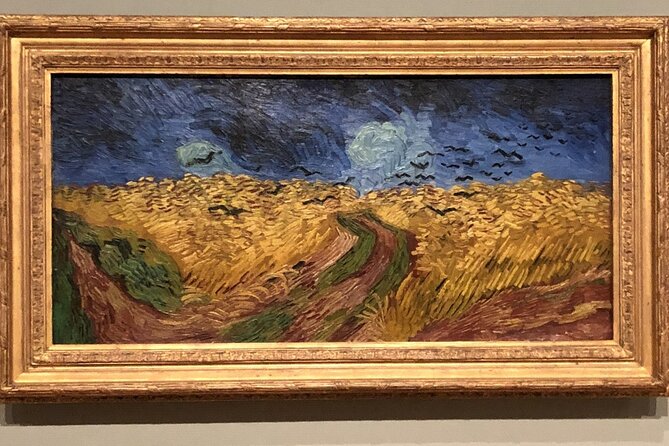
The final stop is the Auvers room on level three. It includes Tree Roots and Wheatfield with Crows, with about 15 minutes allotted.
Tree Roots is particularly important because it is often discussed in relation to the final stage of Van Gogh’s life. The painting rewards close looking. You can focus on tangled lines, color, and the way the subject fills the picture rather than looking for a straightforward scene.
Wheatfield with Crows is one of the museum’s most discussed works. It is tempting to attach a single dramatic meaning to it, but a guide can help you look first at its composition, directional paths, sky, and strong contrast. The best explanations leave room for your own response.
This final stop is shorter than the others, but the route has already built the needed context. You have seen Van Gogh’s early rural subjects, Paris experiments, Arles color, and Saint-Rémy technique. The Auvers works then feel like part of a continuous artistic story.
Some guides, including Marlene and Roland, have been praised for keeping a good pace in crowded rooms and returning to a painting when someone wanted more time. That flexibility is worth noting. A strict script can make a museum visit feel rushed, while a guide who notices questions can make the final room more useful.
How much the $77.43 price buys you
At $77.43 per person, this is not the cheapest way to enter the Van Gogh Museum. You are paying for more than admission, though. The price includes a two-hour guided route, a live English-speaking guide, a wireless headset, and a group capped at 14 people.
I see the value most clearly if you are not already familiar with Van Gogh’s work. A museum audio guide can give you facts, but a live guide can adjust the explanation, answer questions, and connect paintings across several rooms. The difference is especially clear when the guide explains technique rather than simply repeating dates and titles.
The value is less certain if you want a quiet, slow visit. The guided route has a fixed pace, and one part of the tour may spend more time on self-portraits than you would choose. You may also have a guide whose style does not suit you. Most of the named guides received warm praise for enthusiasm and clear explanations, but one poor experience shows that the quality can vary.
The best way to protect the value is to use the tour as your introduction, then stay inside and explore alone. That gives you structure first and freedom afterward. Guides such as Martina were even praised for extending the visit beyond two hours, but I would treat that as a pleasant extra rather than something to expect.
Who will get the most from this tour?
I would choose this tour if you want to understand how Van Gogh changed over time. The chronological route makes the collection easier to read, and the guide can explain influences, personal events, and painting methods in plain language.
It suits first-time museum visitors, couples with different levels of interest, and anyone who wants help spotting details in major works. One especially useful sign is that a guide helped a person who was not very interested in art enjoy the visit. You do not need to arrive as a Van Gogh expert.
It also suits people who value questions and conversation. The small group and headset make it easier to stay connected to the guide, even when the museum has many people inside.
I would be more cautious if you are under 18, since the experience is limited to adults. I would also think twice if you have already studied the museum closely and want to set your own route from the first minute.
The tour is offered in English, with morning and afternoon options. Free cancellation is available if you cancel at least 24 hours before the start time. Within 24 hours, you do not receive a refund, and late changes are not accepted.
Should you book the Van Gogh Museum guided tour?
I would book it if you want a clear story of Van Gogh’s artistic growth rather than a quick checklist of famous paintings. The guide-led route, small group, and headset solve the main problems of a crowded museum visit, and staying afterward lets you examine more at your own speed.
I would skip it only if you strongly prefer complete independence, already know the collection well, or dislike paying extra for live interpretation. For most adults visiting the Van Gogh Museum for the first time, the $77.43 fee is reasonable when you use the guided two hours as a foundation and remain inside to see more.
FAQ
How long does the Van Gogh Museum tour last?
The guided tour lasts approximately two hours. The itinerary includes five stops of about 20 minutes and a final stop of about 15 minutes.
What language is the tour offered in?
The experience is offered in English with a live English-speaking guide.
Is museum admission included?
Yes. Admission to the permanent collection is included in the two-hour guided tour.
Where does the tour start?
The meeting point is Cobra Café at Hobbemastraat 18, 1071 ZB Amsterdam, Netherlands.
Where does the tour finish?
The tour ends inside the Van Gogh Museum at Museumplein 6, 1071 DJ Amsterdam, Netherlands. You can remain in the museum until closing time and continue exploring independently.
Are special exhibitions included?
No. Special exhibitions are not part of the guided tour. You may visit them afterward at your own pace, subject to the museum’s arrangements.
How many people can join the group?
The maximum group size is 14 travelers.
Can children join the tour?
No. This experience is available only to adults aged 18 and older.
More Museums
- Amsterdam: Red Light Secrets Museum Entry Ticket
★ 4.2 · 5,722 reviews - Amsterdam’s Weirdest Museum: Believe It or Not!
★ 4.5 · 4,086 reviews - Amsterdam: Rembrandt House Museum Entrance Ticket
★ 4.7 · 3,385 reviews - Amsterdam: NEMO Science Museum Ticket
★ 4.4 · 2,979 reviews
Just added around Amsterdam
- Amsterdam 1-Hour Rickshaw Tour★ 4.9 · 17 reviews
- Amsterdam: Canal Cruise and Jewish Cultural Quarter Tickets★ 4.2 · 17 reviews
- Keukenhof Gardens and Tulip Experience Tour from Amsterdam★ 4.8 · 17 reviews
- Marken, Volendam and Edam: Private Full-Day Tour★ 4.6 · 18 reviews
- Discover Amsterdam’s city center in this Outside Escape game tour★ 4.5 · 18 reviews
- Amsterdam: Personal Travel & Vacation Photographer★ 4.8 · 18 reviews
- Amsterdam: Luxury Saloon Boat Cruise with 3-Course Dinner★ 3.9 · 18 reviews
- Rijksmuseum & Amsterdam City Center Semi-Private Tour 12ppl Max★ 5.0 · 18 reviews
Van Gogh Museum Tickets, compared.

Van Gogh Museum Amsterdam Exclusive Tour w/ Reserved Entry
Read our review →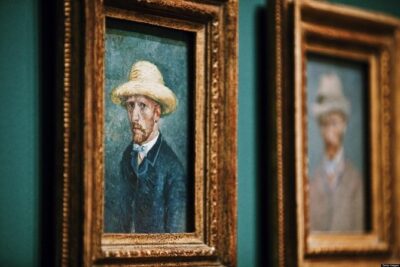
Van Gogh Museum Tour Reserved Entry Semi Private
Read our review →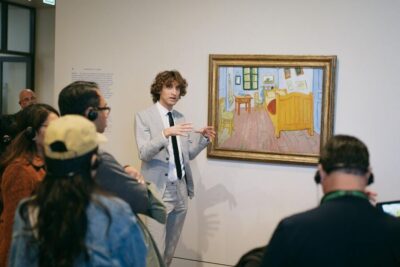
Combo Ticket: Van Gogh Museum Ticket and 1-Hour Canal Cruise
Read our review →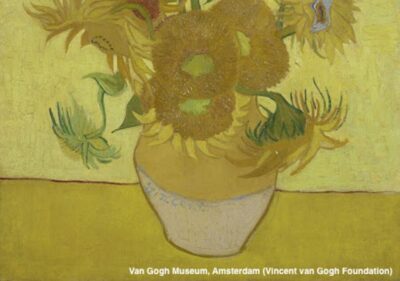
Browse the lists this tour appears in