
REVIEW · WINDMILL TOURS
8 hour Walking and Boat Tour to Rotterdam and Kinderdijk
Rotterdam rewards curious walkers. This nearly eight-hour tour links the city’s bold architecture with Kinderdijk’s famous windmills, giving you a useful mix of urban history, waterfront views, and Dutch water engineering. I like the small maximum of four people, and I like that guide Alex leads the tour with clear knowledge of Rotterdam and Kinderdijk. The main drawback is the pace: with long walks and three hours at Kinderdijk, it is not a good fit if mobility is a concern.
You also get bus tickets to Kinderdijk, coffee or tea, and a serving of Rotterdam’s famous patatje oorlog, or fries with a traditional sauce combination. The price is $591.46 per group of up to four, before the €19 Kinderdijk admission fee per person, so this makes the most sense for a small group that values a private guide rather than the lowest possible cost.
In This Review
- Key reasons to consider this Rotterdam tour
- Starting beneath Rotterdam Centraal’s striking roof
- From water control to wartime survival
- Erasmus, the Markthal, and Rotterdam’s modern face
- Cube houses and the old harbor
- Witte Huis, Willemsbrug, and De Hef
- A waterfront shaped by war and shipping
- Crossing the Erasmus Bridge
- Taking the bus to Kinderdijk
- How the timing affects your experience
- What the $591.46 group price really buys
- Who should book this experience
- Booking advice and final verdict
- FAQ
- Where does the Rotterdam and Kinderdijk tour start?
- Where does the tour finish?
- How long does the tour last?
- How many people can join the tour?
- Is transportation to Kinderdijk included?
- Is the Kinderdijk entrance fee included?
- What food and drinks are included?
- Is admission to the Kijk-Kubus included?
- Is this tour suitable for people with mobility concerns?
- What is the cancellation policy?
Key reasons to consider this Rotterdam tour
- A compact private group: The tour accepts no more than four people, allowing a more personal walk through Rotterdam.
- Two very different Dutch experiences: You see modern architecture and working waterfront sights in Rotterdam, then visit 19 authentic polder windmills at Kinderdijk.
- A guide named Alex: Alex is praised for explaining the sights and the history of both locations clearly.
- Transport is arranged: Bus tickets from Rotterdam to Kinderdijk and back are included, which removes one practical task from your day.
- A taste of Rotterdam: Patatje oorlog, coffee, and tea are included in the tour price.
- A walking-heavy schedule: Expect substantial time on foot in both Rotterdam and Kinderdijk.
Starting beneath Rotterdam Centraal’s striking roof
The meeting point is Stationsplein 48, beside Rotterdam Centraal Station. This is a sensible place to begin because the station is easy to reach by public transport and gives you an immediate introduction to Rotterdam’s modern character.
Rotterdam Centraal handles an average of 170,000 passengers each day. Its architecture makes it more than a place to catch a train. The sharp, forward-pointing roof and broad public space set the tone for a city rebuilt with confidence after the destruction of World War II.
You spend about 20 minutes here. That is enough time to get your bearings and hear why the station matters, but not enough for a long architectural study. Arrive ready to walk, since the tour quickly moves into the city center.
More Boat Trips in Rotterdam
- Rotterdam: Harbor Sightseeing Cruise
★ 4.3 · 7,599 reviews - Rotterdam: Pancake Cruise
★ 4.4 · 1,986 reviews - Rotterdam: Harbor Cruise with Live Guide
★ 4.0 · 1,270 reviews
From water control to wartime survival
The next stop is Rotterdam Partners, a 17th-century building that once served as the headquarters of Waterschap Schieland. This institution handled water policy and management in the area, a fitting subject in a country where controlling water has shaped daily life for centuries.
The building also has a connection with Napoleon Bonaparte, who used it as temporary accommodation. You get about 30 minutes here, including admission. That extra time gives Alex room to connect the building with Rotterdam’s wider struggle to manage rivers, canals, and low-lying land.
At Grote of Sint-Laurenskerk, you see the oldest building in Rotterdam, dating from 1525. The late Gothic church is especially important because it was one of the few buildings to survive the Nazi bombing of May 15, 1940. The visit lasts only 10 minutes, so think of it as a focused stop rather than a full church tour.
That short visit still gives you an important contrast. Rotterdam is often presented as a city of new towers and experimental buildings, but Laurenskerk helps you picture what existed before the wartime destruction and postwar rebuilding.
Erasmus, the Markthal, and Rotterdam’s modern face
A 15-minute stop at the Erasmus sculpture introduces Desiderius Erasmus Roterodamus, one of Rotterdam’s best-known historical figures. Erasmus was a 16th-century philosopher, theologian, scholar, and priest. His name appears across the city on public buildings, educational institutions, and other structures.
The stop is brief, but it gives your walk a human link. Rotterdam’s architecture can feel large and impersonal at times, so a monument to a major local thinker adds a useful personal note.
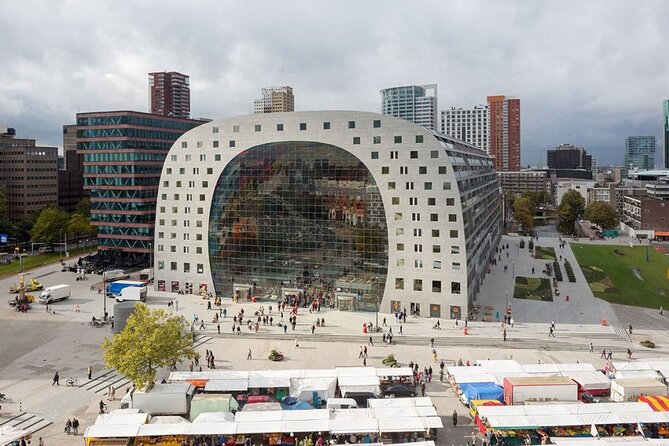
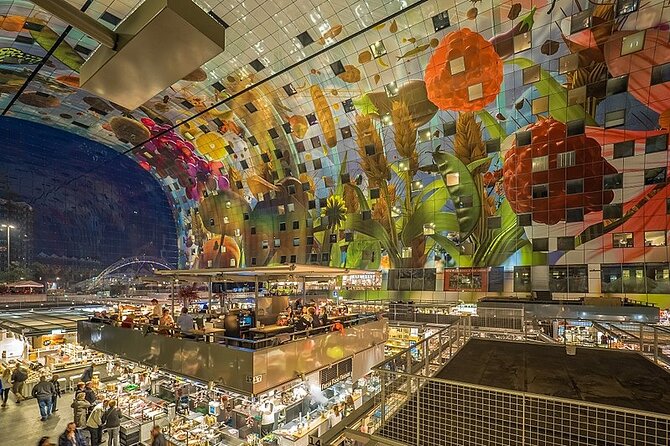
You then reach Markthal, one of Rotterdam’s most recognizable modern buildings. Its horseshoe form combines a covered market with housing and other facilities. The interior is known for its huge artwork, which has earned the building the nickname the Sistine Chapel of Rotterdam.
The tour allows about 20 minutes here. That is enough to see the building’s shape and get a sense of its public market function. If you enjoy food halls, you may wish you had more time to browse. The schedule favors a broad city overview rather than lingering at one attraction.
Cube houses and the old harbor
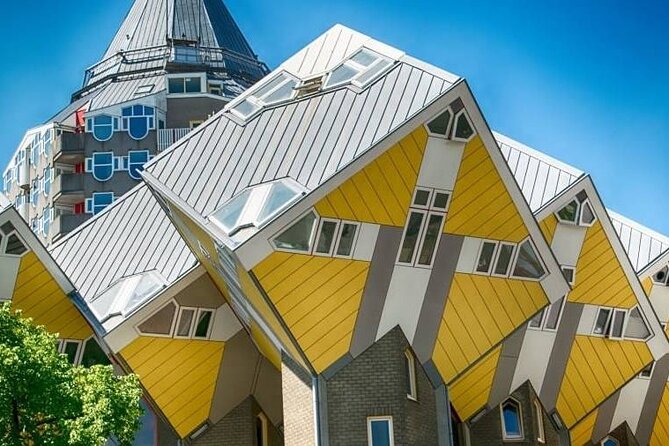
Kijk-Kubus offers one of the tour’s most unusual architectural stops. These cube-shaped apartments sit on top of support columns, creating a tree-like group of buildings. The design is clever, but it also has a practical cost: because of the unusual angles, only about three-quarters of the interior space works well for ordinary living.
Admission to the Kijk-Kubus buildings is included. That matters because seeing the outside alone does not fully explain the idea. Inside, the sloping walls and odd corners help you judge whether this is a brilliant use of space or an architectural puzzle you would not want to live in.
The stop lasts about 20 minutes. It is a good example of the tour’s approach: you are not just looking at famous buildings, you are also considering how they function.
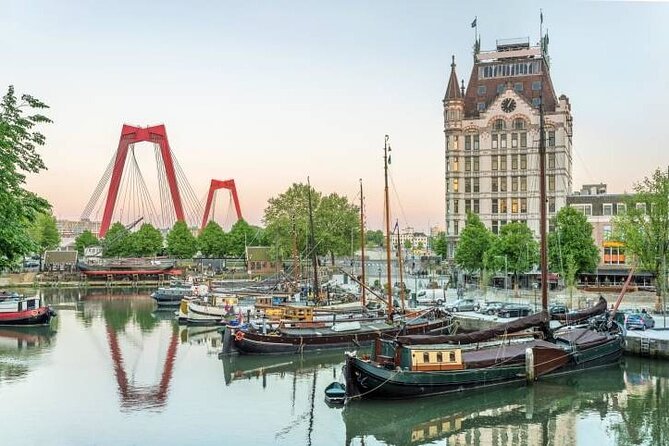
Oude Haven receives the longest city-center stop, about one hour. It is one of medieval Rotterdam’s oldest ports, though not the oldest. The harbor once marked the mouth of the river Rotte where it met the Nieuwe Maas. Today, it is a social area with coffee bars, restaurants, taverns, and nightlife venues.
This is a natural place for the included patatje oorlog. The snack is a famous Rotterdam treat, and its name translates as war fries. You should expect a casual local food moment rather than a formal meal. Coffee or tea is also included.
The hour at Oude Haven gives the schedule a welcome pause. After several short stops, you have time to absorb the waterfront and listen to Alex explain how the old harbor fits into the city’s past and present.
More Walking Tours in Rotterdam
- Rotterdam: Architectural Highlights Guided Walking Tour
★ 4.8 · 215 reviews - Rotterdam Walk: Hilights, Gems, Architecture & WWII | 2 or 3hrs
★ 5.0 · 149 reviews - Rotterdam: Highlights & Gems Walking Tour with Dutch Local
★ 5.0 · 133 reviews - Rotterdam 2-Hour Walking Tour | Discover The City With A Local
★ 4.5 · 111 reviews
Witte Huis, Willemsbrug, and De Hef
At Witte Huis, you see a landmark from another stage of Rotterdam’s development. Completed in 1898, it was once the tallest building in Europe and is often described as Europe’s first skyscraper. Like many Amsterdam buildings, it rests on 1,000 wooden pillars.
The stop lasts about 15 minutes. Its value lies in the engineering story. Rotterdam is famous for its postwar modernism, but Witte Huis shows that the city was already experimenting with height and ambitious construction before the 20th century.
The walk continues to Willemsbrug, known as the Red Bridge. It is one of three Rotterdam bridges connecting the central and northern parts of the city with southern districts. You spend about 15 minutes here, likely taking in the bridge, river, and changing views of the city.
De Hef follows with a 10-minute stop. Its name means the lift, and the huge steel structure once served as a rotating and lifting railway bridge across the Nieuwe Maas. It operated before a rail tunnel was built beneath the river.
De Hef is a good reminder that Rotterdam’s infrastructure is part of its character. Bridges, rail links, ports, and tunnels are not background details here. They explain how the city works.
A waterfront shaped by war and shipping
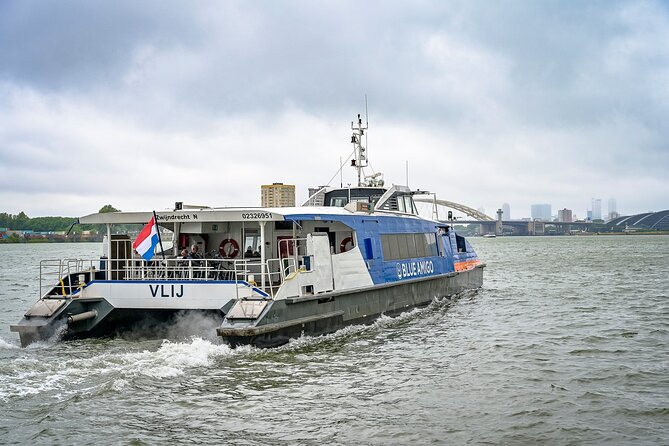
De Boeg is a war memorial on the right bank of the Nieuwe Maas. It commemorates the 3,500 people aboard Dutch merchant ships who died during World War II.
The stop lasts 15 minutes. After the lively old harbor and dramatic bridges, this memorial shifts the mood. It also connects Rotterdam’s identity with the merchant fleet and the dangers faced by people working at sea.
You then reach the open-air section of Maritime Museum Rotterdam at Leuvehaven. The collection includes steamships, cargo-handling machines, ship equipment, engines, and other objects linked to the Dutch navy and shipping from the mid-19th century through the 1970s.
The tour allows about 20 minutes. That is enough for an introduction, but not for a full museum visit. If maritime technology is a major interest, you may want to return independently with more time. On this tour, the open-air collection works as part of a larger walk through Rotterdam’s working waterfront.
Crossing the Erasmus Bridge

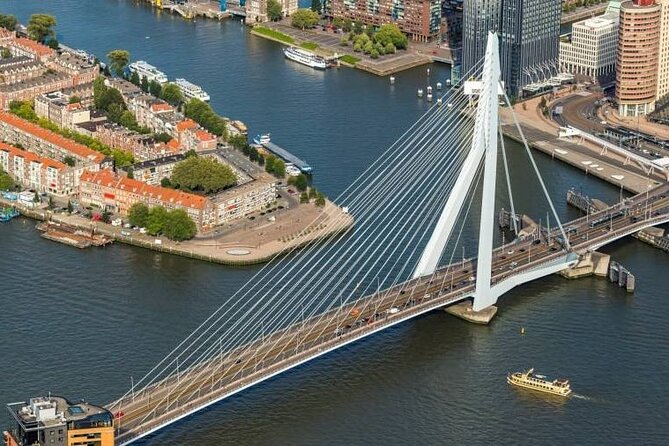
The Erasmus Bridge is the youngest bridge on the route and one of Rotterdam’s strongest symbols. Its nickname, the Swan or the Harp, comes from its distinctive form. The bridge crosses the Nieuwe Maas and includes an 80-meter opening section, described as the largest and heaviest of its kind in Europe. Its main structure reaches 139 meters high.
The tour spends about 30 minutes here. That gives you time to look across the river and consider the bridge from different angles. The stop also brings together many of the themes from the morning: transport, engineering, water, and the city’s preference for bold design.
You should not expect a specialized bridge tour or a long photography session. The guide is balancing this stop with the many others on the route. Still, the Erasmus Bridge is one of the places where Rotterdam’s modern identity becomes easiest to understand.
Taking the bus to Kinderdijk
The move from Rotterdam to Kinderdijk is handled by bus, with tickets included for the trip there and back. This is a useful part of the package because you do not need to arrange the connection yourself during an already full day.
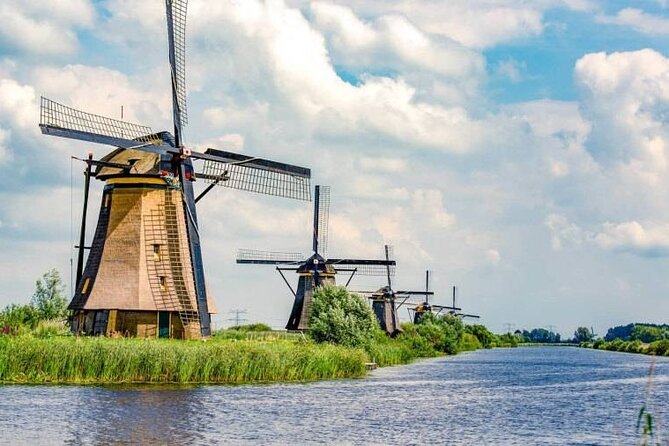
Kinderdijk is about 25 kilometers from Rotterdam, yet it feels very different from the city. Rotterdam shows how people build around water. Kinderdijk shows how people manage water across open polders.
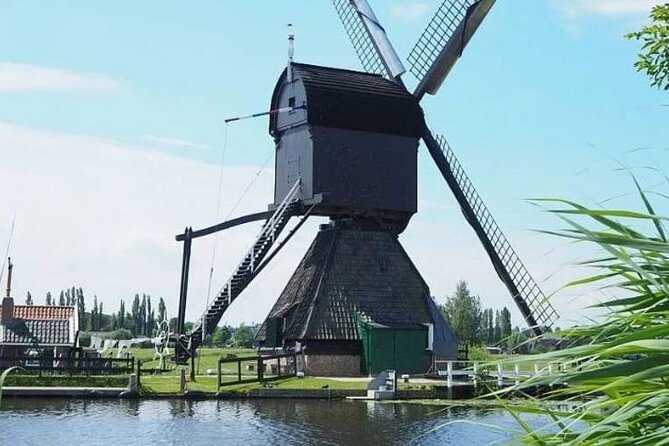
The tour gives you about three hours at the site. That is a substantial portion of the day, and rightly so. A quick stop would not do justice to an area with 19 authentic windmills dating from the first half of the 18th century.
The mills form one of the clearest examples of organized Dutch water management. Their job was to help drain and control polder water, protecting land that lies below or close to the water level. The value of the visit is not just the postcard view. You can see how a system developed over centuries made settlement and farming possible.
Admission to Kinderdijk is not included. It costs €19 per person, so add this to your budget before booking. For a group of four, that is €76 on top of the tour price. The long visit gives you time to walk among the mills, but it also makes this the most physically demanding part of the day.
How the timing affects your experience
The listed duration is about 7 hours and 40 minutes, while the tour is described as an eight-hour experience. The schedule includes many stops, with most Rotterdam visits lasting between 10 and 30 minutes. Oude Haven receives one hour, and Kinderdijk receives three hours.
This format works well if you want a broad introduction. You will see far more than you would on a short city stroll, and Alex can explain how the buildings, bridges, ports, and water systems relate to one another.
The tradeoff is limited free time. You will not have long to shop, sit in a café, or explore each attraction in detail. Markthal and the Maritime Museum, in particular, may leave you wanting a return visit.
You should also be comfortable walking for much of the day. Both Rotterdam and Kinderdijk are described as very walkable, but the pace and total distance make this a poor choice for anyone with mobility concerns. Most people can participate, yet that general suitability does not remove the need for steady walking.
What the $591.46 group price really buys
The cost is $591.46 per group of up to four people. That is not a budget walking tour, but the calculation changes if you fill the group. Split four ways, the tour costs about $147.87 per person before the €19 Kinderdijk entry fee.
Included are the guide, bus transportation to and from Kinderdijk, Kijk-Kubus admission, coffee or tea, and patatje oorlog. The maximum of four is important. You are paying for a small private format, not for a large coach group with a fixed script.
The strongest value comes from combining two destinations that are easy to treat as separate outings. You get a city walk in Rotterdam and a well-organized visit to Kinderdijk in one day. If you prefer independent exploration and already know how to reach Kinderdijk, the price may feel high. If you want one person to connect the sights and manage the transport, the cost is easier to justify.
Who should book this experience
I would choose this tour for a small group that wants context, not just photographs. It suits first-time visitors who want to understand why Rotterdam looks so different from other Dutch cities and how Kinderdijk fits into the country’s water story.
It is also a good match for people who enjoy architecture, bridges, engineering, maritime history, and urban change. The city section moves from a Gothic church to experimental apartments, historic ports, memorials, and major bridges.
I would hesitate if your priority is a slow day. The itinerary is full, and the city stops are tightly timed. I would also hesitate if you have mobility limitations, since the walk through Rotterdam and the three-hour Kinderdijk visit require stamina.
The perfect group size is likely two to four people who enjoy asking questions. Alex’s role is especially valuable here. He is praised for pointing out the sites and explaining Rotterdam, Kinderdijk, and the history connected with both places.
Booking advice and final verdict
You receive confirmation within 48 hours, subject to availability. The tour operates daily from 8:00 a.m. to 6:00 p.m. during the stated operating period, from November 4, 2023, through May 2, 2027.
Free cancellation is available if you cancel at least 24 hours before the start time. Changes or cancellations made inside that 24-hour window are not accepted for a refund.
I would book this tour if you want a full day that connects Rotterdam’s daring city design with Kinderdijk’s traditional windmills. The small group, included bus tickets, included Kijk-Kubus entry, snacks, and Alex’s personal guiding add real value. I would skip it only if you want a cheap overview, extensive museum time, or a low-effort day. For an active group of up to four, it is a strong way to see two very different sides of Dutch life in one outing.
FAQ
Where does the Rotterdam and Kinderdijk tour start?
It starts at Stationsplein 48, 3013 AJ Rotterdam, Netherlands, near Rotterdam Centraal Station.
Where does the tour finish?
The activity ends back at the meeting point.
How long does the tour last?
The duration is approximately 7 hours and 40 minutes, described as an eight-hour walking and boat tour.
How many people can join the tour?
The tour has a maximum of four travelers.
Is transportation to Kinderdijk included?
Yes. Bus tickets from Rotterdam to Kinderdijk and back are included.
Is the Kinderdijk entrance fee included?
No. Admission costs €19 per person and must be paid separately.
What food and drinks are included?
The tour includes patatje oorlog, a famous Rotterdam fries snack, along with coffee and/or tea.
Is admission to the Kijk-Kubus included?
Yes. Entrance fees to the Kijk-Kubus buildings are included.
Is this tour suitable for people with mobility concerns?
The tour is very walkable in both Rotterdam and Kinderdijk and is not recommended if you have mobility concerns.
What is the cancellation policy?
You can cancel at least 24 hours before the start time for a full refund. Cancellations or changes made less than 24 hours before the start time are not accepted for a refund.
More Windmill Tours
- Kinderdijk Area Cycling Tour
★ 5.0 · 17 reviews - Kinderdijk Photography tour
★ 5.0 · 7 reviews - Famous Holland Tour: visit The Hague, Delft, Rotterdam and Kinderdijk from A’dam
★ 5.0 · 5 reviews - Private tour from Rotterdam to Windmills of Kinderdijk & Gouda Cheese Experience
★ 5.0 · 3 reviews
More Windmill Tours in Rotterdam
- Rotterdam: Kinderdijk UNESCO World Heritage Entry Ticket
★ 4.6 · 1,477 reviews - Rotterdam: Waterbus Ticket to Dordrecht and/or Kinderdijk
★ 4.6 · 542 reviews - All-Inclusive Private Windmill Tour to Kinderdijk from Rotterdam
★ 4.5 · 59 reviews - Kinderdijk Bike Tour
★ 5.0 · 35 reviews
Just added around Rotterdam
- Private tour: Markthal, Cube houses and Rooftop Het Witte Huis★ 4.5 · 3 reviews
- Private tour from Rotterdam to Windmills of Kinderdijk & Gouda Cheese Experience★ 5.0 · 3 reviews
- Discover Rotterdam: Classic Highlights Bike Tour by a Local★ 5.0 · 3 reviews
- Private Transfer from Rotterdam Port to Amsterdam Airport (AMS)★ 5.0 · 3 reviews
- Discover Rotterdam’s most Photogenic Spots with a Local★ 5.0 · 3 reviews
- privatetour Delft, The Hague&Rotterdam Kinderdijk from Amsterdam★ 5.0 · 3 reviews
- Rotterdam: Capture the most Photogenic Spots with a Local★ 5.0 · 3 reviews
- Private Tour of Rotterdam and The Hague including Transfer★ 5.0 · 3 reviews
Windmill Tours, compared.
Guided Zaanse Schans, Windmills & Cheese Tour
Read our review →
Windmill Tour from Amsterdam, Including Volendam & Marken
Read our review →
Tour to Keukenhof Gardens with Windmill Cruise
Read our review →
Zaanse Schans Windmills, Clogs and Dutch Cheese Small-Group Tour from Amsterdam
Read our review →
Zaanse Schans windmills & Volendam Guided Tour
Read our review →
Day Tour Keukenhof and Zaanse Schans Windmills
Read our review →
Countryside Bike Tour from Amsterdam: Cheese, Clogs & a Windmill
Read our review →
Kinderdijk UNESCO World Heritage Entry Ticket
Read our review →Browse the lists this tour appears in