
REVIEW · ROTTERDAM TOURS
Rotterdam Walk: Hilights, Gems, Architecture & WWII | 2 or 3hrs
Rotterdam tells its story in concrete and water. This 2 to 3-hour walk links the city’s best-known sights with quieter corners, from the mirrored Depot Boijmans Van Beuningen to the old harbor and the Cube Houses. I especially like the strong focus on World War II and reconstruction, plus the use of photos and visual aids that help you see how much Rotterdam changed. I also like the finish inside the Markthal, where you can keep exploring after the guide says goodbye.
The main trade-off is pace. You cover nine stops in a fairly short time, so this is an orientation walk rather than a deep visit to museums or buildings. You will also want decent weather, since the experience can be canceled in poor conditions. Still, for about $49.60 per person, the small-group format and local storytelling make this a solid first look at Rotterdam.
In This Review
- Five things that make this Rotterdam walk worthwhile
- Why this is a smart first walk in Rotterdam
- Starting at Depot Boijmans Van Beuningen
- Nieuwe Werk and the open view of the Maas
- Erasmus Bridge and Rotterdam’s wartime story
- The Maritime District and its old boats
- The Destroyed City at Square 1940
- Witte Huis, once Europe’s tallest office tower
- Oude Haven and Rotterdam’s older waterfront
- Walking through the Cube Houses
- Ending inside the Markthal
- Price, pace, and who gets the most value
- Should you book this Rotterdam walking tour?
- FAQ
- How long does the Rotterdam walking tour last?
- Where does the tour begin?
- Where does the tour end?
- Is admission included for the museums and attractions?
- How many people can join the tour?
- Can I cancel for a refund?
Five things that make this Rotterdam walk worthwhile

- WWII history with visual context: The guide explains the invasion and bombardment of Rotterdam, then connects that destruction to the city you see today.
- A rare view from Nieuwe Werk: The Shipping Quarter opens toward the Maas, with views of Hotel New York, the steamship Rotterdam, and the Erasmus Bridge.
- Architecture from several eras: You move from the historic Witte Huis and old harbor to the striking Cube Houses and modern Markthal.
- A local guide’s personal view: Guides such as Yoreh bring pride, humor, photographs, and practical city tips to the walk.
- A useful finish at Markthal: The tour ends inside Rotterdam’s food hall, close to the Cube House demonstration home and other central sights.
Why this is a smart first walk in Rotterdam
Rotterdam is not a city you understand from a single postcard. Its center has old harbors, modern towers, rebuilt streets, bold experiments in architecture, and reminders of wartime destruction. This route puts those pieces together in a way that makes the city easier to read.
I like the tour’s balance between famous sights and less obvious corners. You see the Cube Houses and Erasmus Bridge, of course, but you also visit Nieuwe Werk and the Maritime District, places that give the walk a more local feel.
The route also works well early in your stay. A guide can point out museums, viewpoints, architectural details, and places worth returning to. Several people have found themselves going back to sites after the walk, which is exactly what a good city introduction should do.
The group is limited to 15 people. That matters in Rotterdam, where busy streets, open plazas, and the Cube House area can make a large group awkward. A smaller group should make it easier to hear the guide and ask questions, though the experience can still feel active because the route covers a lot of ground.
Guides have included Yoreh and Elmore. Yoreh is praised for his energy, humor, love of Rotterdam, and use of photographs. Elmore has also been described as friendly and clear, with a comfortable pace and good answers to questions. Your guide may vary, but the experience clearly depends on a personal, talkative approach rather than a recorded script.
More Walking Tours in Rotterdam
- Rotterdam: Architectural Highlights Guided Walking Tour
★ 4.8 · 215 reviews - Rotterdam: Highlights & Gems Walking Tour with Dutch Local
★ 5.0 · 133 reviews - Rotterdam 2-Hour Walking Tour | Discover The City With A Local
★ 4.5 · 111 reviews
Starting at Depot Boijmans Van Beuningen
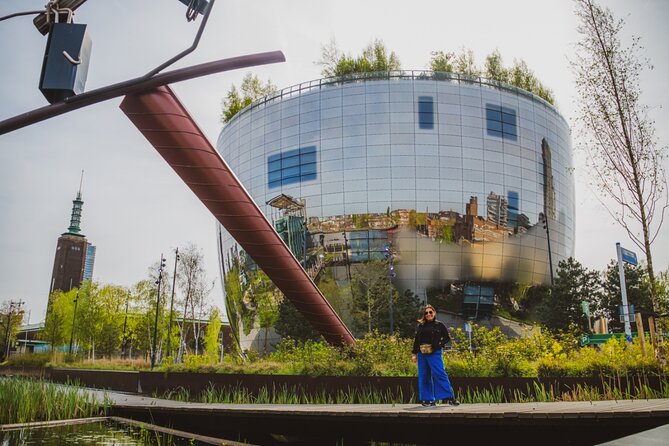
The walk begins near Museumpark at the Depot Boijmans Van Beuningen, the city’s famous mirrored art-storage building. The tour does not include admission, and you do not enter for a museum visit. Instead, this opening stop gives the guide a chance to explain Rotterdam’s Museum District and the Land of Hoboken.
That is a useful beginning because it places the city’s cultural institutions in context. You get an introduction to the area before moving toward the river and older parts of central Rotterdam. The mirrored exterior also provides an immediate reminder that Rotterdam likes to make practical buildings visually memorable.
The stop is scheduled for about 15 minutes. That is enough for an overview, not enough for a serious look inside the Depot or nearby museums. If art is one of your main reasons for visiting Rotterdam, plan a separate visit after the walking tour.
Nieuwe Werk and the open view of the Maas
Next comes Nieuwe Werk, also called the Shipping Quarter. This is one of the most appealing parts of the route for anyone who wants to see Rotterdam as a port city rather than only as a collection of modern buildings.
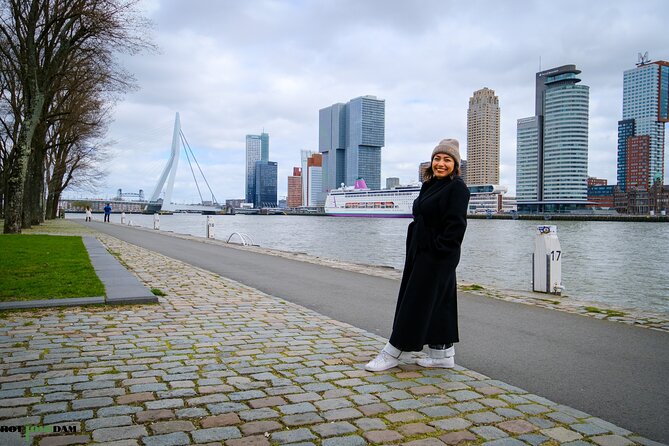
The area has a more open feeling than the tight center. From the Maas, you can look toward Hotel New York, the steamship Rotterdam, and the Erasmus Bridge. The view helps explain Rotterdam’s connection to shipping, migration, trade, and river traffic without requiring a museum ticket.
I would pay close attention here to the change in mood. The route moves from museum architecture into a broad waterfront setting, giving you a pause from the city’s hard angles. The stop lasts about 30 minutes, making it one of the longer parts of the walk.
The drawback is simple: river views depend on the weather and visibility. On a gray or rainy day, the scene will feel less dramatic. The tour can operate in rain according to some past experiences, but the stated policy allows cancellation for poor weather, with a different date or a full refund offered.
Erasmus Bridge and Rotterdam’s wartime story
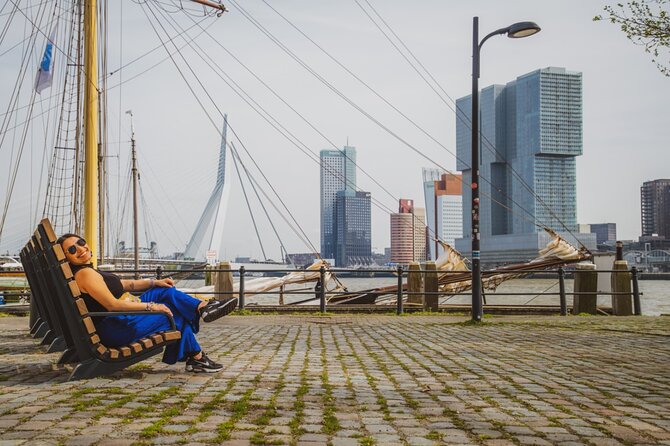
The Erasmus Bridge is one of Rotterdam’s defining sights. Its white structure crosses the Maas and connects the northern and southern parts of the city. The bridge is impressive on its own, but the guide uses it as a place to explain the Second World War, including the invasion and bombardment of Rotterdam.
This is where the walk’s history becomes more than a list of dates. The city’s modern appearance can make it easy to forget that much of central Rotterdam was destroyed. A guide who carries old photographs can show you the difference between the prewar city and the rebuilt one. That visual comparison is one of the strongest features of the experience.
I like this approach because the history is tied to the pavement under your feet and the buildings in front of you. You are not simply hearing that Rotterdam was damaged. You are learning how the damage shaped the city’s decision to rebuild in a modern, daring style.
The bridge stop lasts about 20 minutes. It is long enough for explanation and photographs, but not a full architectural study. Bring a jacket if the weather is unsettled, since open waterfront areas can feel cooler than the streets behind them.
More WWII and Jewish history tours:
- Amsterdam: Life of Anne Frank and World War II Walking Tour
★ 4.8 · 10,467 reviews - Anne Frank Walking Tour Amsterdam Including Jewish Cultural Quarter
★ 5.0 · 1,879 reviews - Amsterdam: Dutch WWII Resistance Museum Entry Ticket
★ 4.7 · 951 reviews - Oranjehotel World War II Prison Entrance Ticket
★ 4.6 · 708 reviews
The Maritime District and its old boats
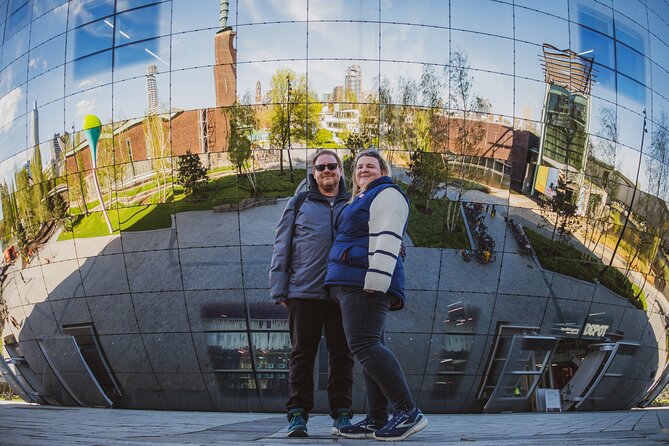
The route then reaches Rotterdam’s Maritime District, near the Maritiem Museum. The walk does not include museum admission. Instead, you pass through the open-air area, where old boats and maritime objects help preserve the look of an earlier port.
The boats here are described as some of the last of their kind, with several more than 100 years old. That gives the district a different character from the glass, steel, and concrete elsewhere on the route. You get a quick sense of the working harbor that existed before Rotterdam’s postwar rebuilding.
This is a short stop of about 10 minutes, so expect an introduction rather than a detailed examination of each vessel. If you want to explore the maritime collection at greater length, set aside time for the museum separately. The advantage of seeing the area during the walk is that you understand its place in the larger city story before deciding how much more time to spend there.
The Destroyed City at Square 1940
At Square 1940, the guide points out Ossip Zadkine’s statue The Destroyed City. The sculpture is one of Rotterdam’s key memorials to the war and the destruction of the old center.
This stop is brief, about 10 minutes, but it carries emotional weight. After hearing about the bombardment near the Erasmus Bridge, you now encounter a public work that gives that loss a human shape. The title alone tells you what the city chose to remember.
I find memorials most useful when a guide explains their place in local life. Without context, a sculpture can be easy to pass. With the story behind it, you understand why this particular work matters in Rotterdam and why it belongs on a city walk focused on war and rebuilding.
Witte Huis, once Europe’s tallest office tower
The Witte Huis, or White House, offers another change of scale. This historic office building was once the tallest office tower in Europe. In a city now known for dramatic modern architecture, it is a reminder that Rotterdam was experimenting with tall urban buildings long before the current skyline took shape.
The building is near the old harbor, so the stop leads naturally into the next part of the route. The guide can compare its earlier form of ambition with the daring structures built after the war.
The scheduled stop is about 15 minutes. You will hear about the building and its role in the city, but you should not expect to go inside. The value here comes from seeing the Witte Huis in relation to the water, the old harbor, and the newer buildings around it.
Oude Haven and Rotterdam’s older waterfront
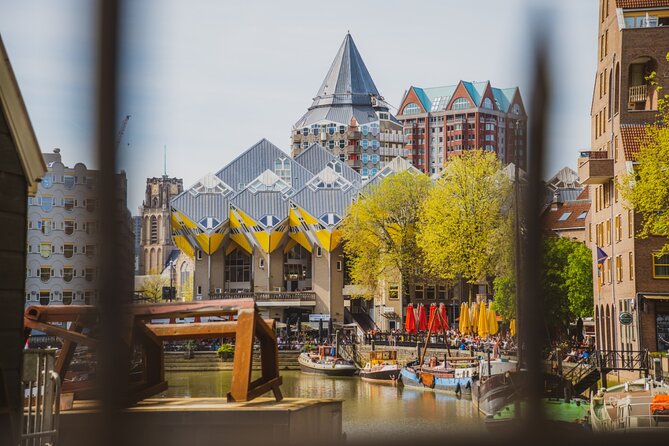
Oude Haven is one of the oldest harbors in the Netherlands. Today, it is also one of the most pleasant places to pause, with a cozy atmosphere and views toward the Cube Houses.
This section helps you see how Rotterdam layers old and new. The harbor retains a sense of earlier port life, while the Cube Houses rise immediately nearby with their tilted walls and yellow surfaces. The contrast is almost comical in the best way: one side suggests working boats and traditional waterfront buildings, while the other looks like an architect’s geometric experiment.
The stop lasts about 15 minutes. It is a good place for photographs, but the guide’s explanation is the main reason to be here. You learn how the old harbor fits into Rotterdam’s development and get a clear view of the next major stop.
Walking through the Cube Houses
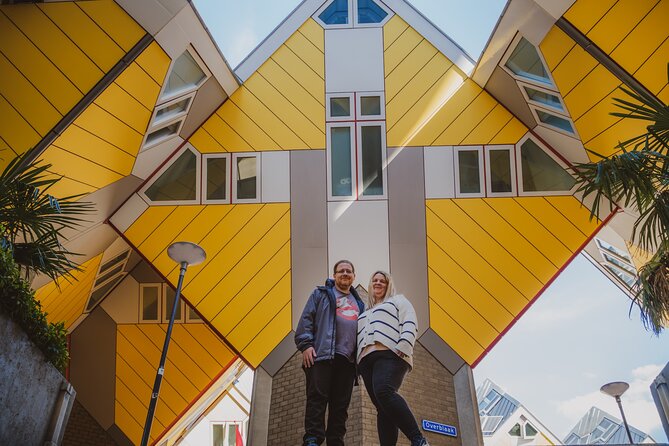
The Cube Houses are among Rotterdam’s most recognized sights, and the route takes you along Overblaak through this concrete forest. The guide explains why the homes were designed this way, how the architecture works, and what it means to live in such an unusual structure.
This is more helpful than simply taking a quick photo from outside. The tilted houses raise practical questions right away: where are the floors, how does the space function, and why would anyone choose this design? The walk gives you the basic ideas before you decide if you want to enter the demonstration Cube House on your own.
The stop is listed at about 10 minutes, though the time spent walking through the area may make it feel a little longer. You will not get a full interior tour as part of the experience. If the houses are a major interest, keep time after the tour to visit the demo home.
The Cube Houses also show why Rotterdam can feel so different from other Dutch cities. Instead of preserving a uniform historic center, Rotterdam often uses architecture to ask questions. Some buildings are practical, some are symbolic, and some seem determined to make you tilt your head.
Ending inside the Markthal
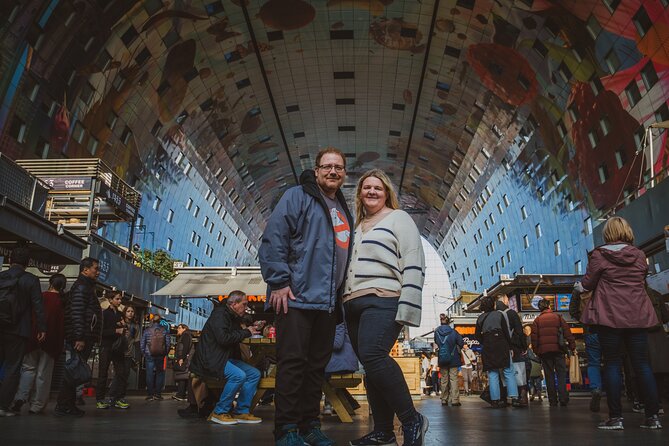
The tour finishes inside the Markthal, Rotterdam’s modern indoor market. This is a sensible ending because the building brings together food, color, public space, and ambitious design in one place.
The guide explains the building and its huge interior artwork, sometimes called Rotterdam’s modern Sistine Chapel. You will learn why the Markthal became such a prominent city sight, then receive tips on where to go next.
The tour itself does not include food, and the end point is not a reserved meal. That is actually useful. You can stay for a snack or meal at your own pace, browse the stalls, and decide whether to visit the Cube House demo home nearby.
I would protect extra time after the walk rather than scheduling something immediately afterward. The Markthal is the sort of place you may want to explore slowly, especially after hearing the guide explain its design. One useful tip from the guide’s own advice is to leave time to eat and look around here.
Price, pace, and who gets the most value
At $49.60 per person, this is not the cheapest way to see Rotterdam, but it offers good value if you want history and interpretation rather than a simple route map. You are paying for a small group, a local guide, visual material, and a two to three-hour walk through several distinct parts of the city.
The price makes less sense if you plan to rush through Rotterdam alone and only want photographs. All stops are viewed from outside, and admission tickets are not included. You will need separate time and payment for museums or the Cube House demonstration home.
I think the tour suits you best if:
- You are visiting Rotterdam for the first time.
- You want the city’s WWII story explained alongside its architecture.
- You enjoy asking questions and hearing local recommendations.
- You like a mixture of famous sights and quieter streets.
- You want ideas for what to do after the walk.
- You are comfortable walking outdoors for several hours.
It is also a good choice before a cruise departure from Rotterdam, since the route provides a strong introduction in one afternoon. The pace has been comfortable for people even on rainy days, but wear sensible shoes and dress for changing weather.
The walk is offered in English, mobile tickets are available, and it is near public transportation. Service animals are allowed, and most people can participate. Since the route is outdoors and requires a reasonable amount of walking, you should consider your own mobility before booking.
Free cancellation is available up to 24 hours before the start time. Cancellations made later are not refunded, and late changes are not accepted. The experience requires a minimum number of participants, and poor weather can also lead to a new date or full refund.
Should you book this Rotterdam walking tour?
I would book it early in a Rotterdam visit, especially if you want the city to make sense quickly. The best parts are the clear WWII context, the old and new architecture placed side by side, the open view from Nieuwe Werk, and the personal style associated with guides such as Yoreh.
Choose another option if you want long museum visits, an indoor-only activity, or a very slow architectural study. Choose this walk if you want a lively introduction, practical tips, and a city story that connects wartime loss with Rotterdam’s bold rebuilding.
The final stop at Markthal is another reason to say yes. You finish in a place where you can eat, revisit the Cube Houses, and continue exploring without having to cross town. For a first day in Rotterdam, that is useful planning as well as good sightseeing.
FAQ
How long does the Rotterdam walking tour last?
The experience lasts approximately 2 to 3 hours.
Where does the tour begin?
It begins at the Vaimoo deelfietsstation on Melkkoppad, near Museumpark, at Museumpark 20 in Rotterdam.
Where does the tour end?
The tour ends inside the Markthal at Verlengde Nieuwstraat. From there, you can continue exploring the Markthal and visit the Cube House demonstration home on your own.
Is admission included for the museums and attractions?
No. The stops list free admission for the tour, and the walk provides explanations from outside. Separate admission may be needed if you choose to visit museums or enter the demonstration Cube House afterward.
How many people can join the tour?
The maximum group size is 15 people.
Can I cancel for a refund?
Yes. You can cancel at least 24 hours before the local start time for a full refund. Cancellations or changes made less than 24 hours before the start time are not accepted, and poor weather or an unmet minimum group size may lead to a new date or full refund.
More Walking Tours
- Walking Rotterdam Food Tour
★ 5.0 · 89 reviews - Rotterdam: City Center Walking Tour
★ 4.5 · 88 reviews - Rotterdam Architecture Highlights Walking Tour
★ 5.0 · 66 reviews - Rotterdam Walking Tour and Harbor Cruise
★ 4.7 · 59 reviews
Just added around Rotterdam
- Rotterdam: Summer Cocktail Cruise★ 4.7 · 18 reviews
- Skip the Line: SS Rotterdam Steam Ship Entrance Ticket★ 4.5 · 18 reviews
- Rotterdam: Beer Brewery Noordt Tastings with Optional Tour★ 4.9 · 18 reviews
- Guided 3-Hour Food Tasting Experience in Rotterdam★ 5.0 · 19 reviews
- Private Day Trip from Amsterdam to Rotterdam and the Hague★ 5.0 · 19 reviews
- Rotterdam Must Do Tour: Highlights, History, WW2 and Architecture★ 5.0 · 20 reviews
- Private Day Tour: Rotterdam and The Hague. English or Spanish★ 4.5 · 20 reviews
- Private Day Tour to Keukenhof Gardens – from Amsterdam/Rotterdam★ 5.0 · 20 reviews
Rotterdam Tours, compared.




Kinderdijk UNESCO World Heritage Entry Ticket
Read our review →
Browse the lists this tour appears in