
REVIEW · ROTTERDAM TOURS
Cultural Walking Tour in Rotterdam
Rotterdam tells its story in concrete. I like the way this two-hour walking tour links the rebuilt city center with the Markthal and Erasmus Bridge, and I especially value the architectural guidance from a professional art historian or architect. The market stop also gives you a chance to buy a local snack rather than simply stare at another monument.
The main drawback is that the tour covers a lot of ground in a short time, and the route is outdoors from start to finish. You should dress for the weather, carry water, and remember that food and drinks are not included. A winter walk can be cold, though guide Tania apparently kept one January group engaged despite the weather.
In This Review
- Key points to know before you book
- Rotterdam’s story begins at Centraal Station
- Lijnbaan shows Rotterdam’s postwar experiment
- Sint-Laurenskerk gives the city an older voice
- Markthal mixes architecture with everyday Rotterdam
- The route may include more than the four named stops
- Finish beside the Maas with the Erasmus Bridge
- What the guides add to the walk
- Is $54.06 a fair price?
- Practical advice for a comfortable walk
- Who should book this Rotterdam walk?
- Should you book the Cultural Walking Tour in Rotterdam?
- FAQ
- Where does the tour begin?
- Where does the tour end?
- How long does the experience last?
- What language is the tour offered in?
- What landmarks are included?
- Is food included?
- Is hotel pickup provided?
- How many people can join the tour?
- Is there a minimum age?
- Can I cancel for a full refund?
Key points to know before you book
- Rotterdam Centraal is the starting point: The station is easy to reach by train, tram, metro, and bus, making this a useful first activity in the city.
- Postwar architecture is the main subject: You will connect Rotterdam’s modern buildings with the destruction of World War II and the city’s decision to rebuild in a bold new style.
- The Markthal stop is brief but practical: You hear about the indoor food hall and can buy your own snack during or around the visit.
- The walk ends beside the Maas: The final view toward the Erasmus Bridge and newer developments gives the tour a strong finish.
- The group can include up to 20 people: A smaller group may feel more personal, while a full group could make detailed questions harder.
- The tour suits visitors aged 12 and older: You need moderate physical fitness for a roughly two-hour city walk.
Rotterdam’s story begins at Centraal Station
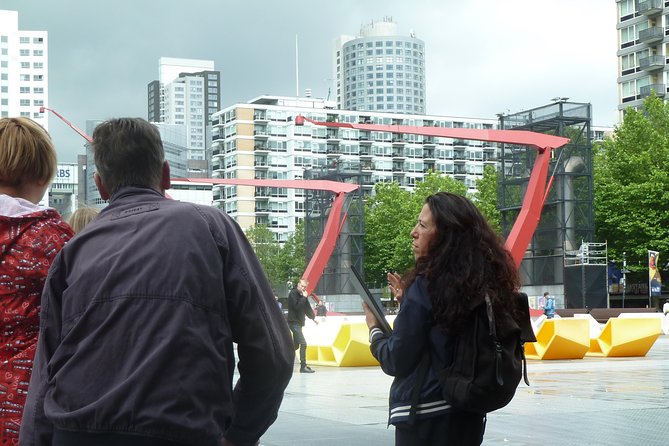
Rotterdam Centraal Station is a sensible meeting point. It is the city’s main transport hub, so you can arrive by train or local public transport without hunting for a tucked-away meeting place. The tour begins outside the newly built station, and admission to the station area costs nothing.
This opening gives you an immediate lesson in Rotterdam’s character. The city does not ease you in with a medieval square or a quiet canal. Instead, you begin with a modern transport building and a city center shaped by rebuilding, commerce, traffic, and ambitious design.
Allow a few minutes to find the guide before the scheduled start. Your confirmation gives the meeting location as Rotterdam Centraal, 3013 AJ Rotterdam. The exact guide may vary, and the experience can be operated by a multilingual guide, but the main offering is in English.
The first stop itself is listed at about 10 minutes. That does not mean the station is the only thing you see. The route continues into central Rotterdam, where the guide connects the station with the wider rebuilding plan and the city’s modern identity.
More Walking Tours in Rotterdam
- Rotterdam: Architectural Highlights Guided Walking Tour
★ 4.8 · 215 reviews - Rotterdam Walk: Hilights, Gems, Architecture & WWII | 2 or 3hrs
★ 5.0 · 149 reviews - Rotterdam: Highlights & Gems Walking Tour with Dutch Local
★ 5.0 · 133 reviews
Lijnbaan shows Rotterdam’s postwar experiment
From the station, the walk passes through the Lijnbaan, described as the country’s largest national monumental area. This is one of the places where the tour’s architectural focus becomes useful. You are not just walking along a shopping street. You are looking at a planned piece of postwar urban design.
The Lijnbaan helps explain how Rotterdam tried to create a new kind of city after wartime destruction. Its importance is not based on old stonework. It comes from the way planners imagined shopping, movement, open space, and modern city life.
I would pay close attention here to how the guide explains the difference between Rotterdam’s prewar city and the one built afterward. A general sightseeing walk might point out the shops and move on. An architect or art historian can help you notice why the area was designed as it was and how it fits into the city’s larger story.
The route is still a working city street, not a museum. That means you may encounter ordinary shopping traffic, bicycles, and changing street activity. This is useful if you want to see Rotterdam as a lived-in city, but less appealing if you prefer a quiet heritage walk.
Sint-Laurenskerk gives the city an older voice
The Grote of Sint-Laurenskerk offers a sharp contrast with the modern center. Its exterior is part of the oldest surviving building tradition in Rotterdam, and it partly survived the bombing that destroyed much of the city during World War II.
The stop is focused on the exterior and lasts about 10 minutes. You should not book this tour expecting a long interior visit or a religious-art tour. Its value is the contrast: after hearing about modern planning and new buildings, you face one of the few major reminders of the city that came before the wartime destruction.
This is also a good place to listen for the guide’s explanation of memory and reconstruction. Rotterdam could have rebuilt as a faithful copy of its old center. Instead, it took a more forward-looking route. The church helps make that choice visible.
A short stop can feel rushed if you want detailed church history or time for careful photographs. Still, the limited pause keeps the walking tour moving and prevents the day from becoming a series of long lectures.
Markthal mixes architecture with everyday Rotterdam
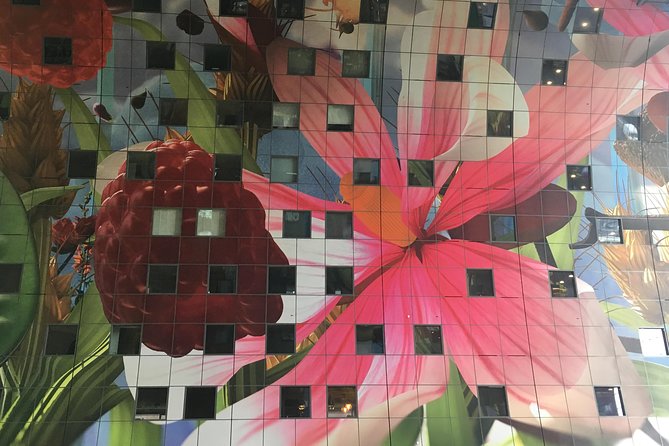
The Markthal is one of the tour’s most enjoyable stops because it combines design with food. The guide explains the indoor market and food hall, while you get a look at a place used for ordinary eating and shopping rather than only sightseeing.
The scheduled stop is about 10 minutes, so keep your expectations realistic. This is an introduction, not a full market meal or a lengthy tasting session. Snacks and drinks are not included in the tour price, but you can buy something yourself if timing and the market setup allow.
That distinction matters. The tour summary presents the market as a chance to enjoy a local snack, while the inclusion details make clear that food is your own expense. Bring a little spending money if you want to turn this stop into a taste of Rotterdam.
I like this part of the route because it breaks up the architecture talk. Buildings can seem abstract when you discuss only dates and design. A market connects the city’s new architecture to daily life, and the guide can show you how the building functions as more than a photo stop.
The Markthal is also a strong place for photographs, but the short timing may limit how long you can linger. If you want to browse food stalls at leisure, return later on your own.
More walking tours:
- Rotterdam 2-Hour Walking Tour | Discover The City With A Local
★ 4.5 · 111 reviews - Walking Rotterdam Food Tour
★ 5.0 · 89 reviews - Rotterdam: City Center Walking Tour
★ 4.5 · 88 reviews - Rotterdam Architecture Highlights Walking Tour
★ 5.0 · 66 reviews
The route may include more than the four named stops
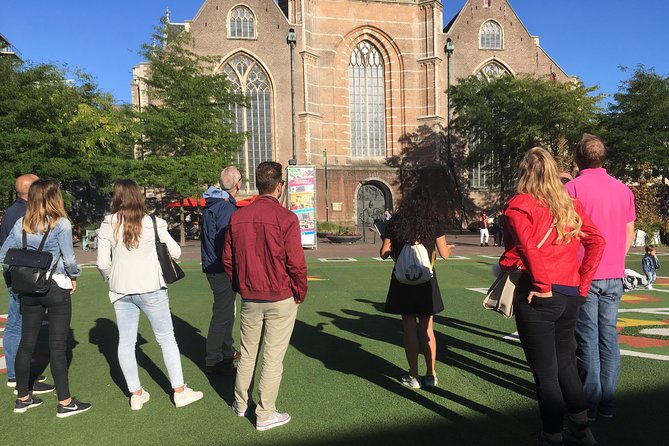
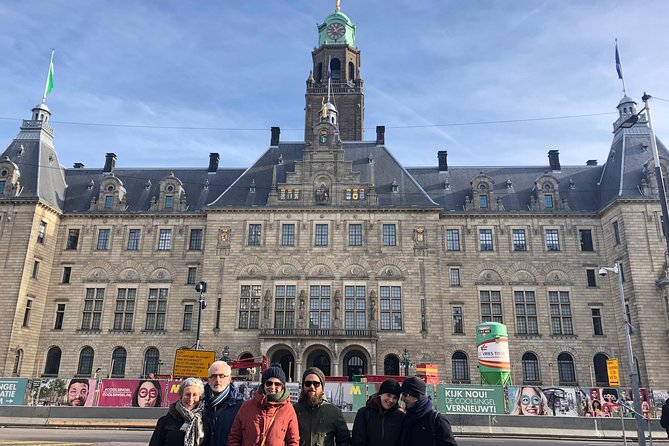
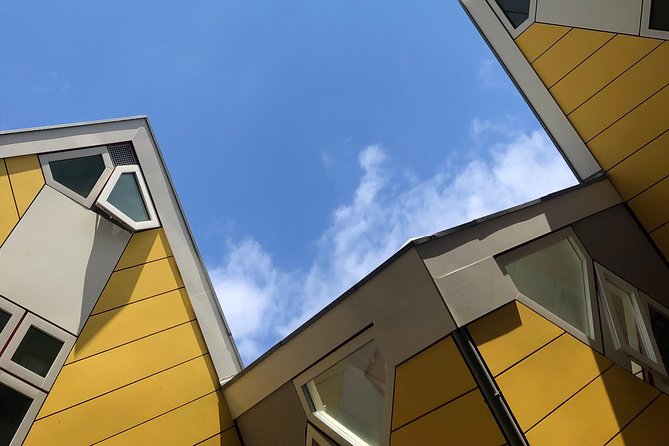
The core itinerary names Centraal Station, Lijnbaan, Sint-Laurenskerk, Markthal, and Erasmus Bridge. A detailed walking experience described by one participant also covered or passed major structures such as the Groot Handelsgebouw, Cube Houses, the Pencil Building, Timmerhuis, City Hall, the White House, and the Maas riverfront.
I would treat those extra sights as possible route coverage rather than guaranteed extended stops. The exact order and amount of explanation can depend on the guide, the group, and the pace. The formal stop list promises the main landmarks, while the walk between them is where many additional buildings and urban details may appear.
This is one reason the guide matters so much. The strongest part of the experience is not simply reaching a famous building. It is hearing how architecture, engineering, politics, culture, and city planning fit together.
A solo participant received a longer, more personalized discussion and described the experience as about two and a half hours. The advertised duration is approximately two hours, so do not schedule a tight connection immediately afterward. The actual pace can vary, especially if the guide answers questions or the group pauses for photographs.
Finish beside the Maas with the Erasmus Bridge
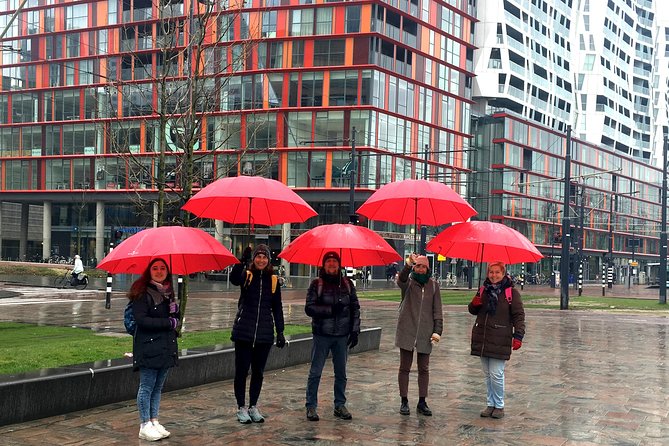
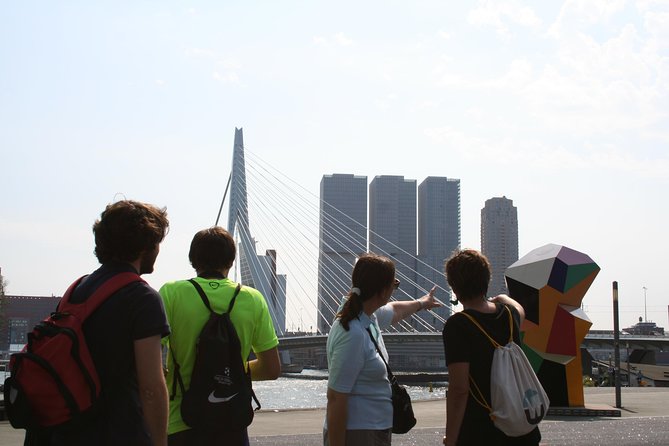
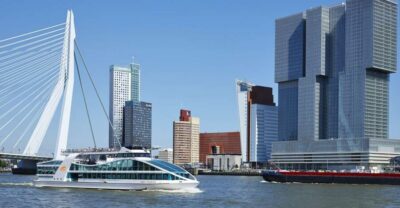
The tour ends at Boompjeskade, 3011 Rotterdam, beside the Maas river. This is a good finishing point because it opens the view beyond the compact center and toward Rotterdam’s famous bridges and newer high-end developments on the opposite side of the river.
The Erasmus Bridge is the headline landmark here, but the setting also helps you understand Rotterdam as a port city with a strong modern business identity. After the earlier stops, the riverfront gives the city room to breathe. You can see how the center relates to the water and to development across the Maas.
The formal end point is not the same as the starting point, so plan your next move before you set out. The tour does not include hotel pickup or drop-off. You will need to make your own way back, continue sightseeing along the river, or use public transportation from the area.
The final 10-minute stop may not satisfy anyone hoping for a long bridge walk. The advantage is that the guide finishes at a memorable viewpoint rather than returning you to the station. You can continue taking photographs or exploring the waterfront afterward.
What the guides add to the walk
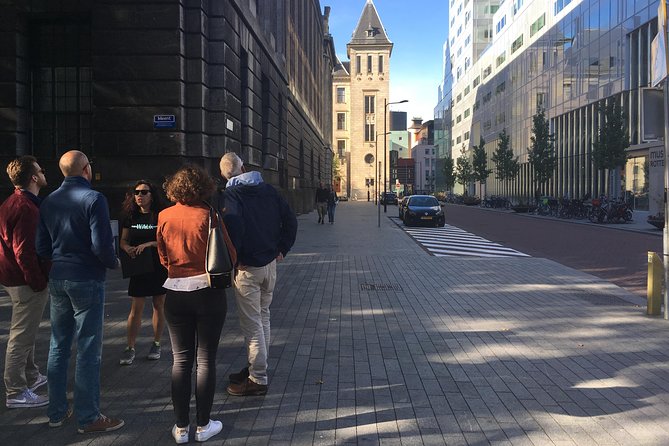
The experience includes a local guide and a professional architect guide. The material also describes the guide as a professional art historian, so the emphasis is not limited to quick facts or standard sightseeing commentary.
Guide quality appears to be a major strength. Tania was praised for knowing her material and keeping the walk engaging in cold January weather. Sonia, described as a local architect, led a tour focused on the rebuilt downtown and the urban design choices made after the city’s destruction.
Those names do not mean Tania or Sonia will lead your particular departure. The guide can vary, and the activity may use a multilingual guide. Still, the comments point to the kind of experience you should expect: explanation of buildings, city planning, engineering, politics, culture, and memorial sites.
I especially like that the tour can move beyond dates and labels. One detailed account included explanations of sculptures and memorial places that a visitor might otherwise pass without understanding. That kind of context is the real reason to choose this walk instead of following a map on your phone.
The tradeoff is that an expert-led discussion may be more serious than a light sightseeing stroll. If you want nonstop jokes and rapid landmark collecting, this may feel slower. If you like knowing why a city looks the way it does, the format should suit you well.
Is $54.06 a fair price?
At $54.06 per person, this is not the cheapest way to see Rotterdam’s center. You are paying for a roughly two-hour guided walk, a local guide, and professional architectural interpretation. There is no included meal, drink, hotel transfer, or entrance ticket.
The value depends on what you want from the city. If you only need directions to the Markthal and Erasmus Bridge, you can visit those places independently for far less. If you want someone to connect the postwar rebuilding, surviving historic buildings, modern structures, and riverfront development, the fee becomes easier to justify.
The lack of admission charges is not a major problem here because the tour is built around exterior architecture and public spaces. You are paying for the guide’s time and interpretation, not for paid museum entry.
Group discounts may reduce the cost for some bookings. The maximum group size is 20, which is small enough to keep the experience organized but not necessarily intimate. The best value is likely in a small group, when you can ask questions without slowing everyone down.
The tour is booked about 31 days ahead on average, which suggests you should not leave it until the final morning if your schedule is fixed. That does not guarantee every date sells out, but advance planning is sensible.
Practical advice for a comfortable walk
Wear shoes you can use comfortably for two hours on city streets. The route connects several central districts and ends by the river, so you should expect continuous walking rather than a few short transfers between sites.
Dress for the forecast. The experience runs outdoors, and the January feedback makes clear that cold weather can affect comfort even when the guide is engaging. Rain protection is sensible in Rotterdam, and sunglasses may help on a bright day.
Carry water and keep your phone charged. One long version of the walk included many photo opportunities, and a full battery lets you record buildings, sculptures, bridges, and views without worrying about your camera dying halfway through.
You need moderate physical fitness. The tour is not presented as accessible only to highly athletic people, but it is still a walking activity with no hotel transport. Service animals are allowed, and the route is near public transportation.
The minimum age is 12. A booking must include at least two people, so a person traveling alone should check the booking conditions carefully. A solo participant has taken the walk before and received extra attention, but the stated booking rule still requires a minimum of two people per reservation.
Free cancellation is available if you cancel at least 24 hours before the local start time. Changes or cancellations inside that window are not accepted for a refund.
Who should book this Rotterdam walk?
I would choose this tour for a first visit to Rotterdam, especially if you are curious about architecture and want a clear introduction to the rebuilt city center. It also works well at the start of a stay because the route helps you identify places worth revisiting later.
It suits adults and older children aged 12 and up who can manage a two-hour walk and enjoy listening. Students of architecture, urban design, engineering, or modern European history may find the guide’s subject especially useful.
Food-focused visitors should see the Markthal as a short orientation stop, not a tasting tour. You can buy your own snack, but the price does not cover food and drinks, and you may not have enough time for a relaxed meal.
This is less suitable if you want indoor shelter, extensive church interiors, hotel transportation, or a private tour with guaranteed stops at every famous building. It is also not the best choice for a very tight schedule, since the walk can run longer than the approximate two-hour estimate.
Should you book the Cultural Walking Tour in Rotterdam?
Book it if you want Rotterdam explained, not just photographed. The strongest reasons are the professional architectural focus, the clear postwar story, the contrast between Sint-Laurenskerk and the modern center, and the finish beside the Maas.
I would be comfortable paying $54.06 when the guide is the priority and you are new to the city. Go prepared for weather, walking, and a market stop where you pay for your own food. If you prefer to move at your own pace or spend a long time inside the Markthal, explore independently instead.
For many first-time visitors, this is a useful two-hour orientation with real substance. Its best moments come when the guide explains why Rotterdam chose to rebuild boldly rather than simply replace what had been lost.
FAQ
Where does the tour begin?
The tour begins at Rotterdam Central Station, 3013 AJ Rotterdam, Netherlands.
Where does the tour end?
It ends at Boompjeskade, 3011 Rotterdam, beside the Maas river.
How long does the experience last?
The stated duration is approximately two hours. One account describes a walk lasting about two and a half hours, so allow some extra time.
What language is the tour offered in?
The tour is offered in English. It may be operated by a multilingual guide.
What landmarks are included?
The main route includes Rotterdam Centraal Station, the Lijnbaan, Grote or Sint-Laurenskerk, Markthal, and the Erasmus Bridge.
Is food included?
No. Snacks and drinks are not included. You can purchase your own food at the market.
Is hotel pickup provided?
No. Hotel pickup and drop-off are not included.
How many people can join the tour?
The maximum group size is 20 people.
Is there a minimum age?
Yes. The minimum age is 12.
Can I cancel for a full refund?
Yes, if you cancel at least 24 hours before the experience start time. Cancellations or changes made less than 24 hours beforehand are not accepted for a refund.
Just added around Rotterdam
- Rotterdam: Summer Cocktail Cruise★ 4.7 · 18 reviews
- Skip the Line: SS Rotterdam Steam Ship Entrance Ticket★ 4.5 · 18 reviews
- Rotterdam: Beer Brewery Noordt Tastings with Optional Tour★ 4.9 · 18 reviews
- Guided 3-Hour Food Tasting Experience in Rotterdam★ 5.0 · 19 reviews
- Private Day Trip from Amsterdam to Rotterdam and the Hague★ 5.0 · 19 reviews
- Rotterdam Must Do Tour: Highlights, History, WW2 and Architecture★ 5.0 · 20 reviews
- Private Day Tour: Rotterdam and The Hague. English or Spanish★ 4.5 · 20 reviews
- Private Day Tour to Keukenhof Gardens – from Amsterdam/Rotterdam★ 5.0 · 20 reviews
Rotterdam Tours, compared.



Kinderdijk UNESCO World Heritage Entry Ticket
Read our review →
Browse the lists this tour appears in