
REVIEW · ROTTERDAM TOURS
Rotterdam: Art and Architecture Highlights Walking Tour
Rotterdam makes modern architecture feel personal. This 2.5-hour walk gives you a clear route through the city’s rebuilt center, from Central Station to the Cube Houses and Markthal. I like the focus on postwar architecture and the open-air art collection, and I also like that the tour connects museums, street art, and daily city life rather than treating each sight as a separate photo stop. The main consideration is that you will spend the whole tour outdoors, rain or shine, with no food, transport, or entry tickets included.
You meet by Rotterdam Central Station, under the clock at the main entrance. From there, an English-speaking guide leads you through a compact but busy stretch of the city. The tour is wheelchair accessible, though it is not suitable for people with visual or hearing impairments. Comfortable shoes and weather-ready clothing are essential.
In This Review
- Key points to know before you book
- Why Rotterdam is such a good city for an architecture walk
- Starting under the clock at Central Station
- The Calypso building and Theater Square
- The Kunsthal, New Institute, and Boijmans Depot
- Public art and the memory of the bombed city
- Witte de Withstraat, Rotterdam’s artsy pause
- Cube Houses and the walk toward Markthal
- What $65 gets you
- Practical details that affect the experience
- Who will enjoy this Rotterdam walk most
- Should you book it?
- FAQ
- Where does the Rotterdam architecture tour meet?
- How long does the tour last?
- What language is the tour offered in?
- Are museum entry tickets included?
- Is food or transportation included?
- Is the tour wheelchair accessible?
- What should I bring?
Key points to know before you book
- Central Station sets the tone: Begin with Rotterdam’s dramatic modern gateway and the story of the city’s postwar rebuilding.
- The Museum Quarter packs in major architecture: See the Kunsthal, the New Institute, and the Boijmans Depot from the outside.
- Public art is part of the route: Works linked to Henry Moore, Rodin, Picasso, and Joep van Lieshout help explain Rotterdam’s artistic character.
- Witte de Withstraat adds street life: This artsy street brings galleries, bars, and a younger feel to the walk.
- The Cube Houses and Markthal make a strong finish: The route ends where unusual architecture and public space meet.
- The $65 price buys context, not admission: It can be good value if you want a guided introduction, but less so if you prefer to explore buildings independently.
Why Rotterdam is such a good city for an architecture walk
Rotterdam is unlike most Dutch cities. You will not find a center dominated by old canal houses and preserved medieval lanes. Much of the central city was destroyed during the Second World War, and the rebuilding that followed gave architects room to try new ideas.
That history matters because the city’s modern buildings are not random decorations. They reflect a decision to rebuild boldly. A guide can point out how transport, public space, art, and commerce fit together, helping you see Rotterdam as a city shaped by planning as much as by individual buildings.
The route also gives you a useful first orientation. In 2.5 hours, you move from the station through the central shopping and theater areas, across the Museum Quarter, along Witte de Withstraat, and toward the Cube Houses and Markthal. You will not enter the museums or spend long periods inside each building, but you will get a framework for deciding where to return later.
I think that makes this especially useful early in a Rotterdam stay. You get the city’s basic visual vocabulary before setting out on your own.
More Walking Tours in Rotterdam
- Rotterdam: Architectural Highlights Guided Walking Tour
★ 4.8 · 215 reviews - Rotterdam Walk: Hilights, Gems, Architecture & WWII | 2 or 3hrs
★ 5.0 · 149 reviews - Rotterdam: Highlights & Gems Walking Tour with Dutch Local
★ 5.0 · 133 reviews
Starting under the clock at Central Station
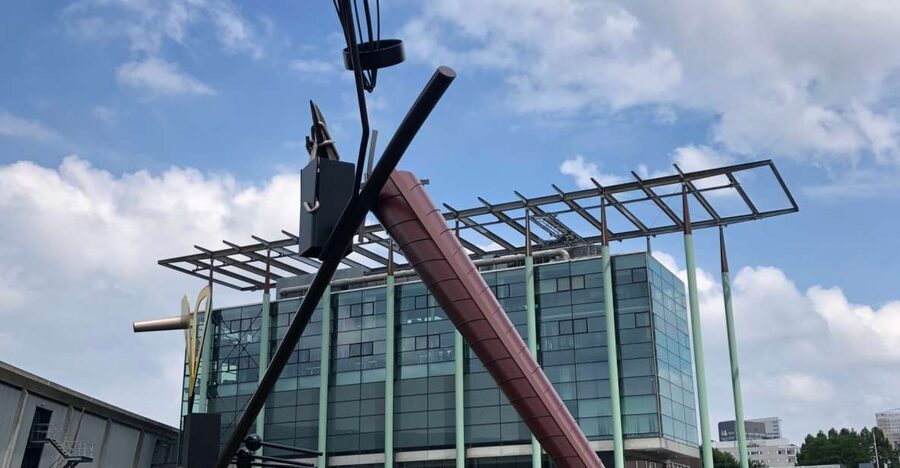
Central Station is an appropriate meeting point. It is easy to find, well connected, and one of Rotterdam’s clearest examples of modern civic design. Look for the main entrance and the clock above it, then meet the guide underneath.
The station is more than a place to catch a train. Its bold roof and angled forms introduce the city’s taste for large, confident gestures. Beginning here also gives the guide a natural way to explain Rotterdam’s rebuilding and the contrast between the old city that was lost and the new city that took shape afterward.
One particularly strong part of the experience is the way the tour uses Central Station as a starting point for the city’s modern planning story. A September 2024 review praised guide Diana for explaining Rotterdam’s postwar development from this station onward, including its planning and architecture. That is useful praise because it identifies the tour’s real strength: connecting buildings to the decisions behind them.
You should arrive ready to walk soon after the meeting time. Hotel pickup and drop-off are not included, and transportation is not provided during the tour. Since the meeting point is at the station, you will need to make your own way there.
The Calypso building and Theater Square
From Central Station, the route follows several of the city center’s architectural landmarks, including the Calypso building and Theater Square. These stops help show that Rotterdam’s modern identity is not limited to one spectacular structure. It appears in housing, performance spaces, public plazas, and commercial buildings.
The Calypso building is one of the more noticeable residential forms along the central route. Theater Square adds another layer, with a public setting designed around cultural life rather than just traffic or shopping. You can expect the guide to explain how these spaces fit into the city’s changing center and why Rotterdam often gives architecture a very visible role.
This portion is valuable if you are still trying to understand how the city works. Instead of seeing modern buildings as isolated objects, you begin to notice how they shape streets and gathering places.
The trade-off is that this is a walking explanation rather than an interior architecture visit. Entry tickets are not included, and the activity does not promise access inside the buildings. If your main goal is to study interiors, you may need to plan separate visits.
The Kunsthal, New Institute, and Boijmans Depot
The route then reaches Rotterdam’s Museum Quarter, where the Kunsthal and the New Institute are presented alongside the Boijmans Depot. This section gives you three different approaches to culture and design within a fairly compact area.
The Kunsthal is known for its strong architectural presence and changing exhibitions. The New Institute adds a focus on architecture, design, and digital culture. The Boijmans Depot is the newest visual surprise, with its rounded mirrored exterior reflecting the surrounding city.
The Depot has an unusual purpose. It is the first publicly accessible museum depot in the world, allowing visitors to see how an art collection is stored and managed rather than only viewing finished exhibitions. On this walking tour, you should expect an exterior explanation rather than an included museum visit. Still, the building is important enough to make the stop worthwhile.
I like this part of the route because it shows Rotterdam’s interest in the systems behind art. The city does not only display famous works in traditional galleries. It also experiments with how collections are stored, how buildings interact with the public, and how museums can become architectural attractions in their own right.
Bring your camera, but do not expect a long museum break. The pace is designed to cover several districts and landmarks, so the guide’s interpretation is the main event here.
More walking tours:
- Rotterdam 2-Hour Walking Tour | Discover The City With A Local
★ 4.5 · 111 reviews - Walking Rotterdam Food Tour
★ 5.0 · 89 reviews - Rotterdam: City Center Walking Tour
★ 4.5 · 88 reviews - Rotterdam Architecture Highlights Walking Tour
★ 5.0 · 66 reviews
Public art and the memory of the bombed city
Rotterdam’s outdoor art collection gives the tour a more human side. Along the route, you encounter works connected with the drama of the bombed city, as well as a mix of street art and major modern sculptures.
The subject can be heavy, but it explains why art matters so much in Rotterdam’s public spaces. Monuments and sculptures are not simply placed around the city for decoration. They help keep the destruction and rebuilding of Rotterdam visible while also showing how later generations used art to shape new surroundings.
The artists associated with the route include Henry Moore, Auguste Rodin, Pablo Picasso, and Joep van Lieshout. Those names cover very different styles and periods. You may find that the contrast between large public sculpture, spontaneous street art, and planned architecture is one of the most interesting parts of the walk.
This is also where a guide adds real value. A quick solo walk might let you spot a sculpture, but it may not explain why it is there or how it relates to Rotterdam’s wider story. The tour gives the artwork a place in the city’s civic life.
Keep in mind that the tour is not presented as a specialist art lecture. It is an overview that links art, architecture, and urban history. That broad approach suits first-time visitors best.
Witte de Withstraat, Rotterdam’s artsy pause
Witte de Withstraat is described as the city’s most vivid and artsy street, and it provides a change of mood after the larger museums and monuments. The street is known for its creative atmosphere and popular art venues, making it a natural place to discuss Rotterdam’s younger cultural side.
You will walk rather than stop for a meal, since food and drinks are not included. Still, the street makes a useful midpoint in the tour. It shows how art is not confined to museums. Galleries, public displays, bars, and street activity all contribute to the character of this part of town.
I like this stop because it prevents the tour from becoming a parade of large buildings. Witte de Withstraat feels more immediate and lived-in. It gives you a sense of where Rotterdam’s cultural energy appears at street level.
The wording about the street’s character should not lead you to expect a quiet historic lane. This is an urban area with plenty going on, and the guide may need to keep the group moving. Stay alert to the walking pace and be ready to pause at the points the guide selects.
Cube Houses and the walk toward Markthal
The Cube Houses bring the tour into one of Rotterdam’s most recognizable architectural experiments. Their angled forms challenge the usual idea of a house as a box, and the complex is easy to understand visually even if you know little about architecture.
The guide can help you see the Cube Houses as part of a larger attempt to rethink urban living. Their unusual design raises practical questions about space, light, furniture, and daily life. You may leave admiring the idea while also wondering how comfortable the interiors are. That tension is part of the fun.
This is one of the best photo stops on the route, but it is also a place where the guide’s explanation matters. Without context, you might only see a collection of tilted yellow structures. With context, you can consider why the buildings were designed this way and how they fit into Rotterdam’s preference for experimental forms.
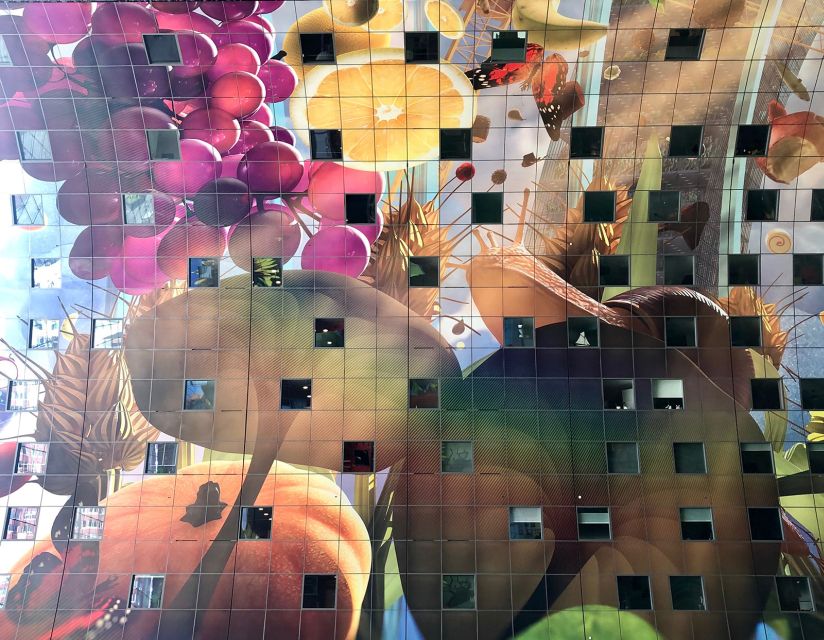
The tour finishes at the Markthal, where art and architecture come together under one enormous roof. The building’s interior artwork turns an ordinary market setting into a dramatic public room. Food stalls and vendors give the space a practical purpose, so the Markthal does not feel like architecture set apart from everyday life.
Because food and drinks are not included, you can decide what to eat after the official tour ends. That is convenient if you want to linger, browse, or make the Markthal your next stop. The ending also places you near one of Rotterdam’s most useful central attractions.
What $65 gets you
At $65 per person, this is not a cheap orientation walk. The value depends on what you want from Rotterdam.
You are paying for a live English-speaking guide, a planned route through several important districts, and explanations that connect architecture with war, planning, public art, and cultural change. For a first visit, that can save you time and help you understand why Rotterdam looks the way it does.
The price is easier to justify if you would otherwise walk past the buildings without knowing their purpose or background. It is less attractive if you mainly want photographs, already know the city, or prefer to read about architecture at your own pace.
No entry tickets are included, so budget separately if you want to visit the Kunsthal, the New Institute, or the Boijmans Depot after the tour. You also pay for your own food and drinks. The tour does not include transport, though the central meeting point and compact route make it suited to exploring on foot.
A private group option is available. That may be worth considering if you want to ask many questions or keep the pace suited to your party. The standard format is better for people who want a straightforward introduction without arranging a full private itinerary.
Practical details that affect the experience
The walk lasts 2.5 hours, which is long enough to cover a lot but short enough to fit into a busy day. You should wear comfortable shoes because the route is entirely on foot and includes several different city areas.
The tour operates rain or shine. Rotterdam weather can change quickly, so seasonal clothing and a rain layer are sensible. Do not plan this as a polished indoor museum visit. Its appeal comes from seeing the city directly, including its streets, plazas, sculptures, and building exteriors.
The activity is wheelchair accessible, but the supplied information says it is not suitable for people with visual or hearing impairments. If either issue affects your ability to follow a guided outdoor walk, contact the provider before booking.
Oversize luggage is not allowed, and unaccompanied minors cannot take part. Children must be accompanied by an adult. Free cancellation is available up to 24 hours in advance, and you can reserve now while paying later, which helps if your schedule is still moving around.
Who will enjoy this Rotterdam walk most
I would choose this tour if you are visiting Rotterdam for the first time and want a solid introduction to its modern center. It is also a good fit if you enjoy architecture but do not want a technical lecture filled with specialist terms.
Art lovers get a useful mix of public sculpture, street art, museum buildings, and the Markthal’s large interior artwork. History-minded visitors benefit from the focus on the bombed city and its postwar rebuilding. Photographers get plenty of unusual angles, especially around Central Station, the Cube Houses, and the Markthal.
You may want something else if you prefer long museum visits, a food tour, or a relaxed walk with very few stops. The route covers a lot of ground, and the outdoor format means weather will shape your experience.
The high rating of 4.9 from 10 reviews points to a consistently positive small sample. The strongest praise centers on clear information, a pleasant walk, and a good overview of Rotterdam. One French review described the tour as a helpful way to gain the right perspective on the city’s modern history, architecture, and relationship with art. That is a fair description of what this experience does best.
Should you book it?
Book this walk if you want Rotterdam explained through its buildings and public art, not just listed as a series of photo stops. The route is well chosen, the meeting point is simple, and the finish at the Markthal gives you an easy place to continue exploring.
I would especially recommend it for a first full day in Rotterdam, when a clear introduction can shape the rest of your visit. The $65 cost is reasonable if you value interpretation and an organized route, but remember that museum entry, food, drinks, and transportation are extra.
Choose a private group if personal questions and a tailored pace matter to you. Otherwise, pack good shoes, prepare for the weather, and expect a brisk outdoor lesson in why Rotterdam rebuilt itself with such remarkable confidence.
FAQ
Where does the Rotterdam architecture tour meet?
The meeting point is by Rotterdam Central Station, next to the main entrance and under the station’s clock.
How long does the tour last?
The walking tour lasts 2.5 hours.
What language is the tour offered in?
The tour is conducted in English by a live guide.
Are museum entry tickets included?
No. Entry tickets are not included in the tour price.
Is food or transportation included?
No. Food, drinks, and transportation are not included. Hotel pickup and drop-off are also not provided.
Is the tour wheelchair accessible?
Yes, the activity is listed as wheelchair accessible. It is not suitable for people with visual or hearing impairments.
What should I bring?
Wear comfortable shoes and weather-appropriate, seasonal clothing. The tour takes place rain or shine. Oversize luggage is not allowed.
Just added around Rotterdam
- Private tour: Markthal, Cube houses and Rooftop Het Witte Huis★ 4.5 · 3 reviews
- Private tour from Rotterdam to Windmills of Kinderdijk & Gouda Cheese Experience★ 5.0 · 3 reviews
- Discover Rotterdam: Classic Highlights Bike Tour by a Local★ 5.0 · 3 reviews
- Discover Rotterdam’s most Photogenic Spots with a Local★ 5.0 · 3 reviews
- Private Transfer from Rotterdam Port to Amsterdam Airport (AMS)★ 5.0 · 3 reviews
- privatetour Delft, The Hague&Rotterdam Kinderdijk from Amsterdam★ 5.0 · 3 reviews
- Rotterdam: Capture the most Photogenic Spots with a Local★ 5.0 · 3 reviews
- Private Tour of Rotterdam and The Hague including Transfer★ 5.0 · 3 reviews
Rotterdam Tours, compared.


Kinderdijk UNESCO World Heritage Entry Ticket
Read our review →
Browse the lists this tour appears in