
REVIEW · ROTTERDAM TOURS
Rotterdam Travel to the Future Walking Tour
Rotterdam looks like a city designed by tomorrow. This three-hour private walk links rooftop farming, public art, and bold architecture with stories about how Rotterdam rebuilt and reinvented itself. I like the focus on real urban projects, and I like that guides such as Danya or Danil have taken visitors beyond the standard postcard stops. The main drawback is the price: at $274.03 per person, this is a costly walking tour unless your group values a private guide.
You should also know that coffee, snacks, and paid entrance tickets are not included. The walk is offered in English, uses a mobile ticket, and begins near Ode aan Marten Toönder before finishing at Erasmusbrug, although the Cube Houses are listed after the bridge stop, so it is sensible to confirm the exact route and final meeting point before setting out.
In This Review
- Key points at a glance
- Why Rotterdam makes a fine city of the future
- De Luchtsingel and the yellow route into Rotterdam
- Street art that explains the city from the side
- The old city survives beside the new
- Markthal, food, and architecture under one roof
- Erasmus Bridge and the view across the river
- Cube Houses and the lessons of experimental housing
- The guide makes or breaks this private walk
- Is $274.03 per person fair value?
- Who should book this Rotterdam walk?
- FAQ
- How long does the Rotterdam future walking tour last?
- Is the tour private?
- Is the tour offered in English?
- What is included in the price?
- Are coffee and tea included?
- Are snacks included?
- Are entrance tickets included?
- Where does the tour begin?
- Where does the tour end?
- Can I cancel for a full refund?
- Is the tour suitable for most people?
- Are group discounts available?
- Should you book it?
Key points at a glance
- A private look at Rotterdam’s future: Your group explores experimental public spaces, rooftop food production, and modern city planning with a certified guide.
- De Luchtsingel and rooftop farming: The yellow wooden footbridge and DakAkker help explain how neglected parts of Rotterdam were brought back into daily use.
- Street art with context: Graffiti and sculptures are not just quick photo stops. The guide explains the stories and ideas behind selected works.
- Markthal and Cube Houses: These famous buildings become easier to understand when connected to housing, architecture, food, and public space.
- Good for families and repeat visitors: Guides have kept children aged 5 and 7 interested, and one long-time Rotterdam resident discovered unfamiliar parts of the city.
- Private, but expensive: The price makes the most sense for a small family or group that wants flexibility and conversation rather than a low-cost overview.
Why Rotterdam makes a fine city of the future
Rotterdam is not a city of one tidy historic center. Much of it was destroyed during the Second World War, and its rebuilt center took a different path from older Dutch cities such as Delft or Leiden. Instead of recreating the past street by street, Rotterdam made room for new forms, new uses, and plenty of architectural experiments.
That gives this tour a clear purpose. You are not simply collecting photographs of the Cube Houses or Erasmus Bridge. You are looking at how a city uses buildings, bridges, food production, art, and open spaces to change the way people live.
I especially like the tour’s attention to projects that are easy to miss. A visitor can walk through central Rotterdam and notice the big structures without understanding the smaller ideas around them. A yellow wooden road, a rooftop farm, a public garden designed by Piet Oudolf, and a bridge built with help from local crowdfunding tell a more complete story.
The private format matters here. Your guide can adjust the pace, answer questions, and spend more time on the subjects that interest you. If you want a quick list of famous buildings, a standard group walk may be better value. If you want to ask why a project exists and how it affects the city, private guiding has a real advantage.
More Walking Tours in Rotterdam
- Rotterdam: Architectural Highlights Guided Walking Tour
★ 4.8 · 215 reviews - Rotterdam Walk: Hilights, Gems, Architecture & WWII | 2 or 3hrs
★ 5.0 · 149 reviews - Rotterdam: Highlights & Gems Walking Tour with Dutch Local
★ 5.0 · 133 reviews
De Luchtsingel and the yellow route into Rotterdam
The opening portion focuses on innovative public spaces. One of the most memorable examples is De Luchtsingel, a bright yellow wooden footbridge that reconnects parts of central and northern Rotterdam.
The bridge is 390 meters long and links the Schieblok area with Hofbogen. That simple connection carries a larger story. The project was associated with the Rotterdam architectural firm ZUS and supported by the city. Much of its funding came through a crowdfunding campaign involving local residents.
That detail gives the bridge more meaning than its color alone. It was not simply dropped into the city as a finished monument. It helped bring attention and movement to an area that had suffered from neglect, while showing how residents could support a public project directly.
You may also hear about the former railway viaduct at Hofbogen. The arches beneath it now hold boutiques, design shops, restaurants, bars, and cafes. The tour information does not promise time inside each business, so think of this as an urban-design stop rather than a shopping session.
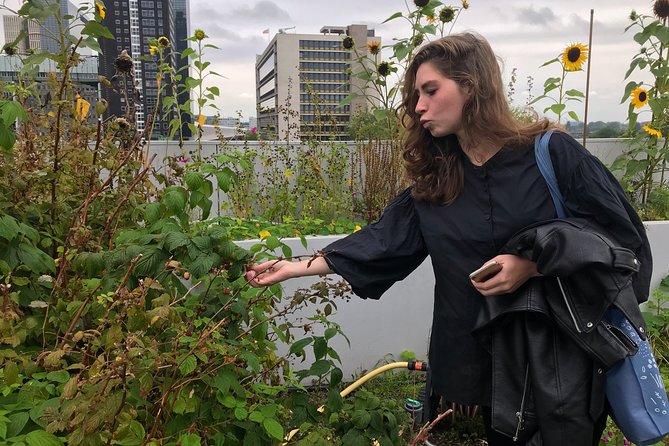
The yellow route also leads toward DakAkker, a rooftop farm on the Schieblock. At about 1,000 square meters, it grows vegetables, fruit, and edible flowers and keeps bees. The farm is one of the clearest examples of Rotterdam’s practical approach to city-making: a roof becomes productive space instead of unused concrete.
A bistro has operated there, and the site can host public events such as harvest festivals, lunches, and seminars. Food and drinks are not included in the tour, so bring money if you want to stop for coffee or something to eat. The exact food operation can change, so do not plan your day around a specific cafe without checking first.
The route also brings in a garden designed by Piet Oudolf. That adds a softer note to a tour otherwise filled with wood, concrete, steel, and glass. You can expect discussion of planting, public use, and the role of design in making city spaces more pleasant.
Street art that explains the city from the side
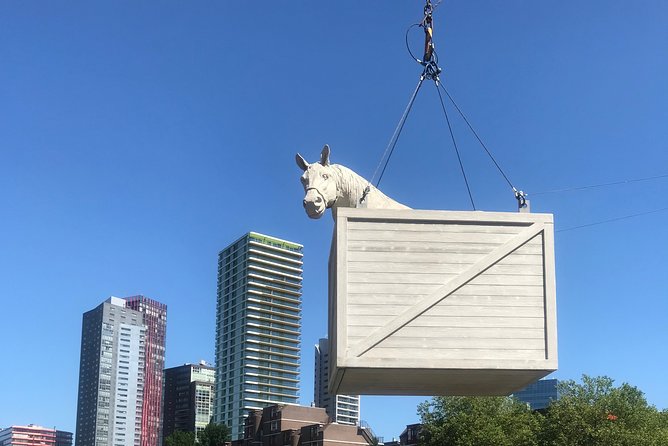
Rotterdam’s public art is one of the strongest parts of this experience. The scheduled street-art stop lasts about 15 minutes, but the art may appear in several places along the walk.
The guide points out street sculptures and graffiti while explaining the stories behind selected pieces. That matters because Rotterdam’s wall art can be easy to pass without a second look. A painted wall may seem like decoration, a tag, or a random burst of color until someone explains its subject and local setting.
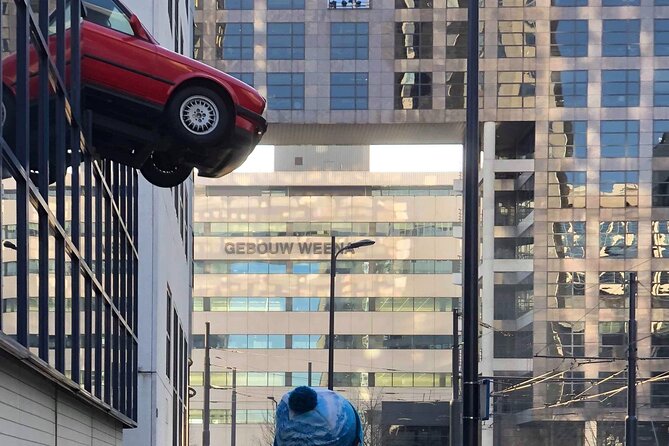
The long account from a repeat Rotterdam resident gives a useful sense of what this part can do. The guide led her away from the obvious center and onto a bright yellow street, past a red car breaking through a wall, and into a courtyard filled with art. The point was not just to find attractive pictures. It was to show how art can connect neighborhoods and comment on social divisions.
That is a good reason to choose a guide-led walk rather than explore alone with a map. Public art changes quickly, and its meaning is rarely printed on a plaque. The guide can also help you notice the difference between a formal sculpture, commissioned work, and graffiti with a stronger social message.
The short scheduled time is a possible limitation. Art lovers may want much longer than 15 minutes, especially if the guide finds several pieces worth discussing. If street art is your main interest, ask whether the guide can devote extra time to it within the private format.
The old city survives beside the new
The stop at Grote of Sint-Laurenskerk provides a needed change of pace. Rotterdam is famous for modern architecture, but Laurenskerk is a reminder that the city did not begin with postwar construction.
The church and the old city hall area help place today’s Rotterdam in a longer story. Your guide is expected to introduce important figures and explain parts of the city’s earlier history without turning the walk into a date-heavy lecture.
That balance is important. The experience is built around the future, but modern Rotterdam makes more sense when you understand what came before the war and how the city changed afterward. The church gives you a visual pause from experimental buildings and a chance to connect the present city to its older identity.
The stop is listed at about 15 minutes, so expect an introduction rather than a full interior tour. Entrance tickets are not included, and the experience does not promise admission inside the church. If you specifically want to visit Laurenskerk, ask the guide or check opening details separately.
More walking tours:
- Rotterdam 2-Hour Walking Tour | Discover The City With A Local
★ 4.5 · 111 reviews - Walking Rotterdam Food Tour
★ 5.0 · 89 reviews - Rotterdam: City Center Walking Tour
★ 4.5 · 88 reviews - Rotterdam Architecture Highlights Walking Tour
★ 5.0 · 66 reviews
Markthal, food, and architecture under one roof
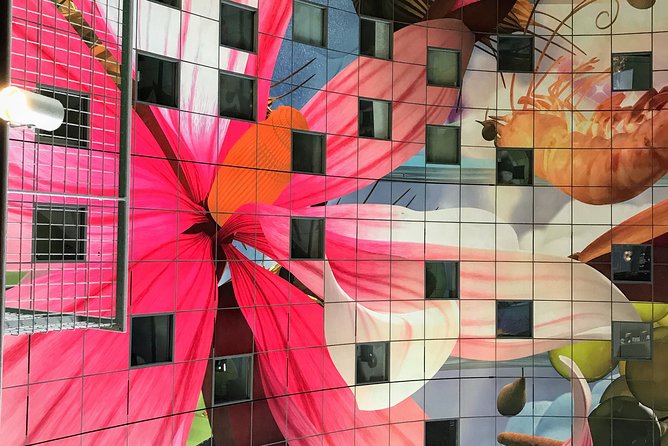
Markthal is one of Rotterdam’s best examples of architecture designed around public use. The building by MVRDV combines homes with an indoor market, creating a large covered space where eating, shopping, housing, and visual spectacle meet.
The scheduled stop lasts about 30 minutes. You will walk through the market and hear how the building works as architecture and as a public place. This is also the most obvious opportunity to buy food during the tour.
Possible tastes include herring, farmer cheese, Dutch wine, truffle sausages, and other food products. Since snacks are excluded, anything you sample comes at your own cost. That is not a flaw, but you should budget for it if tasting is part of your plan.
I like the way Markthal fits the theme of the walk. It is not futuristic merely because it looks unusual. It asks how a market can function in a dense city and how housing can be combined with public activity. The guide can help you look past the colorful interior and see the building as a response to urban needs.
Families may enjoy this stop because food gives younger children something immediate to focus on. One family with children aged 5 and 17 found the private walk engaging for everyone, and another family said a 7-year-old stayed interested. The market setting helps, but the guide’s storytelling is still important.
You should not expect a full meal during the scheduled half hour. If you want to taste several items or sit down, plan extra time after the tour.
Erasmus Bridge and the view across the river
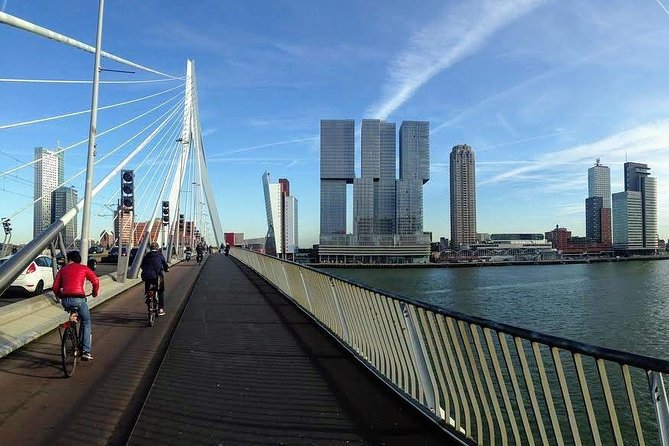
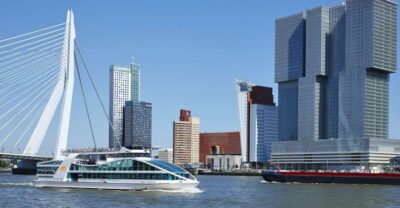
Erasmus Bridge is the tour’s main city-view stop. Its long white form and angled support have made it one of Rotterdam’s best-known modern symbols.
The stop is listed at about 15 minutes, giving you time to take in the river and the opposite side of the city while your guide explains the bridge and the wider architectural setting. This is likely to feel more open and scenic after the tighter streets, courtyards, market spaces, and building details earlier in the walk.
The route also refers to OMA and Rem Koolhaas, connecting the bridge stop to Rotterdam’s larger role in modern architecture. The information provided does not specify a visit inside an OMA building, so expect discussion and views rather than an indoor architectural tour.
The bridge is also listed as the end point at Erasmusbrug. Because the Cube Houses appear as a later stop in the supplied sequence, confirm how the guide handles that order. The route may involve a final transfer or a differently arranged walk, and you will want to know where you actually finish.
Cube Houses and the lessons of experimental housing
The Cube Houses are perhaps Rotterdam’s most recognizable architectural stop. Their tilted forms make an excellent photo, but the more useful part of the visit is the explanation of the ideas behind them.
The guide discusses 20th-century architectural movements, social housing, and the way unusual buildings can shape daily life. Nearby landmarks include the Pencil and Apple buildings, giving you several examples of Rotterdam’s taste for distinctive forms in a compact area.
This is where the tour’s title makes most sense. The Cube Houses were not designed only to look strange. They raise practical questions about how people live in unconventional spaces, how much private and public space a city needs, and whether experimental design can work for ordinary residents.
The tour does not include entrance tickets, and it does not promise access inside a model Cube House or other building. You can still get plenty from seeing the exterior and hearing the guide explain the concept, but architecture enthusiasts should check separately if they want an indoor visit.
The guide makes or breaks this private walk
The strongest praise attached to this experience centers on the guides. Danya, Danil Hochlovic, Danny, and Daniel appear in the supplied material, with spellings varying between accounts. That may reflect transliteration or different references to the same guiding team, so I would confirm the guide’s name when booking.
The best description of the guiding style is informative without becoming overloaded with dates. A guide named Danya was praised for showing a repeat visitor parts of Rotterdam she had never noticed, while another account highlights explanations of wartime Rotterdam, the city’s hardworking spirit, and its modern direction.
That is exactly the right approach for this city. You need enough history to understand the streets, but not so much that every stop becomes a classroom. A good guide links the building in front of you to a larger idea, then lets you keep walking.
The private setup should help families and mixed-interest groups. Adults can ask about architecture or urban planning while children focus on bridges, bold buildings, food, and street art. The experience is not presented as difficult, and most people can participate, but it is still a three-hour walk, so comfortable shoes and weather-ready clothing are sensible.
Is $274.03 per person fair value?
The price is the hardest part to overlook. At $274.03 per person, this is far above the cost of a typical group walking tour, especially since food, drinks, and entrance tickets are extra.
The comparison changes if you are booking for a small private group. You are paying for a certified guide dedicated to your party, not simply for access to the sights. That can be worthwhile if you want a flexible conversation, a family-friendly pace, or a deeper explanation of Rotterdam’s less obvious projects.
It is also a better fit for repeat visitors than for someone who only wants the city’s basic highlights. The tour does cover major sights such as Markthal, Erasmus Bridge, and the Cube Houses, but its real value lies in the connections between them: public art, rooftop food production, social housing, postwar change, and new public spaces.
Group discounts are available, though the exact savings are not given. Check the total before booking, especially if you are traveling with several people. Since the walk is private, splitting the cost across a larger group may make the rate easier to accept.
Who should book this Rotterdam walk?
I would choose this tour if you care about architecture, city planning, street art, or the way Rotterdam keeps testing new ideas. It also suits families who want one guide and one route rather than a large group moving on a fixed schedule.
It is a strong option for a repeat visitor. Several of the most interesting details are away from the standard postcard circuit, and one long-time resident discovered parts of the city she had previously overlooked.
I would be more hesitant if you want a cheap introduction, a full church visit, or a food tour with tastings included. You can see several major sights from the outside, but the price only makes sense if the guide’s interpretation is central to your plans.
The meeting point is at Ode aan Marten Toönder, Verlengde Nieuwstraat, 3011 GA Rotterdam, and the listed end point is Erasmusbrug, 3011 BN Rotterdam. The tour is near public transportation, uses a mobile ticket, and accepts free cancellation up to 24 hours before the start time. Changes or cancellations inside that window are not refundable.
FAQ
How long does the Rotterdam future walking tour last?
The experience lasts approximately three hours.
Is the tour private?
Yes. Only your group participates in the private activity.
Is the tour offered in English?
Yes. English is the stated tour language.
What is included in the price?
A certified guide is included.
Are coffee and tea included?
No. Coffee and tea are not included.
Are snacks included?
No. Snacks are not included, though you may have opportunities to buy food at Markthal.
Are entrance tickets included?
No. Entrance tickets are not included.
Where does the tour begin?
The listed starting point is Ode aan Marten Toönder, Verlengde Nieuwstraat, 3011 GA Rotterdam, Netherlands.
Where does the tour end?
The listed end point is Erasmusbrug, 3011 BN Rotterdam, Netherlands. Since the Cube Houses appear later in the stated sequence, confirm the final route details before the walk.
Can I cancel for a full refund?
Yes, if you cancel at least 24 hours before the experience starts. Cancellations made less than 24 hours before the start time are not refunded.
Is the tour suitable for most people?
The activity information says most people can participate. It is also near public transportation.
Are group discounts available?
Yes. Group discounts are offered, though the exact amount is not specified.
Should you book it?
Book this walk if you want Rotterdam explained as a working experiment, not just photographed as a collection of strange buildings. The rooftop farm, De Luchtsingel, street art, Markthal, Laurenskerk, Erasmus Bridge, and Cube Houses form a useful three-hour story about a city that rebuilt itself by trying new things.
At $274.03 per person, I would book only after confirming the guide, route order, and group discount. For a family or small group that values a private, personal experience, it can be worthwhile. For budget-minded visitors, choose a less expensive group walk and explore Markthal and the Cube Houses independently.
Just added around Rotterdam
- Private tour: Markthal, Cube houses and Rooftop Het Witte Huis★ 4.5 · 3 reviews
- Discover Rotterdam: Classic Highlights Bike Tour by a Local★ 5.0 · 3 reviews
- Private tour from Rotterdam to Windmills of Kinderdijk & Gouda Cheese Experience★ 5.0 · 3 reviews
- Discover Rotterdam’s most Photogenic Spots with a Local★ 5.0 · 3 reviews
- Private Transfer from Rotterdam Port to Amsterdam Airport (AMS)★ 5.0 · 3 reviews
- privatetour Delft, The Hague&Rotterdam Kinderdijk from Amsterdam★ 5.0 · 3 reviews
- Rotterdam: Capture the most Photogenic Spots with a Local★ 5.0 · 3 reviews
- Private Tour of Rotterdam and The Hague including Transfer★ 5.0 · 3 reviews
Rotterdam Tours, compared.


Kinderdijk UNESCO World Heritage Entry Ticket
Read our review →
Browse the lists this tour appears in