

REVIEW · ANNE FRANK TOURS
Amsterdam: Anne Frank and World War II Walking Tour (TOP RATED)
History feels different on foot. This two-hour Amsterdam walk connects the Jewish Quarter, wartime memorials, and Anne Frank’s story through streets where these events unfolded. I like the focus on real places rather than a lecture in a museum, and I like the small-group limit of 15 people, which leaves room for questions.
The tour also earns praise for guides such as James, Misha, Keese, Stan, Peter, Aaron, and Maša, who bring personal stories and modern context to the subject. The key drawback is important: the Anne Frank House is not included, despite the tour title, and some people may find the long walk tiring.
In This Review
- Key things to know before booking
- What this Amsterdam walk is really about
- Portuguese Synagogue: Amsterdam’s Sephardic past
- Auschwitz Monument and the weight of deportation
- Verzetsmuseum and the question of resistance
- Hollandsche Schouwburg and the machinery of deportation
- De Plantage: beauty beside painful memory
- Spinoza Monument and the wider Jewish story
- Dam Square, the Royal Palace, and changing city memory
- De Schaduwkade and the final memorial stop
- Anne Frank’s story without entering the house
- Guide style and the value of a small group
- Is $29.45 a fair price?
- Who should book this walk?
- Practical advice for a better experience
- Should you book the Anne Frank and World War II walk?
- FAQ
- Is the Anne Frank House included in the tour?
- How long does the walking tour last?
- Where does the tour start?
- Where does the tour end?
- What language is the tour offered in?
- What is included in the price?
- Are food and drinks included?
- How large is the tour group?
- Can I cancel for a full refund?
Key things to know before booking
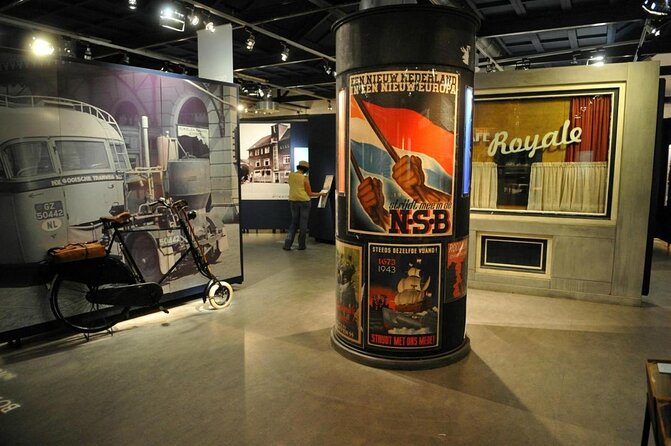
- Anne Frank House entry is not included: This is an outdoor history walk, not a museum visit. You need a separate ticket if you want to enter the house.
- The Jewish Quarter is the real focus: The route covers the Portuguese Synagogue, deportation sites, resistance history, monuments, and the wartime experience of Amsterdam’s Jewish community.
- The tour lasts about two hours: You visit several places for roughly ten minutes each, with walking time between them.
- A maximum of 15 people keeps it manageable: The group size should make it easier to hear the guide and ask questions.
- Guide quality is central to the experience: Past guides praised by name include James, Misha, Keese, Stan, Peter, Aaron, and Maša.
- The walk costs $29.45 per person: That is fair for a guided history walk, but the value depends on how much context and storytelling your guide provides.
What this Amsterdam walk is really about
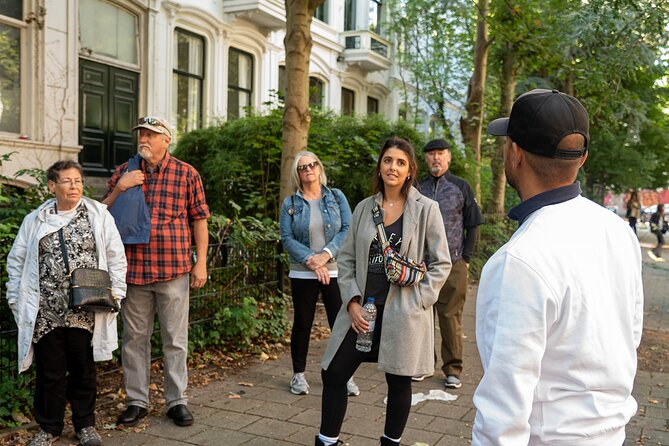
The title may lead you to expect a tour centered mainly on Anne Frank. In practice, I would think of it as a Jewish Amsterdam and World War II walk that places Anne Frank’s life within a larger story.
That wider frame is useful. Anne Frank did not live through the war in isolation. Her family’s experience connects to the history of Amsterdam’s Jewish community, Nazi deportation, resistance, memorials, and the destruction of Jewish life across the Netherlands.
The route begins near Amstel 51C, at 1018 EJ Amsterdam, and ends back at the same meeting point. It is conducted in English and includes a local guide. Food, drinks, and museum admission are not part of the price.
I like that the route uses public spaces with free admission. You are not paying for a string of entry tickets, so the money goes toward the guide’s interpretation and the time spent walking between locations. That also means the quality of the experience depends heavily on who leads your group.
More Walking Tours in Amsterdam
- Anne Frank’s Story – Guided Walking Tour through Amsterdam
★ 5.0 · 11,619 reviews - Amsterdam: Life of Anne Frank and World War II Walking Tour
★ 4.8 · 10,467 reviews - Absolutely Amsterdam – the Essential Introductory Walking Tour
★ 5.0 · 3,629 reviews
Portuguese Synagogue: Amsterdam’s Sephardic past
The first listed stop is the Portuguese Synagogue, where the guide explains the origins and importance of Amsterdam’s Sephardic Jewish community.
During the Dutch Golden Age, this community became one of the largest and wealthiest Jewish communities in Europe. The scale of the synagogue reflected that prosperity and influence. It remains an active place of worship and is also open as a tourist attraction, though this walking tour allows about ten minutes here and does not include an entrance ticket.
I see this as a useful opening because it gives you a picture of Jewish Amsterdam before the Second World War. The story begins with a community that had institutions, wealth, religious life, and a strong place in the city. That context makes the later stops more meaningful.
The short visit is also a limitation. Ten minutes is enough for an exterior explanation and a quick orientation, but not enough for a full visit to the synagogue. If the building is a major priority for you, plan separate time for it.
Auschwitz Monument and the weight of deportation
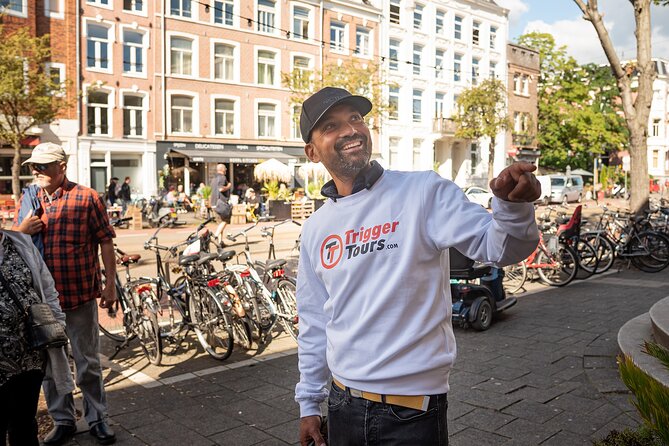
The Auschwitz Monument is one of the most solemn points on the route. Here, the guide discusses the monument and the deportation of Amsterdam’s Jewish population.
The value of a stop like this is its directness. You are not simply hearing a date or a figure in a classroom. You are standing at a place created for remembrance, with the city continuing around you. That contrast can be powerful and uncomfortable, which is appropriate for the subject.
The tour allows roughly ten minutes at the monument. I would not expect an extended ceremony or a long silent pause, but you should have time to understand what the memorial represents and ask questions.
This is a serious tour. It deals with forced removal, deportation camps, resistance, and mass murder. It is not designed as light sightseeing, and families should consider how younger children will respond. One family found the long walk tiring for children aged eight and ten, especially by the time they reached the Anne Frank Museum area.
Verzetsmuseum and the question of resistance

At the Verzetsmuseum Amsterdam, the guide explains the resistance of the Jewish community and the broader wartime setting.
The museum itself is not included in the walking tour, so you should treat this as an exterior or nearby historical stop rather than a museum visit. The guide’s explanation is what matters here. You may learn how resistance fits into the wider story of occupation, persecution, and survival.
I appreciate this part of the route because it avoids presenting Amsterdam’s wartime story as only a tale of victims and perpetrators. Resistance, individual choices, civic courage, and the limits of what people could do all deserve attention.
With only about ten minutes at the stop, the discussion will be an introduction. If the resistance museum interests you, set aside separate time to visit it. The walking tour can give you a reason to go, but it does not replace the museum experience.
More Anne Frank walks and tickets:
- Amsterdam: Anne Frank Guided Small Group Walking Tour
★ 4.8 · 2,722 reviews - Amsterdam: Anne Frank Walking Tour – Guided in EN/DE/IT/ES
★ 4.9 · 2,676 reviews - Anne Frank Walking Tour Amsterdam Including Jewish Cultural Quarter
★ 5.0 · 1,879 reviews - Anne Frank’s Last Walk & See Anne Frank House in Virtual Reality
★ 5.0 · 957 reviews
Hollandsche Schouwburg and the machinery of deportation
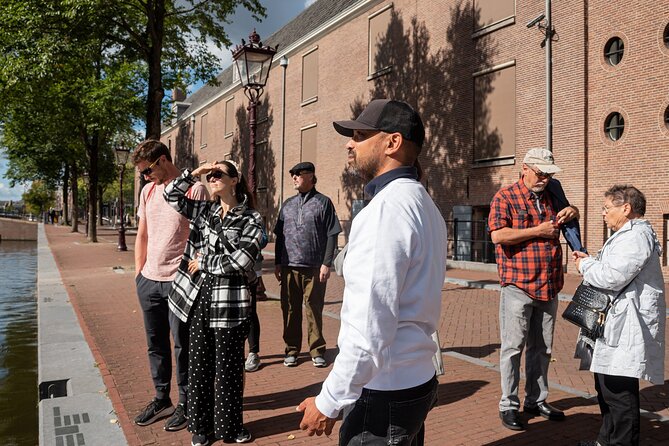
The Hollandsche Schouwburg is tied to the deportation of Jewish residents and the camps to which people were sent.
A theater used in this way is a difficult place to discuss. The guide’s job is to explain how a familiar urban building became part of a system of persecution. That shift from ordinary city life to organized deportation helps you understand how wartime policy reached into homes, streets, and neighborhoods.
The stop lasts about ten minutes. I would expect a focused explanation rather than a complete account of the camps. Still, it is an important part of the route because it links the city itself to the mechanics of deportation.
This is also where a strong guide can make a major difference. James was praised for combining historical detail with personal stories, while Keese brought in his own family’s wartime background. Those details can make a difficult subject easier to follow without turning it into entertainment.
De Plantage: beauty beside painful memory
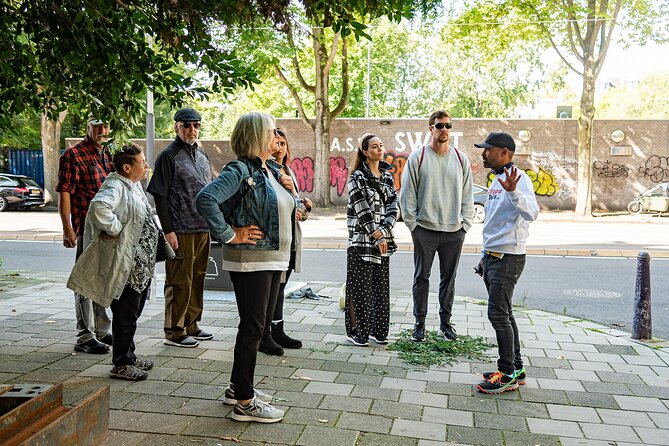
De Plantage provides a change of setting. The guide points out the area’s beauty while explaining its place in Amsterdam’s history.
That contrast is one of the better features of a walking tour. Amsterdam’s streets and neighborhoods are not preserved as a single outdoor memorial. People live, work, cycle, and relax in places that also carry painful memories. Seeing the pleasant surroundings alongside the history can help you grasp how the past remains part of daily life.
The visit is again about ten minutes. You may want to use this section to take photographs, but keep the mood in mind. This is a remembrance walk, not a sightseeing circuit built around postcard views.
The walking format works well here. You get time to notice how the area changes from one stop to another, rather than moving between isolated attractions by vehicle. You also get a better feel for the distances and connections within the old Jewish Quarter.
Spinoza Monument and the wider Jewish story
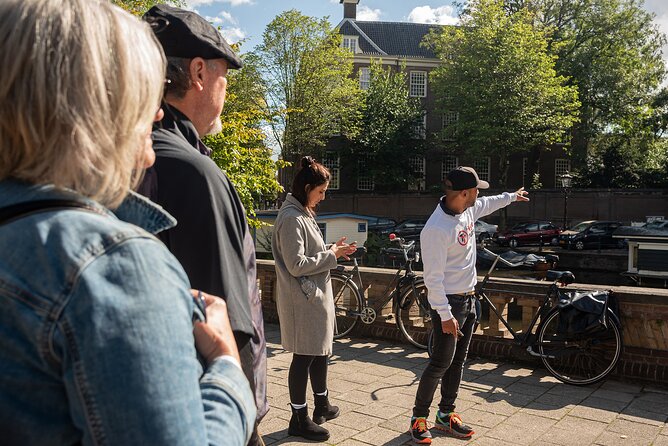
The Spinoza Monument adds an intellectual and cultural layer to the walk. The guide explains the monument and its connection to Baruch Spinoza, the Amsterdam philosopher.
This stop helps broaden the story beyond the Second World War. Amsterdam’s Jewish history includes religious communities, political ideas, scholarship, family life, and debate. Spinoza’s place in the city gives the guide a chance to show that Jewish Amsterdam was never one simple or uniform community.
The stop lasts about ten minutes. If philosophy is not your main interest, it may feel less directly connected to Anne Frank than the wartime memorials. I still find it worthwhile because it shows the city’s Jewish heritage over a longer span of time.
A good guide should explain why the monument belongs on this route rather than treating it as a random extra stop. The strongest accounts of this tour describe guides who could connect the places and answer questions instead of reciting isolated facts.
Dam Square, the Royal Palace, and changing city memory
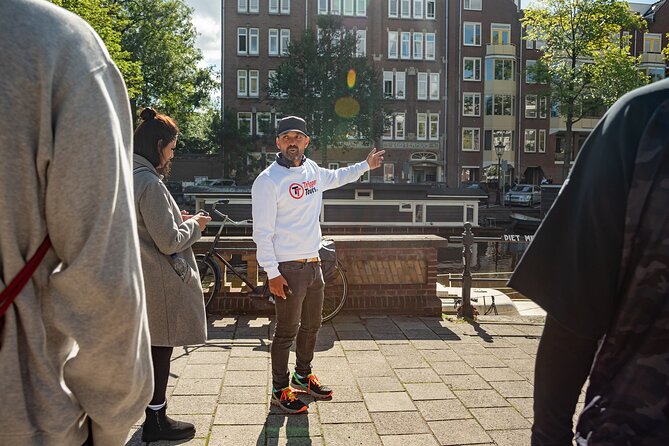
The route then walks toward Dam Square, the Royal Palace, and the Dam Square monument.
This section shifts from the Jewish Quarter to one of Amsterdam’s best-known public spaces. Dam Square is full of visitors, shops, street activity, and major buildings, yet it also carries national memory through its monument. The guide uses the square to discuss remembrance in a more public and central setting.
You have about ten minutes at the Dam Square monument. The Royal Palace is part of the walk’s surroundings, but there is no palace admission included. Think of this as an orientation stop, not a palace tour.
I like the change of pace. After several concentrated Jewish history sites, the square shows how wartime memory fits into the identity of the wider city and country. It also gives you a familiar Amsterdam landmark, which can help balance the heavier parts of the walk.
De Schaduwkade and the final memorial stop
The final listed stop is De Schaduwkade, a memorial connected with remembrance along the canal area.
The name refers to a place of memory rather than a major indoor attraction. The guide explains the monument and its meaning, helping bring the walk back to individual lives and local remembrance.
As with the other stops, the planned visit is brief. You will not spend a long time at each location, so I would listen for the connections between them. The tour works best when you treat it as one continuous story: a thriving Jewish community, wartime persecution, deportation, resistance, remembrance, and the place Anne Frank occupies in that history.
The walk ends back at the starting point. That return is practical, especially if you are using public transportation or have another Amsterdam activity planned afterward.
Anne Frank’s story without entering the house
This is the point I would make most clearly before you book: the tour does not include admission to the Anne Frank House.
You may hear substantial background about Anne Frank, her diary, and her family. Several guides were praised for explaining her story in a clear and personal way, and one guide was noted for offering detailed explanations of Anne Frank and the surrounding area. But the walk does not take you inside the museum.
That is not automatically a weakness. The Anne Frank House is a separate experience, and its timed tickets are handled independently. A walking tour can provide historical setting before or after your museum visit. It can explain the city around Anne Frank’s life in a way that an indoor visit cannot.
The problem is the wording of the title. If you book quickly and assume the house is included, you may be disappointed, especially because tickets can be difficult to arrange at short notice. I would book the house separately whenever possible and use this tour for the wider city context.
Guide style and the value of a small group
The strongest part of this experience is the guide. The best accounts describe guides who were passionate, easy to understand, energetic, patient, and willing to answer questions.
James received praise for combining relevant wartime information with modern perspective. Misha was appreciated for flexibility and for adapting the timing when the group was small. Keese connected the subject with his own family’s history, while Stan was singled out for his command of Anne Frank and Jewish history. Aaron was praised for going beyond Anne Frank and World War II into the broader story of Amsterdam.
Those differences matter. You are not booking a standardized audio guide. You are booking a live explanation, and the tone may vary with the person leading the walk.
The group limit of 15 is a useful middle ground. It is small enough for questions and personal attention, while still offering the social feel of a group tour. There is also an option to upgrade to a private tour if you want more control over the pace and discussion.
One report described a guide failing to appear, with the group waiting 30 minutes. That appears to be an isolated but serious service problem. I would arrive at the exact meeting point early and keep the booking confirmation available on your phone.
Is $29.45 a fair price?
At $29.45 per person, the tour is reasonably priced for a two-hour guided walk in central Amsterdam.
You are paying for a local guide, historical interpretation, route planning, and access to a small group rather than a self-guided stroll. There are no extra attraction fees hidden in the basic experience because the listed stops do not require admission for the tour.
The value is strongest if you want the background supplied by a person who can answer questions and connect the sites. It is weaker if you only want a quick look at monuments or if you expect museum entry.
I would also factor in the opportunity cost. Two hours is not a huge block in Amsterdam, but the walk covers several serious subjects and may leave you wanting to visit the Verzetsmuseum, Portuguese Synagogue, or Anne Frank House separately. That can turn a $29.45 activity into part of a larger history-focused day.
Who should book this walk?
I would recommend it most strongly to:
- First-time Amsterdam visitors who want the Jewish Quarter explained in context
- People interested in Anne Frank but unable to fit every museum into their schedule
- History-minded visitors who prefer real streets and memorials to a lecture hall
- Adults and older children who can manage a two-hour walk and serious subject matter
- Visitors who want to ask questions rather than follow a fixed audio guide
I would be more cautious if you have young children, limited mobility, or little interest in World War II history. The route is described as a long walk by one family, and the subject matter is emotionally heavy.
If your main goal is to enter the Anne Frank House, book the museum separately. If your goal is to understand Amsterdam’s Jewish history and wartime memory, this walk gives you a useful framework.
Practical advice for a better experience
Wear comfortable walking shoes. The itinerary includes several stops of about ten minutes each, but the distance between them adds up.
Keep your schedule flexible after the tour. Some groups finish early, while others spend more time on questions. One small group completed the walk in about an hour, while the advertised duration is approximately two hours.
Do not expect food, drinks, or indoor admission. Bring what you need for the walk, and arrange any museum tickets separately.
The tour is offered in English and accepts mobile tickets. It operates near public transportation, and most people can participate. Service animals are allowed.
You can cancel for a full refund up to 24 hours before the local start time. A cancellation for poor weather may result in a different date or a full refund, while changes made inside the 24-hour window are not accepted.
Should you book the Anne Frank and World War II walk?
I would book it if you want a serious, place-based introduction to Amsterdam’s Jewish Quarter and World War II history. The most praised guides, including James, Misha, Keese, Stan, Peter, Aaron, and Maša, appear to bring warmth, personal detail, and strong subject knowledge to a difficult topic.
Just book it for what it actually is: a guided outdoor history walk, not a ticket to the Anne Frank House. Pair it with a separate museum visit if Anne Frank’s hiding place is your main reason for coming. With that expectation set, the $29.45 price is fair, the small group is practical, and the route offers a thoughtful way to see Amsterdam beyond its canals and pretty façades.
FAQ
Is the Anne Frank House included in the tour?
No. Entrance to the Anne Frank House is not included, and you need a separate ticket if you want to visit it.
How long does the walking tour last?
The tour lasts approximately two hours, though one small group finished earlier.
Where does the tour start?
The meeting point is Amstel 51C, 1018 EJ Amsterdam, Netherlands.
Where does the tour end?
The activity ends back at the meeting point.
What language is the tour offered in?
The tour is offered in English.
What is included in the price?
A local guide is included.
Are food and drinks included?
No. Food and drinks are not included.
How large is the tour group?
The maximum group size is 15 people. A private tour upgrade is also available.
Can I cancel for a full refund?
Yes. You can cancel at least 24 hours before the experience start time for a full refund. Poor weather may lead to a different date or a full refund.
More Walking Tours
- Amsterdam: Guided Cultural Walking Tour
★ 4.9 · 2,384 reviews - Amsterdam: Guided Ganja Walking Tour of Coffee Shops
★ 4.2 · 2,092 reviews - Amsterdam Highlights Walking Tour: Small Group Experience
★ 5.0 · 1,132 reviews - Amsterdam Small-Group Walking Tour
★ 4.7 · 995 reviews
More WWII and Jewish History Tours
- Amsterdam: Dutch WWII Resistance Museum Entry Ticket
★ 4.7 · 951 reviews - Anne Frank and Jewish Quarter Amsterdam Private Walking Tour
★ 5.0 · 684 reviews - Amsterdam: Anne Frank and Jewish Quarter Tour
★ 4.7 · 434 reviews - Amsterdam: Anne Frank and Jewish Quarter Walking Tour (TOP RATED)
★ 4.5 · 430 reviews
Just added around Amsterdam
- Amsterdam 1-Hour Rickshaw Tour★ 4.9 · 17 reviews
- Amsterdam: Canal Cruise and Jewish Cultural Quarter Tickets★ 4.2 · 17 reviews
- Keukenhof Gardens and Tulip Experience Tour from Amsterdam★ 4.8 · 17 reviews
- Marken, Volendam and Edam: Private Full-Day Tour★ 4.6 · 18 reviews
- Discover Amsterdam’s city center in this Outside Escape game tour★ 4.5 · 18 reviews
- Amsterdam: Personal Travel & Vacation Photographer★ 4.8 · 18 reviews
- Amsterdam: Luxury Saloon Boat Cruise with 3-Course Dinner★ 3.9 · 18 reviews
- Rijksmuseum & Amsterdam City Center Semi-Private Tour 12ppl Max★ 5.0 · 18 reviews
Anne Frank Tours, compared.
Anne Frank’s Story – Guided Walking Tour through Amsterdam
Read our review →
Life of Anne Frank and World War II Walking Tour
Read our review →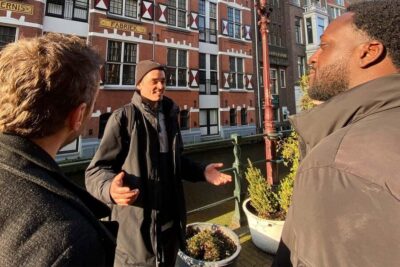

Anne Frank Walking Tour – Guided in EN/DE/IT/ES
Read our review →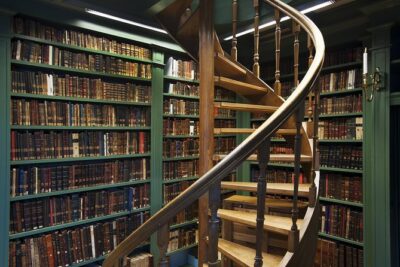
Anne Frank Walking Tour Amsterdam Including Jewish Cultural Quarter
Read our review →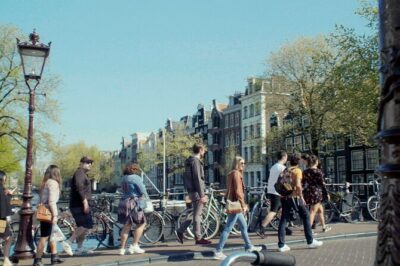
Anne Frank’s Last Walk & See Anne Frank House in Virtual Reality
Read our review →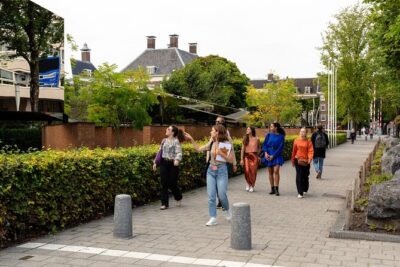
Anne Frank and Jewish Quarter Amsterdam Private Walking Tour
Read our review →
Browse the lists this tour appears in